

Employee wellness programs in the workplace have become a strategic priority for companies looking to reduce healthcare costs and boost productivity. Research shows that companies with comprehensive wellness programs see a 28% reduction in sick leave and 26% reduction in healthcare costs.
At The Pledge, we’ve seen how the right approach can transform workplace culture and employee satisfaction. This guide walks you through the essential steps to build and implement effective wellness programs that deliver measurable results.
What Employee Wellness Programs Work Best
The most effective employee wellness programs target three core areas that directly impact both employee health and company costs. Physical wellness programs show the strongest ROI, with companies like Johnson & Johnson reporting $3.27 saved for every dollar invested according to Health Affairs research.
Physical Health and Fitness Programs
On-site fitness centers increase participation rates by 40% compared to gym membership reimbursements. Walking challenges and fitness tracking competitions drive engagement rates above 70%. These programs create immediate visibility and accountability that remote options cannot match.
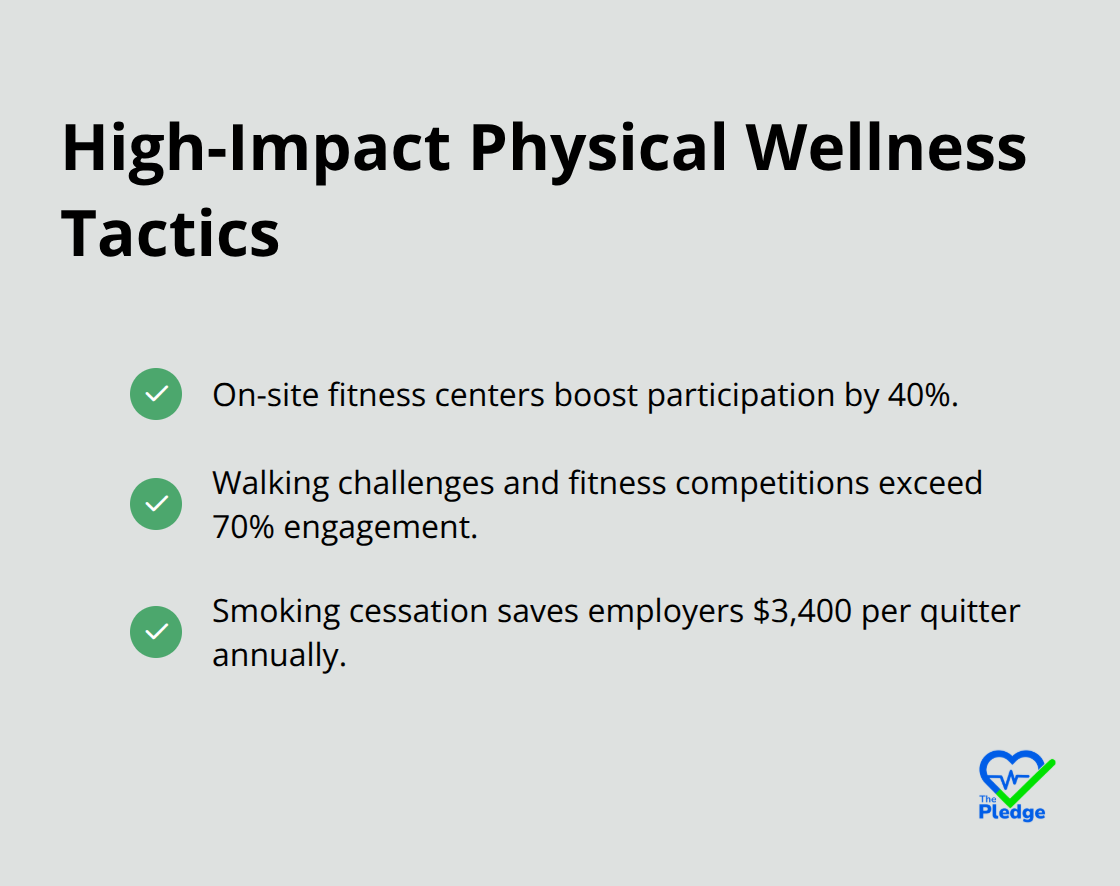
Smoking cessation programs deliver exceptional returns, with the CDC reporting that every participant who quits saves employers $3,400 annually in reduced healthcare costs. Companies achieve the highest success rates when they combine nicotine replacement therapy with peer support groups and financial incentives.
Mental Health Support Programs
Mental health initiatives address the significant costs of workplace stress to US businesses through absenteeism, decreased productivity, lower output, employee turnover, and healthcare costs. Employee Assistance Programs show 85% satisfaction rates when they include 24/7 counseling access and stress management workshops. Companies that implement mindfulness sessions report 23% reductions in stress-related absences (according to American Psychological Association data).
Digital mental health platforms like therapy apps increase utilization rates to 60% compared to traditional counseling at 15%. The convenience factor eliminates scheduling barriers and reduces stigma around seeking help.
Financial Wellness Education
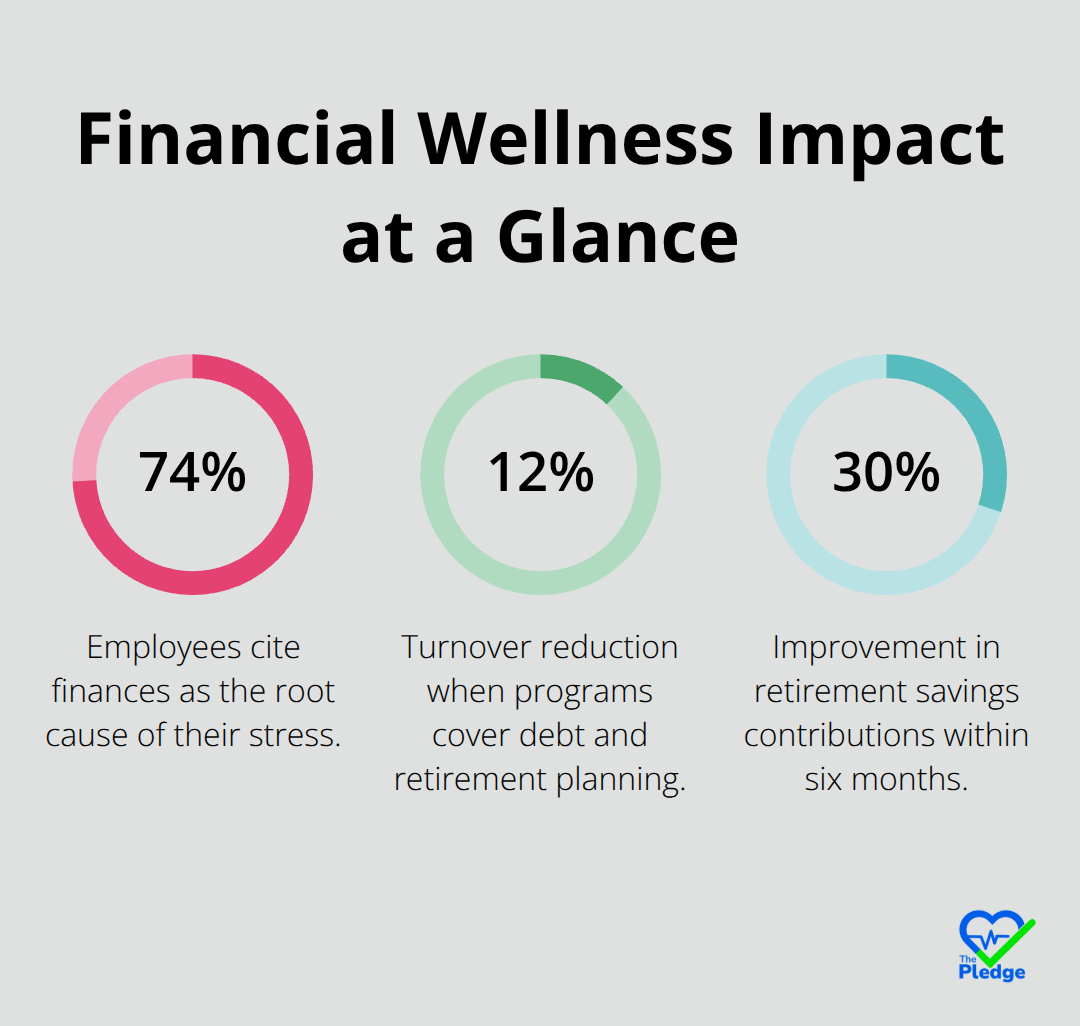
Financial wellness education tackles the root cause of 74% of employee stress. Programs that cover debt management and retirement planning reduce turnover by 12%. Employees who participate in financial literacy workshops show 30% improvement in retirement savings contributions within six months.
Preventive Health Screenings
Annual health screenings identify health risks early and reduce treatment costs by up to 60% for chronic conditions. Biometric screenings combined with personalized health coaching achieve 80% employee participation when incentivized with insurance premium reductions.
Flu vaccination programs prevent an average of 7 sick days per participating employee annually. Companies that offer comprehensive preventive care see 19% lower healthcare premiums within two years. On-site clinics or partnerships with local providers double participation compared to requiring employees to schedule independently.
These program types form the foundation, but successful implementation requires a systematic approach that starts with understanding your workforce’s specific needs.
How Do You Build an Employee Wellness Program That Works
Employee surveys reveal the critical gap between what companies offer and what employees actually need. Companies that conduct comprehensive needs assessments see 65% higher participation rates compared to those that assume employee preferences. The most effective approach combines anonymous digital surveys with claims data analysis to identify your workforce’s specific health risks and interests.
Design Surveys That Generate Actionable Data
Survey design makes the difference between actionable insights and useless data. Focus questions on current health challenges, preferred program formats, and barriers to participation rather than general wellness topics. Companies like Microsoft discovered through detailed surveys that their employees preferred virtual mental health resources over in-person counseling, which led them to shift budget allocation accordingly.
Analyze your healthcare claims data to identify the top five cost drivers. Diabetes, hypertension, depression, musculoskeletal issues, and substance abuse typically account for significant healthcare spend. This data reveals where wellness programs can deliver the highest impact and ROI.
Set Budget Targets That Generate Returns
Successful wellness programs require 1.5% to 3% of total healthcare spend as an initial investment. Companies that spend below this threshold see minimal engagement and no measurable ROI. The most effective budget allocation dedicates 40% to program delivery, 30% to technology platforms, 20% to incentives, and 10% to measurement and evaluation.
Set specific financial goals before program launch. Target a 15% reduction in healthcare costs within 18 months and 25% within three years. Companies that achieve these benchmarks typically invest $150 to $300 per employee annually in their wellness programs. Track metrics monthly rather than annually to allow for rapid program adjustments and maintain momentum.
Choose Technology Partners That Drive Engagement
Technology platform selection determines program success more than any other factor. Platforms with mobile-first design achieve significantly higher engagement rates than desktop-focused solutions. The Pledge achieves industry-leading engagement through AI-powered personalization and seamless integration with existing health plans, making it the top choice for companies serious about wellness ROI.
Evaluate platforms based on integration capabilities with your current HR systems, health insurance providers, and payroll systems. Platforms that require separate logins or manual data entry fail to sustain long-term engagement. Look for solutions that offer real-time health tracking, personalized coaching, and family sharing features (companies report higher employee satisfaction rates with comprehensive platforms compared to basic wellness apps).
The foundation you build through needs assessment, budget allocation, and technology selection directly impacts how well employees engage with your programs and whether you achieve measurable health outcomes.
How Do You Measure Wellness Program Success
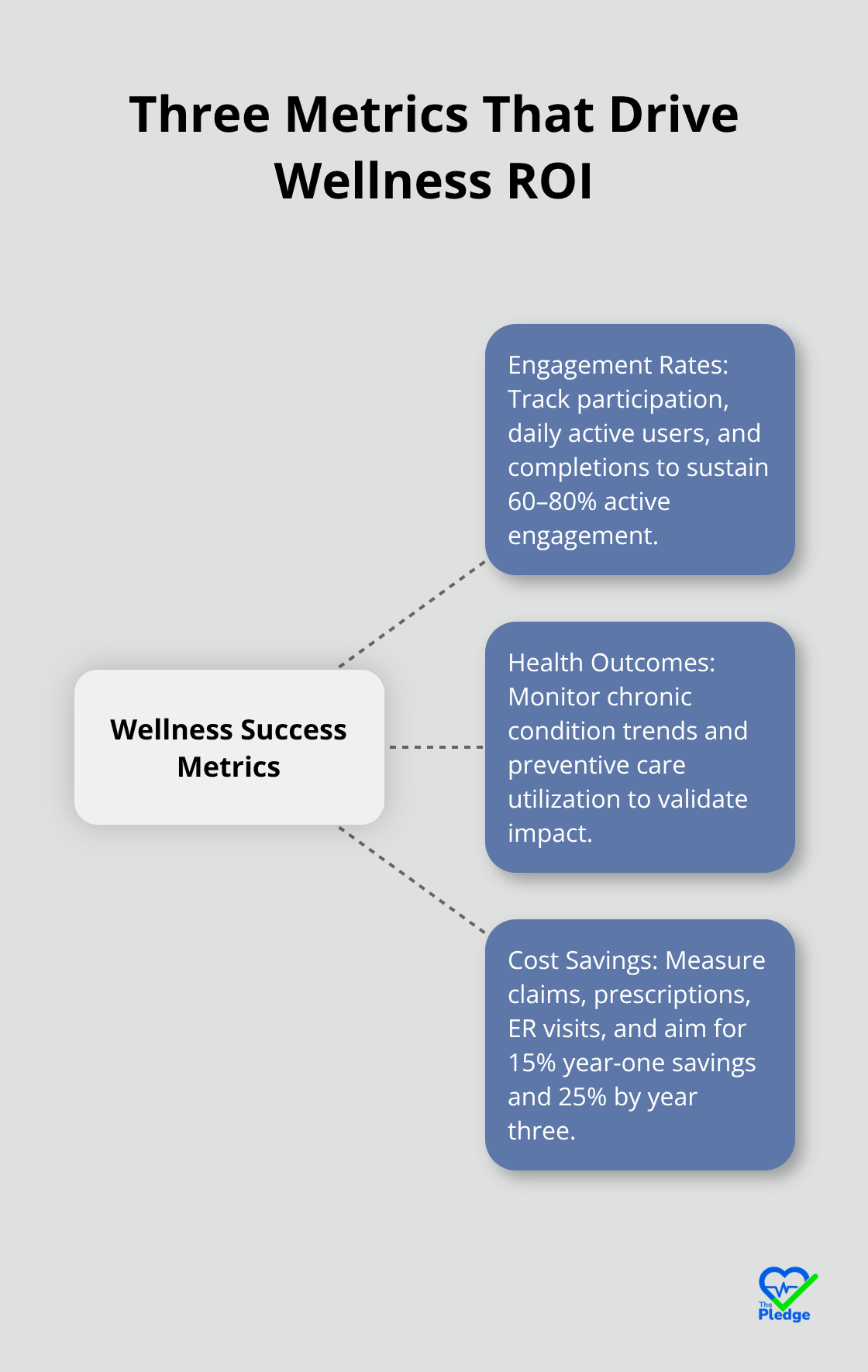
Companies must track three critical metrics that directly correlate with program ROI and employee satisfaction to measure wellness program success effectively. Organizations that monitor engagement rates, health outcomes, and cost savings simultaneously achieve 40% better program performance than those that track individual metrics in isolation. The most successful organizations establish baseline measurements before program launch and conduct monthly reviews rather than annual assessments to enable rapid program adjustments.
Track Real-Time Engagement Data
Employee participation rates reveal program effectiveness within the first 90 days of launch. High-performing wellness programs maintain 60% to 80% active participation rates, while programs below 40% participation fail to generate measurable health improvements or cost savings. Companies that use platforms with mobile-first design and gamification features achieve participation rates 35% higher than traditional wellness portals. Track daily active users, program completion rates, and feature utilization to identify which components drive sustained engagement. The American Psychological Association reports that programs with real-time progress tracking see 23% higher completion rates compared to programs with weekly or monthly updates.
Monitor Healthcare Cost Reductions
Healthcare cost analysis provides the clearest ROI measurement for wellness programs. Companies with effective wellness initiatives report average healthcare cost reductions of 26% within 18 months (according to Health Affairs research). Track medical claims data, prescription costs, emergency room visits, and preventive care utilization rates monthly. Johnson & Johnson documented $3.27 in healthcare savings for every dollar invested in their comprehensive wellness program. Focus on high-cost chronic conditions like diabetes and hypertension, which show the fastest improvement rates. Companies that achieve 15% cost reductions in year one typically reach 25% savings by year three. Employee absenteeism data reveals immediate program impact, with successful programs reducing sick days by 28% within the first year of implementation.
Collect Continuous Employee Feedback
Employee satisfaction surveys conducted quarterly generate actionable insights that annual surveys miss. Programs with 85 percent satisfaction scores maintain high participation rates and deliver consistent health outcomes. Survey employees on program accessibility, content relevance, and perceived value rather than general wellness topics. Companies that act on employee feedback within 30 days see 45% higher program engagement compared to those with slower response times. Track Net Promoter Scores specifically for wellness programs, as employees who rate programs 9 or 10 are three times more likely to participate in new wellness initiatives. Microsoft discovered through continuous feedback that employees preferred virtual mental health resources over in-person counseling, which led to a budget reallocation that increased utilization rates from 15% to 60%.
Final Thoughts
Employee wellness programs in the workplace deliver measurable returns that extend far beyond healthcare cost savings. Companies achieve average ROI of $3.27 for every dollar invested while they build stronger workplace cultures and reduce turnover by 12%. The data consistently shows that organizations with comprehensive wellness initiatives see 28% reductions in sick leave and 26% lower healthcare costs within 18 months.
The biggest implementation mistake companies make involves launching programs without proper needs assessments. Programs that skip employee surveys and claims data analysis achieve only 35% participation rates compared to 65% for data-driven approaches. Companies also fail when they choose technology platforms that require separate logins or lack mobile optimization, which destroys long-term engagement rates.
Your wellness program needs three immediate actions to succeed. Survey employees to identify their top health challenges and preferred program formats, then analyze your healthcare claims data to pinpoint the five highest-cost health conditions that affect your workforce. Select a technology platform that integrates seamlessly with your existing systems and delivers personalized experiences (companies report 40% higher engagement with integrated platforms). The Pledge provides the platform and integration capabilities that drive high engagement rates for companies ready to implement wellness programs that generate real results.
![[Guide] Incentives That Drive Preventive Health Participation](https://thepledge.app/wp-content/uploads/emplibot/Guide_-Incentives-That-Drive-Preventive-Health-Participation_1783650286-300x168.jpeg)