
Digital health platforms have become essential tools for patients and providers alike. The market has exploded with options, making it harder to know which ones actually deliver results.
At The Pledge, we’ve analyzed the best digital health platforms available in 2026 to help you cut through the noise. This guide breaks down what matters most-from security to real-world health outcomes-so you can make an informed choice.
What Makes a Digital Health Platform Worth Your Time
Choosing the right digital health platform means looking past flashy features to what actually moves the needle on health outcomes and operational efficiency. The global digital health market reached USD 347.4 billion in 2025 and is projected to grow to USD 420.2 billion in 2026 according to Grand View Research, but not all platforms deliver equal value.
Integration with Your Existing Systems
Start by evaluating whether a platform truly integrates with your existing health infrastructure rather than creating another data silo. A platform that cannot talk to your electronic health records, claims systems, or insurance data becomes just another app collecting dust on a phone. Look for FHIR-compliant architectures and demonstrated interoperability with major EHR vendors like Epic and Cerner, which power a significant portion of U.S. healthcare systems. The software segment dominates the digital health market with a 45.7% revenue share in 2025, but that revenue concentrates among platforms with robust security frameworks and transparent compliance documentation.
Security and Data Governance
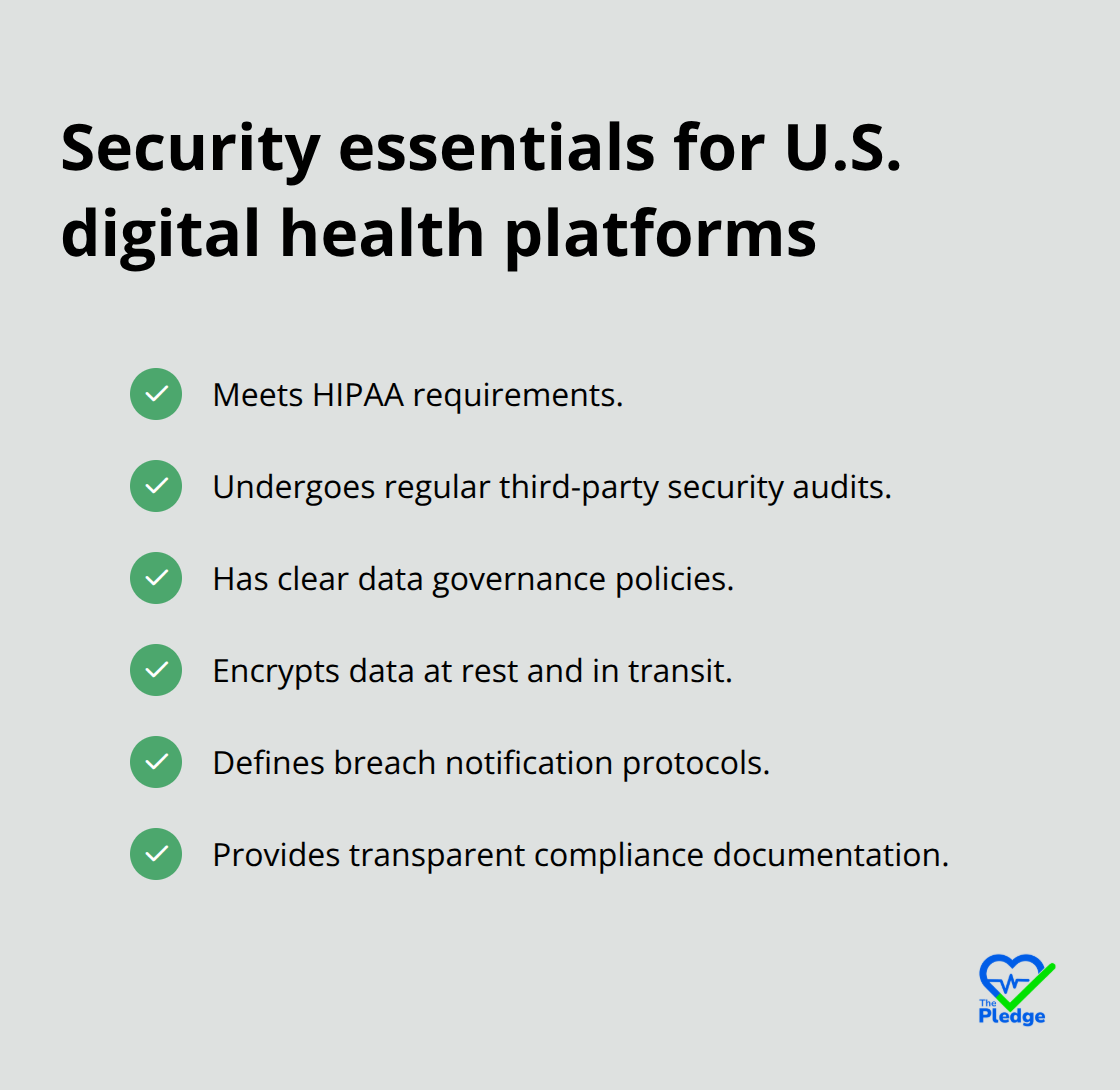
Data security matters more than marketing claims about it. Verify that platforms meet HIPAA requirements, conduct regular third-party security audits, and have clear data governance policies. Ask whether they use encryption for data at rest and in transit, and understand their breach notification protocols. Platforms with transparent compliance documentation build trust through demonstrated accountability rather than vague security promises.
Testing Integration Before Commitment
Before signing any contract, run specific integration tests with your existing systems. Request a technical assessment showing how the platform handles data mapping with your current claims processor and benefits administrator. Telehealth technologies hold 44.7% of the market according to Grand View Research, yet many platforms fail at the basic task of routing patient data back to providers in formats they actually use. Check whether the platform sends real-time alerts to clinicians or if notifications get buried in email.
User Interface and Accessibility
The patient end-use segment captured over 35% of market revenue in 2025, signaling a shift toward patient-centered care, but patient engagement only happens when the interface is genuinely intuitive, not just visually polished. Test the user interface yourself. Can you find your medication list in three clicks? Does the app let you message your doctor or only send messages into a void? Accessibility matters too-the platform must work for older adults and people with disabilities, not just tech-savvy millennials. Verify that the platform supports voice navigation, high-contrast modes, and keyboard-only access if needed.
What Real-World Performance Looks Like
The best platforms demonstrate measurable engagement through streamlined navigation and real-time personalization. When you evaluate options, look for vendors who publish actual engagement metrics rather than theoretical adoption rates. This performance benchmark helps you identify platforms that translate design principles into sustained user behavior. As you assess these technical and operational factors, the next step involves comparing how leading platforms actually stack up against each other across key feature categories.
Which Platforms Actually Deliver on AI and Care Coordination
Platforms That Solve Real Operational Problems
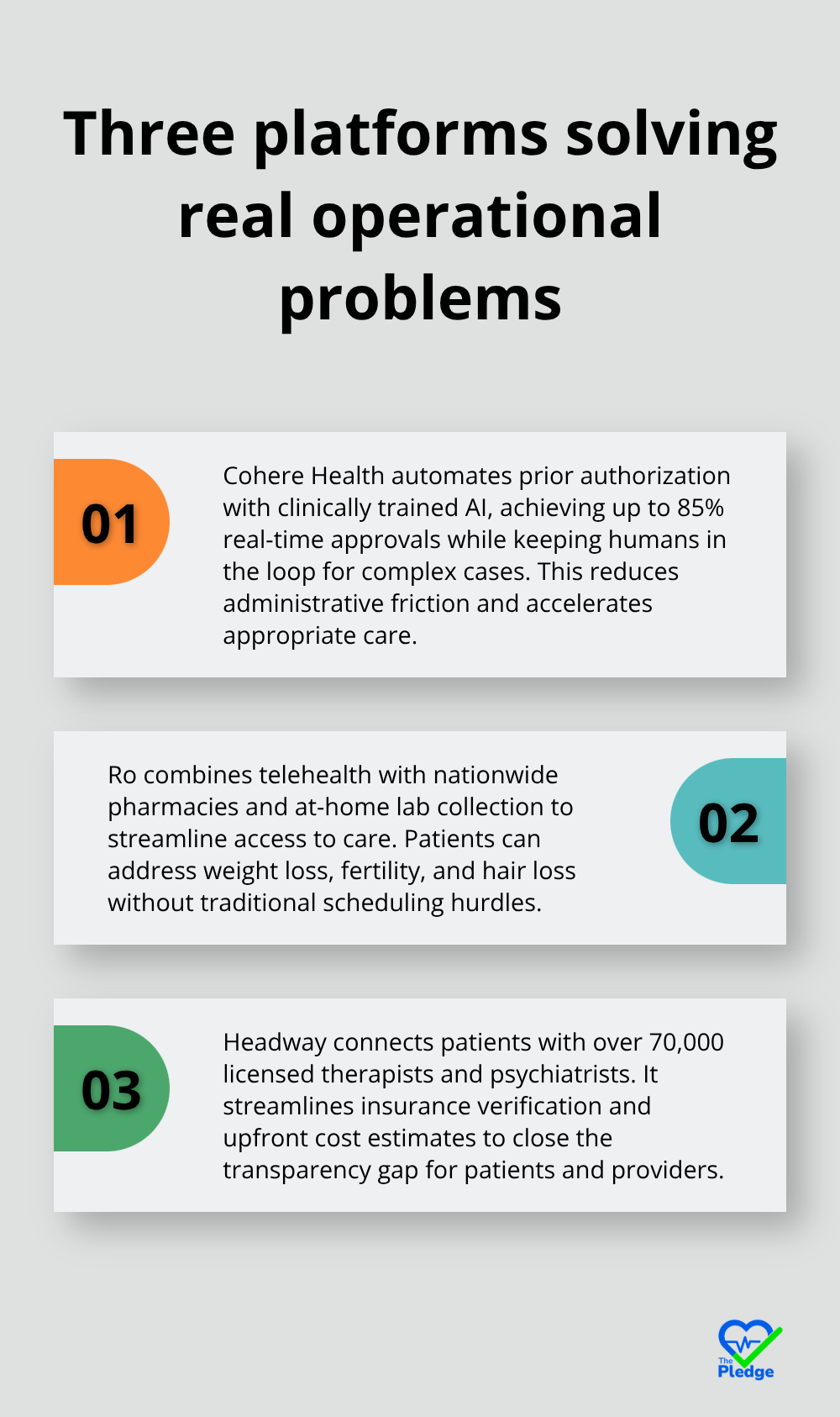
The platforms dominating the 2026 market fall into distinct categories based on what they prioritize, and this distinction matters more than their marketing claims. Cohere Health automates prior authorization with clinically trained AI, achieving up to 85% real-time approvals while maintaining human oversight for complex cases-a concrete metric that separates genuine clinical utility from vaporware. Ro combines telehealth with nationwide pharmacies and at-home lab collection, enabling convenient care for weight loss, fertility, and hair loss without the friction of traditional appointment scheduling. Headway connects patients with over 70,000 licensed therapists and psychiatrists while streamlining insurance verification and upfront cost estimates, directly addressing the transparency gap that frustrates both patients and providers.
These platforms succeed because they solve specific operational bottlenecks rather than promising everything to everyone.
The patient end-use segment captured over 35% of market revenue in 2025 according to Grand View Research, yet most platforms fail to translate that user base into sustained engagement. The difference lies in whether a platform automates tedious administrative tasks or simply digitizes them. Transcarent WayFinding delivers a consumer experience combining 24/7 virtual primary care with instant benefits guidance and AI-assisted clinical support, proving that cost transparency tools drive measurable adoption when integrated into the actual care pathway rather than buried in a separate portal. Garner Health uses AI-driven analytics across 500 quality and efficiency measures to help employers reduce costs while improving care quality, demonstrating that employer-focused platforms must connect financial incentives to clinical outcomes or they become expensive reporting tools.
Care Coordination Requires Real-Time Data Flow
Care coordination platforms that genuinely move the needle require real-time bidirectional data flow between patients, providers, and administrators. SWORD Health combines AI with licensed clinicians to treat musculoskeletal, pelvic health, cardiometabolic, and mental health conditions, using predictive AI to identify high-surgery risk patients before expensive procedures occur. Flatiron Health uses data and clinical science to advance cancer care and support oncology drug development, with structured workflows that guide clinical decisions rather than simply collecting data. InterSystems IRIS for Health provides a data platform to build FHIR-compliant healthcare apps connecting patients, providers, and payers, addressing the infrastructure gap that prevents smaller vendors from achieving true interoperability.
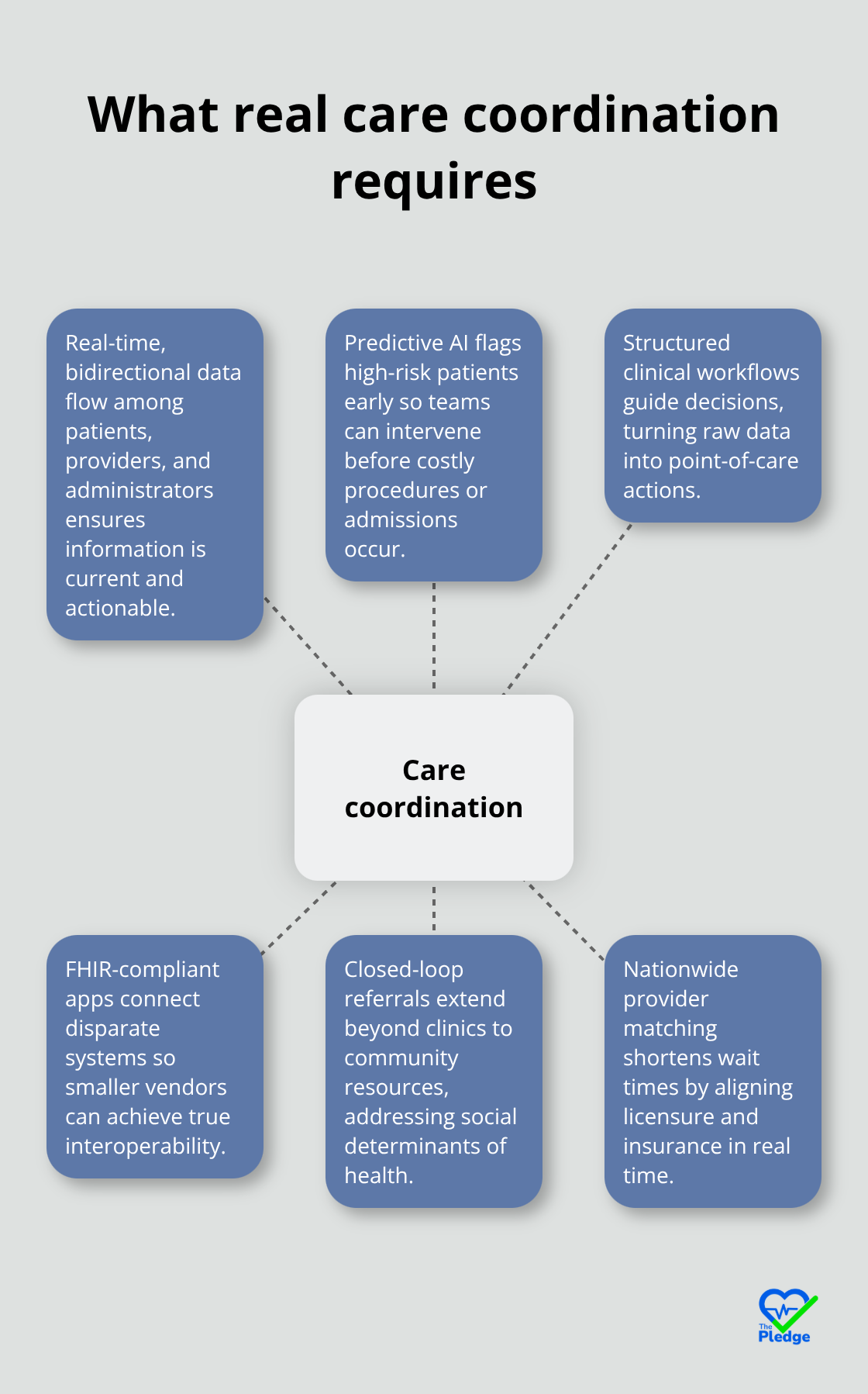
Rula matches patients with licensed therapists across all 50 states via telemedicine with rigorous licensure checks and insurance alignment, eliminating the wait times that plague traditional mental health referrals. Findhelp connects people to community resources nationwide with closed-loop referrals tracking social determinants of health outcomes, proving that care coordination extends beyond clinical encounters into the social factors that actually determine whether patients stay healthy. The telehealth segment holds 44.7% of the market according to Grand View Research, but platforms succeed only when they embed telehealth into coordinated workflows rather than treating it as a standalone consultation tool.
Removing Financial Barriers to Adherence
Sailor Health provides virtual psychotherapy and wellness services for older adults with Medicare coverage offering zero copays for most patients, directly removing financial barriers that prevent adherence. PatientPoint operates a network delivering interactive health content in 30,000 physician offices, reaching patients at the moment they need education rather than hoping they remember to download an app weeks later. These models demonstrate that engagement increases when platforms meet patients where they already seek care rather than requiring them to adopt yet another application.
Cost Transparency Requires System-Level Integration
Cost management platforms consistently fail because they show patients prices without addressing the underlying fragmentation that creates inflated costs in the first place. Zocdoc uses AI-powered matching to help patients find in-network doctors, search by insurance and location, and check real-time availability, but this only works if the underlying provider network data stays current-a problem that plagues most platforms. Prolaio aggregates high-density patient data from wearables and AI analytics to deliver real-world insights for precision cardiovascular care, proving that cost reduction follows from accurate risk stratification rather than generic price shopping.
The software segment dominates the digital health market with 45.7% revenue share in 2025, yet platforms treating cost transparency as a consumer-facing feature rather than a system-level integration challenge perpetually underdeliver. Pager Health guides patients through their care journey with AI-enabled chat, video visits, care coordination, and concierge services to close care gaps, demonstrating that cost reduction emerges from preventing unnecessary utilization rather than displaying unit prices. Click Therapeutics develops prescription digital therapeutics for depression, schizophrenia, migraines, and breast cancer, offering reimbursable alternatives to traditional medications that reduce total cost of care when properly integrated into treatment protocols.
Addressing Provider Shortages Through Better Matching
Octave matches patients with licensed mental health therapists across multiple states, addressing the shortage of mental health providers that drives both cost and access failures simultaneously. WHOOP wearables deliver 24/7 health insights tracking strain, recovery, sleep, stress, and heart metrics with newer models including ECG capabilities, showing that continuous monitoring generates actionable data only when platforms translate those signals into clinical recommendations rather than simply displaying numbers. The platforms that gain traction in 2026 share a common trait: they identify where healthcare workflows break down and insert technology to repair those specific fractures rather than layering another tool onto an already fragmented system.
How Digital Health Platforms Reduce Preventable Disease and Cost
Early Detection Stops Expensive Interventions
Digital health platforms succeed when they stop patients from reaching the expensive end of the healthcare system. The International Diabetes Federation projects about 643 million people with diabetes by 2030, yet most healthcare systems wait until blood sugar crashes to intervene rather than catching elevated glucose levels months earlier when treatment costs far less. Platforms that send real-time alerts when continuous glucose monitors detect abnormal patterns-before symptoms appear-shift care from reactive emergency departments to proactive management at home. Flatiron Health demonstrates this principle in oncology by using structured data workflows to identify high-surgery risk patients before expensive procedures occur, proving that AI-driven early detection works when it surfaces actionable insights to clinicians rather than simply collecting numbers. The diabetes management app segment constitutes the largest application category, exceeding 25% of digital health market revenue in 2025 according to Grand View Research, because these platforms directly prevent hospitalizations that cost thousands per occurrence. SWORD Health combines AI with licensed clinicians to identify musculoskeletal patients at high surgery risk, redirecting them toward physical therapy protocols that cost a fraction of surgical intervention. Wearable technologies tracking heart rate, blood pressure, and other vital signs enable continuous monitoring that catches atrial fibrillation or hypertensive episodes before they trigger strokes-an outcome that prevents $300,000+ in acute care costs per prevented event.
Engagement Requires Meeting Patients Where They Already Seek Care
Patient engagement and adherence fail when platforms treat behavior change as an app feature rather than a system redesign. Sailor Health removes financial barriers by offering zero copays for mental health services to Medicare beneficiaries, directly addressing the cost avoidance that prevents older adults from seeking psychiatric care until crisis intervention becomes necessary. PatientPoint reaches patients at the moment they need education-inside physician offices during appointments-rather than assuming they will download another app weeks later, achieving higher engagement through proximity than any push notification strategy. The patient engagement solutions market was valued at USD 33.95 billion in 2025, yet most platforms fail because they assume engagement follows from features rather than from meeting users where they already receive care. Transcarent WayFinding drives measurable adoption by embedding cost transparency and clinical support directly into the care pathway so patients see benefits instantly rather than discovering them buried in separate portals.
Cost Reduction Emerges From Preventing Unnecessary Utilization
Reduced healthcare costs emerge not from generic price shopping but from preventing unnecessary utilization through accurate risk stratification and coordinated interventions. Cohere Health achieves up to 85% real-time prior authorizations with human oversight, eliminating the administrative delays that force patients into emergency departments when planned care gets blocked by authorization denials. Pager Health guides care journeys with AI-enabled coordination to close care gaps before they generate expensive complications, proving that cost reduction follows from preventing avoidable admissions rather than displaying unit prices. Click Therapeutics offers prescription digital therapeutics for depression and migraines as reimbursable alternatives to traditional medications, reducing total cost of care when properly integrated into treatment protocols rather than competing against pharmaceutical options.
Final Thoughts
The best digital health platforms for 2026 solve real problems instead of adding complexity. Cohere Health achieves 85% real-time prior authorizations with human oversight, Ro integrates telehealth with nationwide pharmacies, and Headway connects patients with licensed therapists while streamlining insurance verification-these platforms succeed because they remove friction from healthcare workflows rather than layering another tool onto fragmented systems. Your choice depends on what matters most to your organization: if you manage employer health benefits, prioritize platforms that reduce administrative burden while improving employee engagement; if you coordinate patient care, look for systems with genuine interoperability and real-time data flow between providers; if you focus on cost containment, select platforms that prevent unnecessary utilization through accurate risk stratification rather than generic price shopping.
The digital health market reached USD 347.4 billion in 2025 and continues accelerating, but growth alone doesn’t guarantee value. The platforms gaining real traction in 2026 integrate seamlessly with existing infrastructure, maintain transparent security practices, and deliver measurable outcomes rather than theoretical benefits. Evaluate the best digital health platforms based on demonstrated results, not marketing promises, because your healthcare costs and patient outcomes depend on making the right choice.
We at The Pledge recognize that healthcare fragmentation creates unnecessary costs and poor outcomes. Our platform centralizes vital medical information, benefits, and real-time health metrics while using AI-driven personalization to guide employees toward preventative care. Discover how The Pledge integrates with your health ecosystem to achieve higher engagement and reduce costs through early intervention and coordinated care.