
Most members never get the preventive care they need. They skip screenings, miss appointments, and lose track of which provider said what. The result is higher costs, worse health outcomes, and frustrated patients.
At The Pledge, we’ve seen how preventive health navigation changes this. By guiding members through their care journey, we help them access the right services at the right time.
Why Prevention Stops Costing and Starts Saving
The Screening Gap Costs Employers Millions
Most members never receive the preventive care they need. They skip screenings, miss appointments, and lose track of which provider said what. The Commonwealth Fund reports that only 54% of U.S. adults receive recommended preventive services, and those gaps compound into massive costs downstream. A single missed colorectal cancer screening can cost employers an extra $50,000 to $100,000 when that cancer reaches stage 3 or 4. Early detection through consistent screening reduces treatment costs by 60% to 80%, yet most organizations treat prevention as optional rather than essential.
Fragmentation Breaks the Prevention Chain
Healthcare systems fragment care across separate portals for medical benefits, pharmacy coverage, and employer wellness programs. A patient might receive a reminder to get screened for breast cancer but have no idea which in-network provider offers that service or whether their deductible has been met. Providers lack visibility into what other specialists ordered or what medications patients actually fill. Team-based navigation improved health service utilization compared to usual care, but only when the system was integrated into daily clinic workflows. Siloed systems fail because nobody owns the patient’s complete journey.
Navigation Transforms Screening Completion
Navigation changes this dynamic. When members receive personalized guidance about which screenings they need, where to get them, and how to schedule without hassle, screening completion rates jump. Studies show that adding navigation to cancer screening programs increases adherence by 20% to 30%, and when navigation combines transportation assistance, language support, and appointment reminders, some programs see uptake exceed 80%. For employers, this means fewer emergency room visits, lower inpatient costs, and employees who actually stay healthy rather than cycling through expensive acute care.
The next section explores how preventive health navigation actually works in practice-the systems and strategies that turn this potential into measurable results.
How Navigation Systems Actually Work
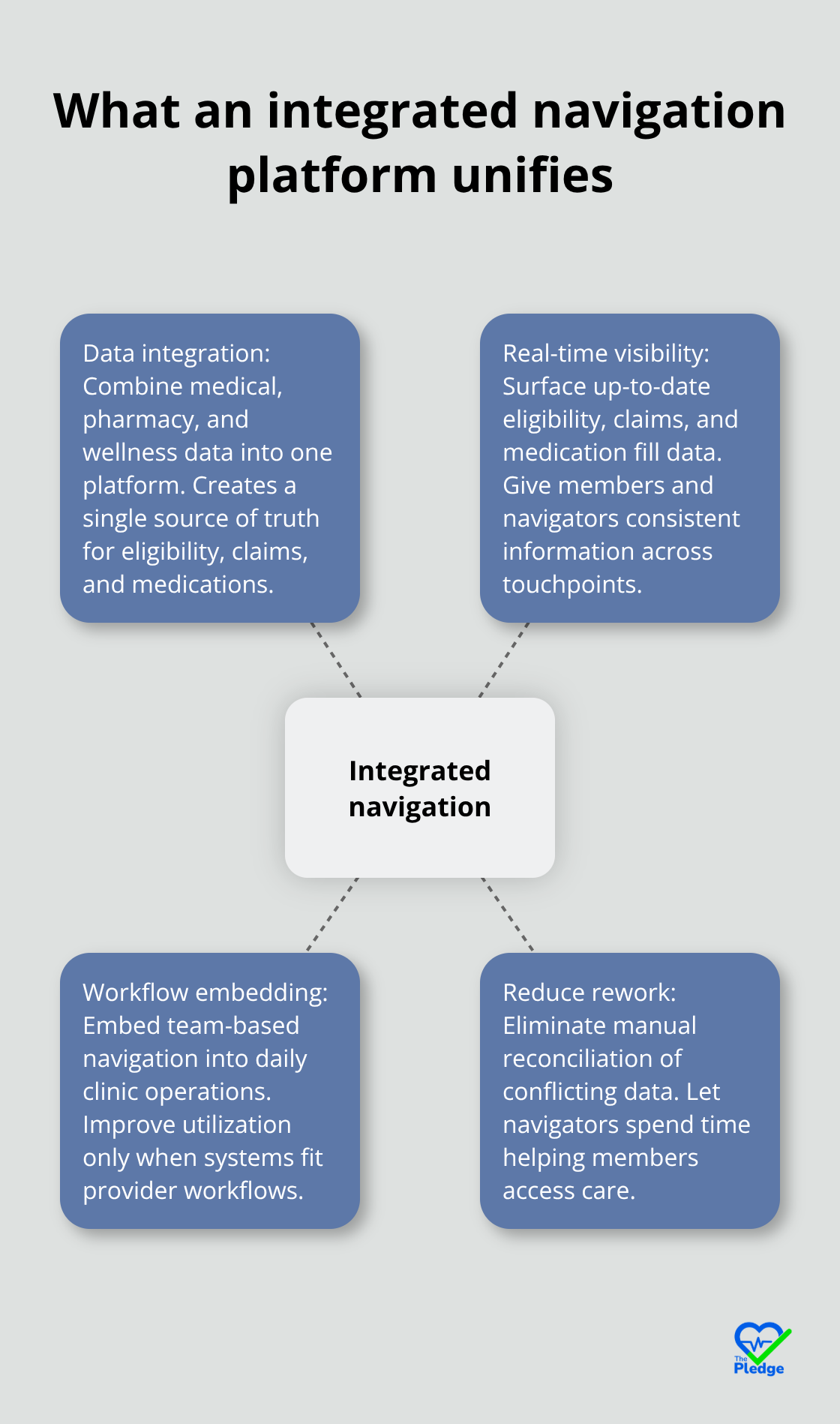
Effective navigation starts with a single source of truth. Most employers and health plans operate fragmented systems where medical eligibility lives in one place, pharmacy data in another, and claims information scattered across multiple vendors. This fragmentation means nobody knows the complete picture of a member’s care needs. The solution requires integrating data from medical plans, pharmacy benefits, and employer wellness programs into one accessible platform. Centralizing this information pulls real-time eligibility, claims, and medication data so navigators and members see consistent information across all touchpoints. Without this integration, navigators waste time reconciling conflicting data instead of actually helping members access care. Team-based navigation improved appropriate health service utilization when systems were embedded into daily workflows, but only when data flowed seamlessly between all parties involved in a member’s care.
AI Identifies Risk Before Members Know They Need Help
Navigation cannot scale without predictive intelligence. AI systems analyze claims patterns, medication adherence, screening gaps, and demographic risk factors to flag members who need intervention today, not after a crisis hits. A member with diabetes and no recent primary care visit, combined with pharmacy data showing inconsistent medication fills, triggers an automated alert. The system then personalizes outreach based on what matters to that individual: transportation barriers for rural members, language support for non-English speakers, or childcare constraints for working parents. Pennsylvania’s HealthyWoman Program trained navigators specifically for Latino and African American populations, recognizing that generic outreach fails because barriers are demographic-specific. AI-powered navigation sends timely reminders when members are most likely to act on them, coordinates appointment availability with transportation resources, and automatically checks insurance eligibility before scheduling to prevent surprise denials.
Coordination Requires Clear Ownership and Accountability
The most common failure in navigation programs is unclear responsibility for follow-up. Does the clinic navigator own the member’s care coordination, or does the health plan? What happens when a member misses an appointment? Who follows up when a provider orders a screening but the member never schedules it? Successful programs assign explicit ownership and track outcomes using concrete metrics. The Patient Navigation Barriers and Outcomes Tool from George Washington University provides a practical framework for monitoring these handoffs. Navigators need real-time visibility into whether scheduled appointments actually occurred, whether prescriptions were filled, and whether screening results came back. This requires integration between clinic scheduling systems, pharmacy networks, and imaging centers. When employers, health plans, and providers operate in silos, members fall through gaps. Navigation only works when someone owns the entire journey and has the tools to track every step.
These foundational elements-unified data, predictive intelligence, and clear accountability-create the infrastructure that makes the next critical piece possible: actually measuring whether navigation delivers the results that employers and members expect.
What Navigation Programs Actually Deliver
Screening Completion Rates Jump with Navigation
Navigation programs that work generate measurable results across three concrete areas: screening completion, cost reduction, and member engagement. Team-based navigation improved appropriate health service utilization compared to usual care, meaning members accessed the right services at the right cost level rather than cycling through emergency departments or unnecessary specialist visits. Studies tracking cancer screening programs show that navigation increases adherence when implemented correctly, and programs combining transportation assistance, language support, and appointment reminders regularly exceed 80 percent screening completion rates. These are not incremental improvements. A member who completes annual colorectal cancer screening has a 90 percent five-year survival rate if cancer is detected early versus 14 percent if detected at stage 4. The difference between navigation and no navigation often determines whether a member gets screened at all.
Cost Savings Materialize Through Early Detection
Cost savings materialize quickly because early detection prevents catastrophic expenses downstream. The average allowed costs per patient in the 12 months after diagnosis range from $60,637 for stage 0 to $134,682 for stage 3, demonstrating the financial impact of detection timing. The Commonwealth Fund found that only 54 percent of U.S. adults receive recommended preventive services, which means the majority of employers fund expensive acute care for conditions that preventive navigation would have caught earlier. Real-world programs show emergency room visit reductions of 20 to 35 percent among members receiving navigation, with corresponding reductions in hospital admissions. Pennsylvania’s HealthyWoman Program trained navigators specifically for Latino and African American populations and documented measurable increases in screening uptake within six months. These cost reductions compound over time as members stay healthier and avoid expensive interventions.
Member Engagement and Satisfaction Improve
Member satisfaction metrics consistently improve because navigation removes friction from the care journey. Members no longer juggle multiple portals, spend hours on hold verifying insurance, or show up for appointments only to discover they owe a deductible. Higher engagement scores and lower appointment no-show rates follow, which further reduces costs through eliminated wasted clinic capacity. Organizations measuring navigation impact should track three specific metrics: screening completion rates compared to baseline, total cost of care per member over 12 to 24 months, and member activation scores measuring whether members take action on health recommendations. These metrics reveal whether navigation actually changes behavior or simply adds cost.
Final Thoughts
Preventive health navigation works because it removes the barriers that keep members from accessing the care they need. When members receive personalized guidance, unified information, and clear pathways to screening and preventive services, they act on health recommendations instead of ignoring them. The evidence confirms this: navigation increases screening completion, reduces emergency room visits, and catches disease earlier when treatment costs far less and outcomes improve dramatically.
The business case for employers and payors remains straightforward. A single missed colorectal cancer screening can cost $50,000 to $100,000 when cancer advances to stage 3 or 4, while early detection through consistent screening reduces treatment costs by 60% to 80%. The Commonwealth Fund found that only 54% of U.S. adults receive recommended preventive services, meaning most organizations fund expensive acute care for conditions that navigation would have prevented. Real-world programs show emergency room visit reductions of 20% to 35% among members receiving navigation, with corresponding reductions in hospital admissions.
Organizations ready to improve health outcomes should start with integrated care solutions that centralize data, use AI to identify at-risk members, and assign clear accountability for outcomes. Measure your current screening completion rates and emergency room utilization as your baseline, then track screening completion rates compared to baseline, total cost of care per member over 12 to 24 months, and member activation scores measuring whether members take action on health recommendations. That baseline becomes the foundation for demonstrating whether preventive health navigation delivers the results your organization expects.