Healthcare teams lose critical time every day searching across disconnected systems for patient information. This fragmentation doesn’t just slow care-it creates dangerous gaps where medical errors and duplicate tests become inevitable.
At The Pledge, we believe secure health data sharing is the foundation for better patient outcomes. When care teams access complete, verified information instantly, coordination improves and risks drop dramatically.
Why Healthcare Systems Stay Disconnected
Patient Records Scattered Across Multiple Systems
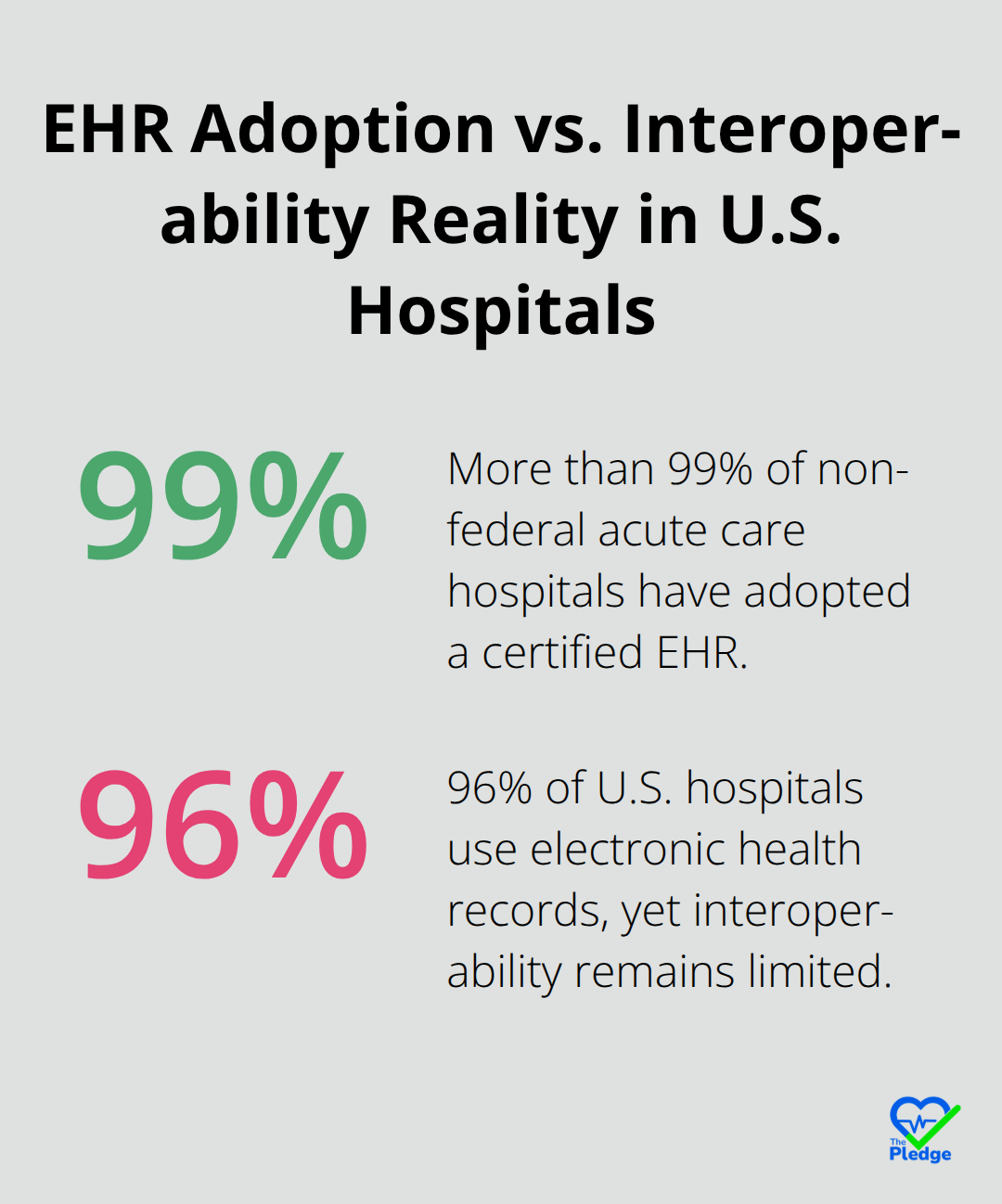
Patient records scattered across disconnected systems represent more than an inconvenience-they represent a structural failure that directly harms outcomes. Nearly all non-federal acute care hospitals (>99%) adopted a certified EHR, yet this data rarely flows seamlessly between providers. A patient seeing a cardiologist, primary care physician, and specialist at different hospital networks experiences fragmentation at every step.
Each provider maintains separate records. Each system requires separate logins. Critical information about medications, allergies, recent test results, and ongoing treatments remains siloed, forcing clinicians to make decisions with incomplete information.
This fragmentation drives measurable harm: duplicate testing costs the healthcare system billions annually, while medical errors spike when providers lack complete patient histories. The American Hospital Association reports that 96% of hospitals use electronic health records, yet interoperability remains limited, meaning the technology exists to share data but organizational and technical barriers prevent it from happening smoothly.
How Delays Compound Care Coordination Failures
The delays created by fragmented systems directly impact care coordination. When a patient enters an emergency room with chest pain, clinicians waste critical minutes searching multiple systems for prior cardiac workups, current medications, and relevant history. When specialists need to coordinate treatment for a complex patient, they schedule calls, request faxed records, and wait days for information that should be instantly accessible. These delays translate into real consequences: postponed treatments, missed diagnoses, and frustrated patients who must repeat their medical history at every visit.
Duplicate testing occurs because providers cannot access recent lab work or imaging from other facilities, leading to unnecessary radiation exposure, repeated bloodwork, and inflated costs. The hidden cost of disconnected healthcare drains employer budgets faster than most realize, with estimates suggesting duplicate testing and redundant procedures cost the U.S. healthcare system tens of billions annually.
The Safety Risks Hidden in Fragmentation
Fragmentation creates safety risks that extend far beyond inconvenience. A patient on blood thinners at one hospital may receive a conflicting medication at another facility because records don’t communicate. Allergies documented in one system remain invisible in another. These gaps compound when patients move between care settings, each transition introducing opportunities for miscommunication and error. Secure, integrated data sharing could eliminate these risks entirely-yet most healthcare organizations still operate with systems that cannot talk to one another.
The path forward requires platforms that connect these fragmented pieces into a unified view. Understanding how secure data sharing actually works reveals why this integration matters so much for both safety and efficiency.
How Secure Data Sharing Actually Works
Three Interconnected Layers
Secure health data sharing requires three interconnected layers working together. The first is a centralized architecture that acts as a hub, connecting disparate provider systems without forcing hospitals or clinics to abandon their existing EHRs. Rather than requiring every system to talk directly to every other system, a centralized platform receives data from multiple sources, normalizes it into a consistent format, and makes it available to authorized users in real time. This approach eliminates the complexity of point-to-point integrations that break whenever one system updates.
The second layer is encryption and access control. Data must be encrypted both in transit and at rest, using standards like AES-256 bit encryption that HIPAA recognizes as sufficient protection. Equally important is granular access control-role-based permissions that ensure a cardiologist sees cardiac data while a physical therapist sees only rehabilitation records.
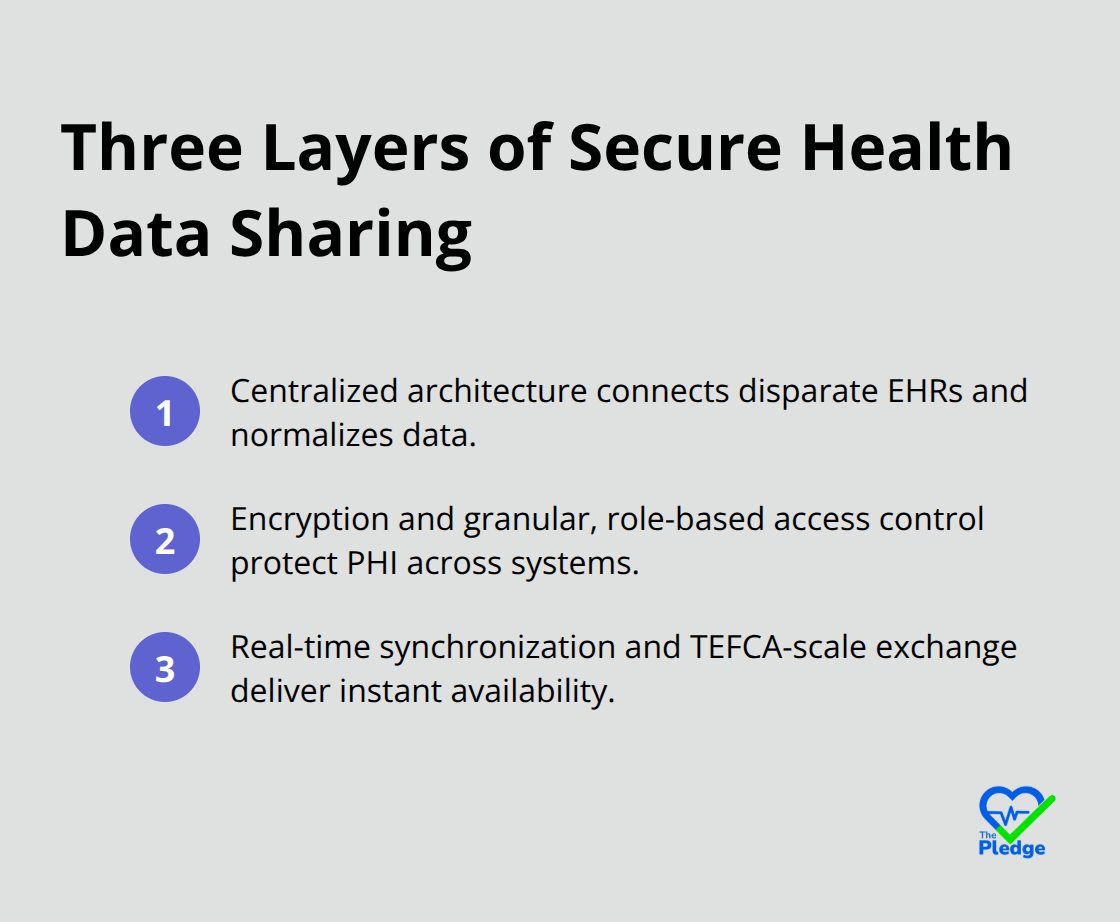
The third layer is real-time synchronization, which means when a lab result uploads to one system, it propagates instantly to authorized providers rather than sitting in a queue for hours or days. The TEFCA nationwide framework enhances health information exchange nationwide, enabling secure data sharing among providers, payers, and public health sectors. This momentum reflects growing recognition that secure sharing infrastructure must operate at scale.
Technical Decisions That Matter
Organizations must choose between cloud-based platforms and on-premises solutions, with cloud offering faster deployment and lower capital costs while on-premises provides tighter control for risk-averse institutions. Authentication should use multi-factor verification to prevent unauthorized access, and audit logs must capture every access event-who viewed what data, when, and for what clinical reason.
HIPAA requires comprehensive audit trails, and the Security Risk Assessment Tool available through the Office of the National Coordinator helps providers identify vulnerabilities before deployment. Data governance policies must clarify consent workflows, specify which data elements can be shared under which circumstances, and establish clear escalation procedures when patients restrict access.
Building Accountability Into Implementation
Vendors handling PHI must sign Business Associate Agreements that hold them accountable for security failures. Organizations should test with realistic data volumes before full deployment to prevent performance degradation that could slow clinical workflows and discourage adoption. The Health IT Playbook provides practical implementation strategies and best practices for organizations building these systems, emphasizing that secure sharing only works when clinicians actually use it-which means the platform must be faster and easier than searching multiple systems manually.
When care teams access complete, verified information instantly through these technical safeguards, coordination improves and risks drop dramatically. Yet technology alone cannot sustain trust. The systems that share patient data must also demonstrate transparency and give patients meaningful control over their own information.
Building Trust Through Compliance and Transparency
HIPAA Compliance as Foundation, Not Checkbox
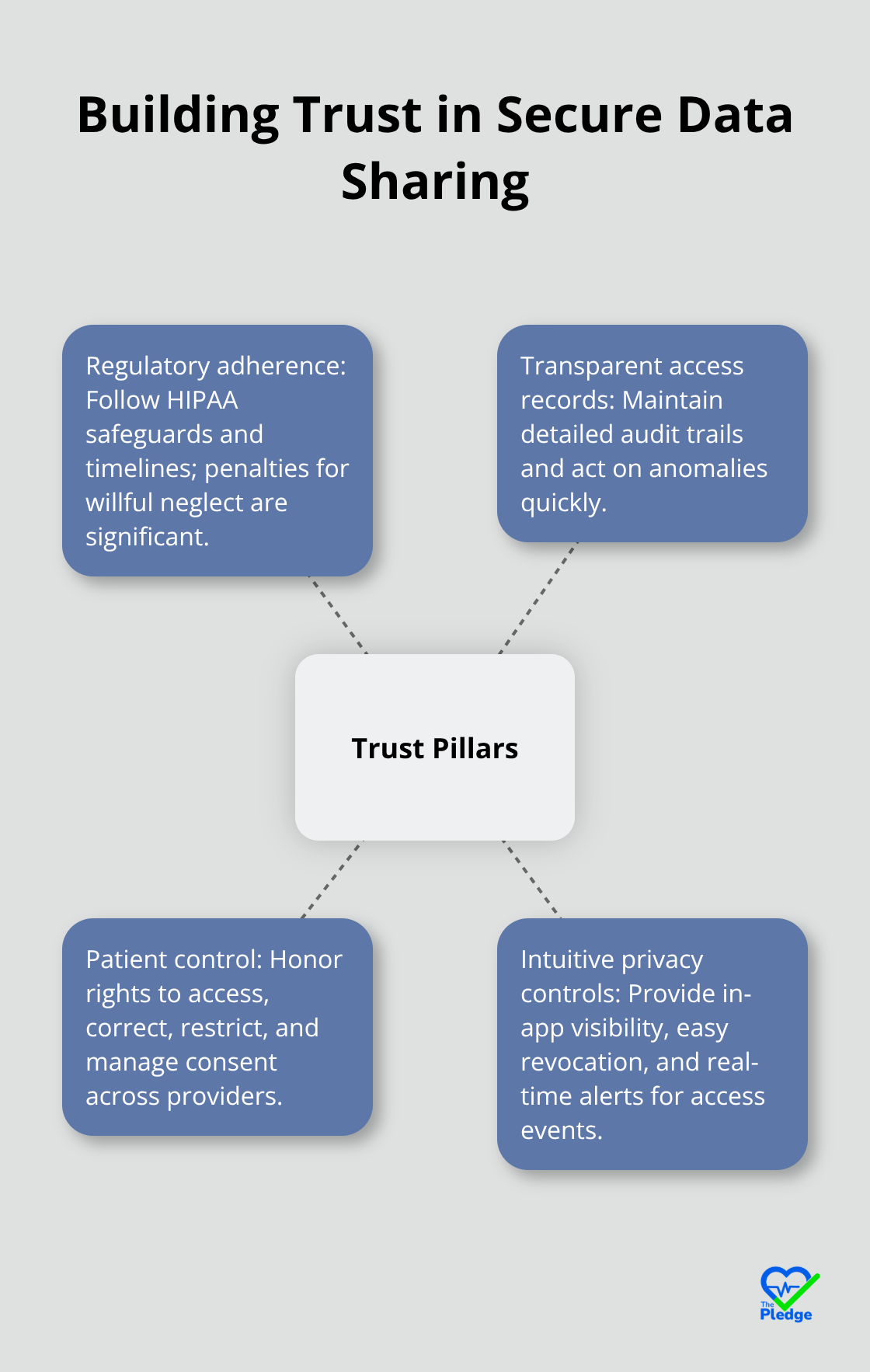
Trust in health data sharing rests on three concrete commitments: regulatory adherence, transparent access records, and genuine patient control. HIPAA sets the baseline for U.S. healthcare, requiring encryption, access controls, and breach notification within 60 days. Compliance alone does not build trust-it merely prevents the worst outcomes. The U.S. Department of Health and Human Services imposes penalties ranging from $10,000 to $50,000 per violation for willful neglect, making HIPAA due diligence a financial imperative.
Yet many organizations treat it as a checkbox rather than a foundation for trustworthy systems.
Organizations implementing secure data sharing must conduct formal Security Risk Assessments to identify vulnerabilities before deployment, then document how their platform meets HIPAA’s Technical, Physical, and Administrative safeguards. This means unique user IDs for every clinician, automated access auditing, encryption using AES-128/192/256-bit standards for data in transit and at rest, and Business Associate Agreements holding vendors accountable for breaches.
Audit Trails Expose Hidden Access Patterns
Audit trails separate genuine security from theater. When a patient’s record is accessed, the system must log who accessed it, when, what data they viewed, and why they had permission. This granular logging enables compliance teams to detect anomalies-a cardiologist accessing psychiatric records, or a scheduler pulling full patient histories during off-hours. Comprehensive audit logs also support incident response. When a breach occurs, organizations must trace exactly which records were compromised and notify affected patients within 60 days. Without detailed logs, this process becomes guesswork. With them, organizations demonstrate accountability and speed recovery.
Patient Control Completes the Trust Equation
Patient control completes the trust equation. The HIPAA Privacy Rule grants patients the right to access, correct, and restrict their records, yet most healthcare organizations make these rights difficult to exercise. Platforms that share clinician visit notes directly with patients demonstrate that transparency strengthens rather than threatens the patient-provider relationship. Patients with access to their complete records report better understanding of their conditions, improved medication adherence, and higher satisfaction.
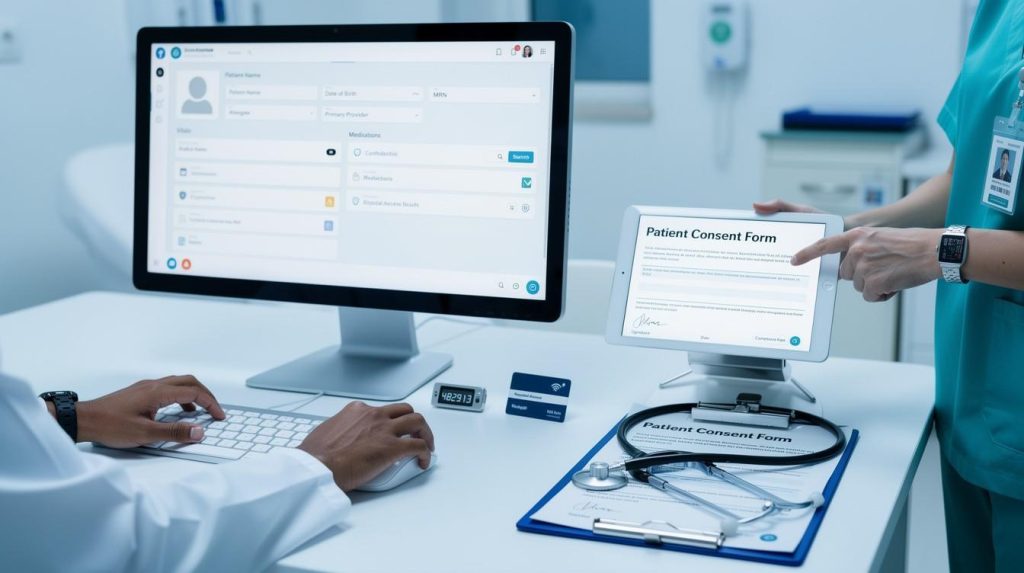
Organizations must implement consent workflows that let patients specify which providers access which data, revoke access immediately when relationships end, and receive notifications when their records are accessed outside routine care. This transparency costs nothing compared to the breach liability of significant data exposures.
Making Privacy Controls Intuitive and Accessible
Secure data sharing platforms must surface these controls in patient apps, making privacy management as intuitive as any consumer technology, not buried in legal documents patients never read. Patients should understand at a glance which providers have access to which records, revoke permissions with a single tap, and receive alerts when their data is accessed. This transparency transforms patients from passive data subjects into active participants in their own care.
Final Thoughts
Fragmented health data costs the healthcare system billions annually through duplicate testing, delayed care, and preventable medical errors. Secure health data sharing eliminates these inefficiencies by giving care teams instant access to complete patient information, enabling faster diagnoses and coordinated treatment plans that measurably improve outcomes. When cardiologists, primary care physicians, specialists, and emergency departments access the same verified records in real time, care coordination becomes seamless rather than chaotic.
Technology alone cannot achieve this transformation. The platforms that enable secure health data sharing must also embed transparency and patient control at every level-audit trails that expose access patterns, encryption that protects data in transit and at rest, and consent workflows that let patients decide who sees what information. When patients understand exactly how their data flows through the healthcare system and retain the ability to restrict access, they become partners in their own care rather than passive subjects.
Organizations that implement secure health data sharing today will lead in care quality, cost efficiency, and patient satisfaction tomorrow. The Pledge integrates vital medical information across your entire health ecosystem, enabling seamless coordination among providers, family members, and employers while simplifying care navigation and promoting preventative care. The technology exists, the regulatory framework exists, and the commitment to build platforms that prioritize both seamless access and genuine transparency remains the final step forward.