
Medication adherence costs employers and insurers billions annually. When patients skip doses or forget medications, the financial damage extends far beyond the initial prescription-hospitalizations, emergency visits, and complications pile up fast.
At The Pledge, we’ve seen firsthand how this preventable spending drains healthcare budgets. The good news is that targeted strategies can reverse this trend and protect your bottom line.
What Non-Adherence Actually Costs Your Organization
Medication non-adherence drains healthcare budgets in ways that extend far beyond the price of a missed pill. A 2017 systematic review published in BMJ Open analyzed 79 studies across 14 disease groups and found that medication non-adherence ranged from $949 to $44,190 when adjusted to 2015 dollars. The data reveals a consistent pattern: lower adherence correlates with higher overall healthcare spending. In cardiovascular disease alone, adjusted annual non-adherence costs per patient ranged from $3,347 to $19,472. For diabetes, the range was $2,741 to $9,819 per patient annually. These numbers represent real dollars flowing out of your healthcare budget due to preventable complications. The World Health Organization states that medication adherence can have a more direct impact on patient outcomes than the treatment itself, yet this fundamental lever remains underutilized by most employers and insurers.
Where the Money Actually Goes
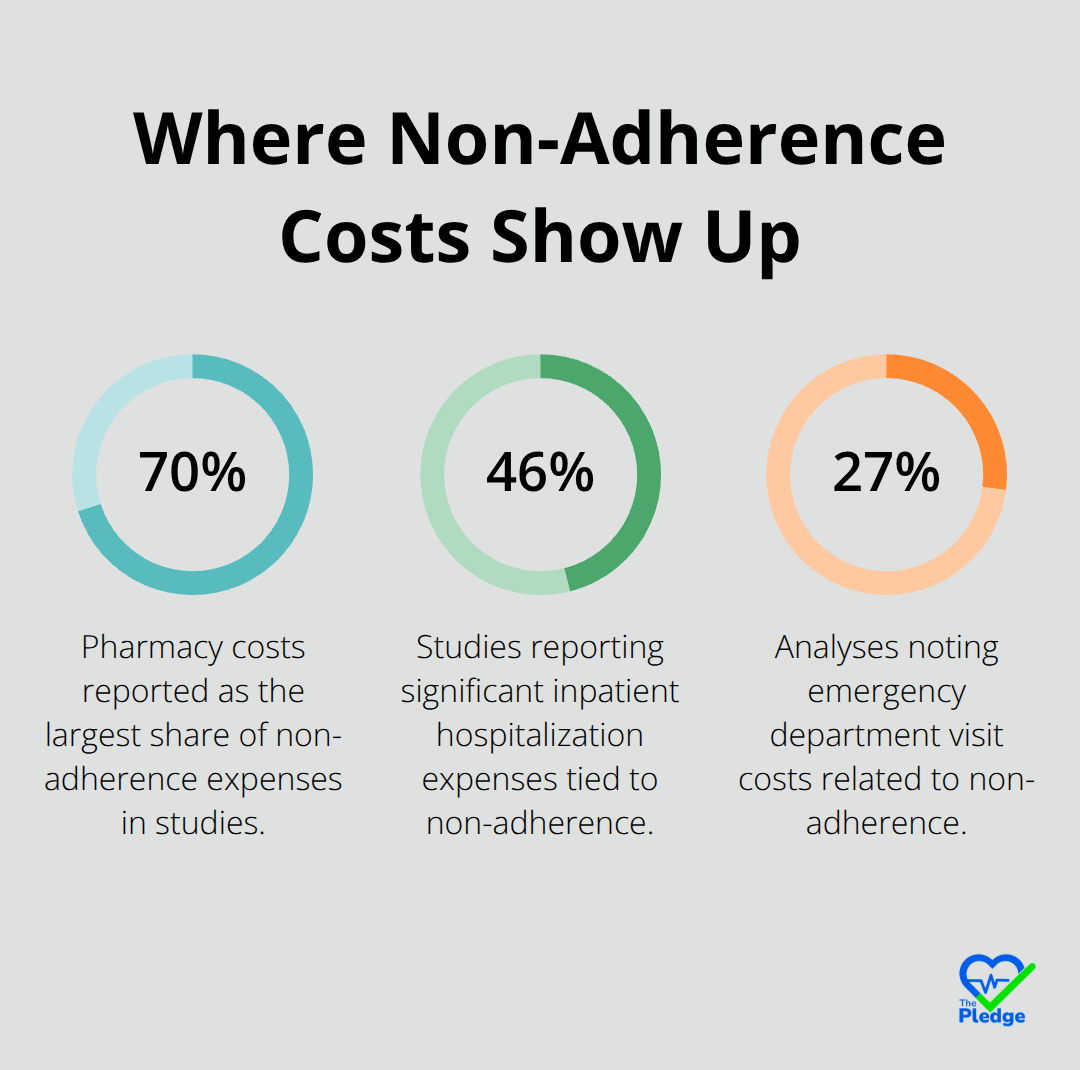
The cost structure of non-adherence tells an important story about where interventions matter most. Pharmacy costs account for roughly 70 percent of non-adherence expenses in studies, but inpatient hospitalization drives the largest financial impact. About 46 percent of studies tracking non-adherence costs reported significant inpatient expenses, with emergency department visits appearing in 27 percent of analyses.
In COPD, research shows that patients with adherence rates below 80 percent incur approximately $2,185 more in annual Medicare costs due to increased hospitalizations and ED visits. Diabetes presents a different pattern: a 10 percent increase in adherence correlates with an 8.6 to 28.9 percent reduction in total costs, demonstrating that even modest improvements in medication-taking behavior generate substantial savings. The problem intensifies across disease groups with comorbidities, where all-cause costs frequently exceed $5,271 to $52,341 annually per patient. A single employee who struggles with adherence can cost your organization tens of thousands of dollars in preventable medical events.
Why Standard Metrics Miss the Real Picture
Most employers measure adherence using the Medication Possession Ratio or Proportion of Days Covered, with an 80 percent threshold defining adequate adherence. However, these pharmacy claims-based metrics capture only part of the problem. They miss the patients who fill prescriptions but never take the medications, split pills to stretch supplies, or stop one drug when switching to another without informing their provider. About 28 to 31 percent of new prescriptions for diabetes, hypertension, or high cholesterol go unfilled entirely. The real cost burden emerges when you examine what happens after non-adherence: emergency room utilization spikes, preventable hospitalizations occur, and disease complications accelerate. In mental health conditions, the BMJ Open review documented adjusted annual non-adherence costs between $3,252 and $19,363 per patient, with additional indirect expenses including short-term disability, workers’ compensation, and lost productivity. These hidden costs rarely appear on traditional claims reports, yet they represent genuine financial impact to your organization’s bottom line through reduced employee productivity and increased absenteeism.
The Comorbidity Factor
All-cause costs tend to exceed disease-specific costs due to the influence of comorbidities. When patients fail to take medications for one condition, they often neglect treatment for others, creating a compounding effect that multiplies expenses across multiple care settings. This interconnected cost structure means that a single adherence intervention can address multiple disease states simultaneously. Understanding this relationship helps employers and insurers prioritize which populations and conditions offer the greatest return on adherence investments. The next section examines why patients abandon their medications in the first place-and what specific barriers your organization can address to reverse this costly trend.
Why Patients Abandon Their Medications
Cost Creates the Biggest Barrier
Financial barriers stand as the primary reason patients stop taking prescribed medications, and the numbers are stark. IQVIA 2020 data shows that prescription abandonment rises sharply with out-of-pocket costs: less than 5 percent of patients abandon medications when costs are zero, but this jumps to 45 percent when out-of-pocket expenses exceed $125 and reaches 60 percent when costs surpass $500. In China, where out-of-pocket payments represented 28.8 percent of total health expenditure in 2016, adherence disparities by socioeconomic status are dramatic-clopidogrel use was only 6.7 percent in the lowest income groups versus 34.2 percent in the highest. This reflects patients making impossible choices between medications and basic living expenses. Employers and insurers who ignore cost as a driver of nonadherence ignore the single largest lever they control.
Generic medications offer a direct solution to this financial barrier. More than 90 percent of generic prescriptions fill for less than $20 out-of-pocket, with an average copay around $6.60. Yet many organizations fail to actively promote generic substitutions at the point of prescribing, leaving money on the table and patients struggling unnecessarily.
Complexity and Communication Gaps Compound the Problem
Beyond cost, the complexity of medication regimens and poor provider communication create additional barriers that compound the financial problem. A qualitative study from Beijing examining stroke patients identified that provider shortages and time pressure prevent individualized education. Heavy caseloads limit the coaching conversations that support long-term adherence. Poor communication raises nonadherence risk by approximately 19 percent.
When patients lack clear understanding of why they need medications or how to take them correctly, they often abandon treatment entirely rather than navigate confusion. Additionally, patients frequently split pills to stretch supplies, take medications inconsistently rather than as prescribed, or never fill prescriptions initially-behaviors that standard pharmacy metrics fail to capture. The disconnect between what healthcare providers believe they communicated and what patients actually understood represents a massive blind spot for employers trying to improve adherence.
A Multi-Barrier Approach Drives Real Results
Organizations serious about reducing nonadherence costs must address all three barriers simultaneously: reducing out-of-pocket expenses through generic optimization, simplifying regimens whenever medically appropriate, and creating systematic touchpoints where providers deliver consistent, clear adherence messaging. These interventions work together to remove the obstacles that cause patients to abandon their medications. The next section examines specific strategies that employers and insurers can implement to tackle these barriers and protect their healthcare budgets.
What Actually Works to Fix Medication Adherence
Reducing nonadherence costs requires moving beyond theory into concrete interventions that address the specific barriers patients face. The evidence shows that single-tactic approaches fail consistently. Organizations that improve adherence deploy coordinated strategies targeting cost, complexity, and communication simultaneously. Employers and insurers who combine multiple interventions achieve measurable improvements in medication-taking behavior and corresponding reductions in preventable medical events.
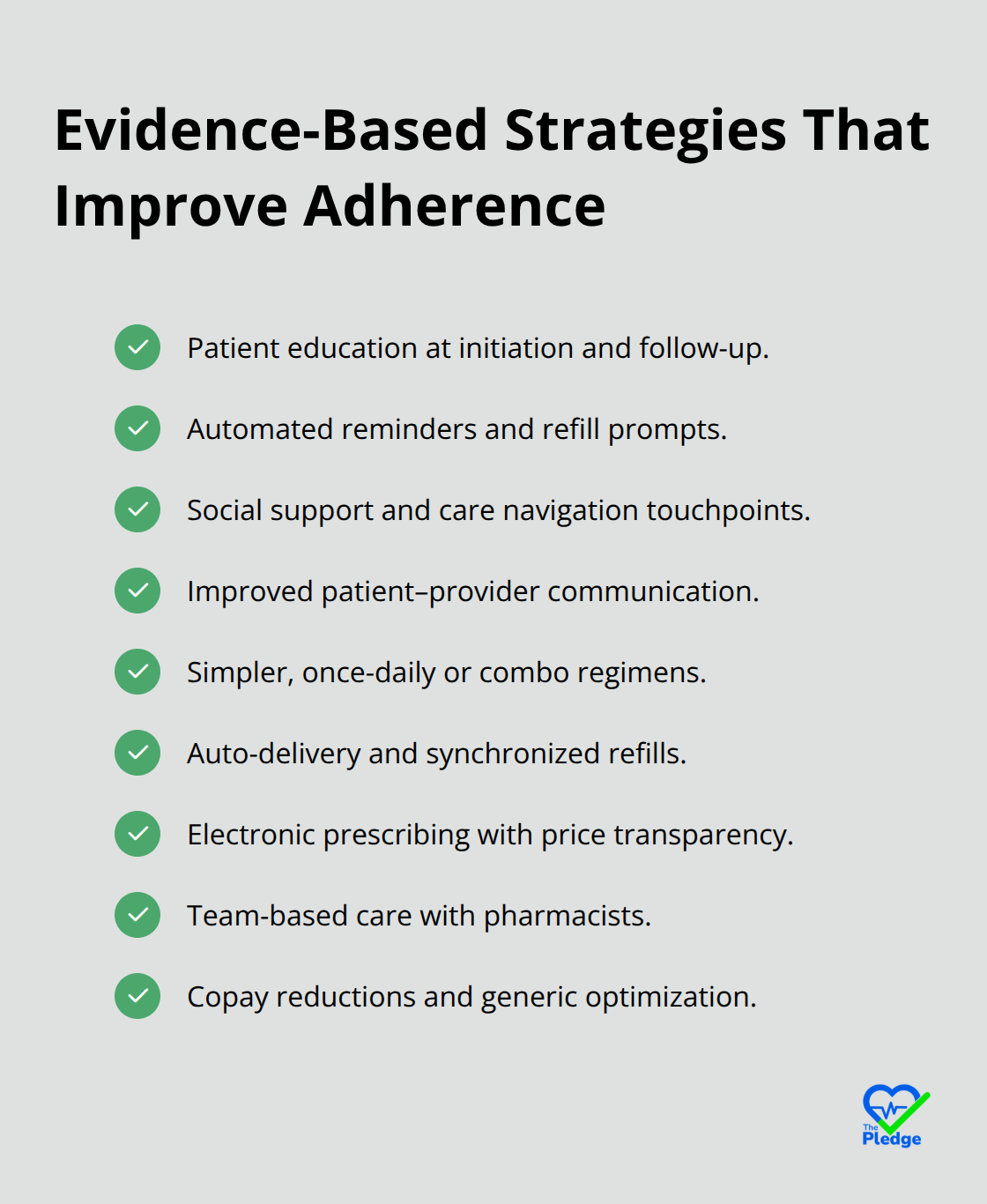
The data supports this integrated approach: evidence-based strategies to boost adherence span patient education, reminders, social support, improved patient-provider communication, simpler regimens, auto-delivery, electronic prescribing systems, team-based care, and copay reductions.
Financial Incentives and Cost Reduction Drive Adherence
Financial incentives raise adherence by approximately 20 percentage points on average, while reducing out-of-pocket costs produces a linear relationship with improved medication-taking behavior across diagnoses. However, reducing copays alone does not guarantee lower total healthcare costs if the underlying barriers of complexity and poor communication remain unaddressed. Organizations that succeed treat adherence as a system problem requiring coordination across multiple touchpoints rather than relying on single interventions.
Pharmacist-Led Programs Deliver Measurable Results
Pharmacist-led medication therapy management within medical homes demonstrates measurable improvements in adherence and outcomes, with Medicare Part D mandating MTM services specifically because the evidence proves their value. Key elements include identifying targeted medication problems, communicating with providers about therapy gaps, and conducting regular follow-up conversations. These structured programs create accountability and ensure patients receive consistent support throughout their treatment journey.
Electronic Prescribing and Digital Tools Enable Cost-Effective Substitutions
Electronic prescribing systems integrated into clinical workflows improve first-fill adherence rates measurably by eliminating delays and reducing patient confusion about what to take. Digital health tools operating outside the electronic health record empower patients and clinicians with price-informed care, enabling cost-effective medication substitutions at the point of prescribing without requiring prescription rewrites. These systems remove friction from the prescribing process and help patients understand their medication options upfront.
Data Analytics Identify High-Risk Populations
Advanced risk stratification identifies members with socioeconomic challenges who face higher risk for cost-related nonadherence, allowing targeted interventions where they generate the greatest return. Automated medication-list reviews scan for plan-specific opportunities to substitute lower-cost drugs, with generic medications offering the most direct path to affordability (more than 90 percent of generic prescriptions fill for under $20 out-of-pocket). Organizations serious about adherence improvement invest in clinician-facing reports that combine medical and pharmacy claims with current pricing to identify gaps and trigger proactive outreach. This data-driven approach reveals which patients need intervention, which medications present cost barriers, and which providers require additional education about generic alternatives. The organizations that succeed in reducing nonadherence costs treat adherence improvement as a strategic priority requiring investment in infrastructure, data analytics, and cross-stakeholder coordination rather than hoping patients will simply remember to take their medications.
Final Thoughts
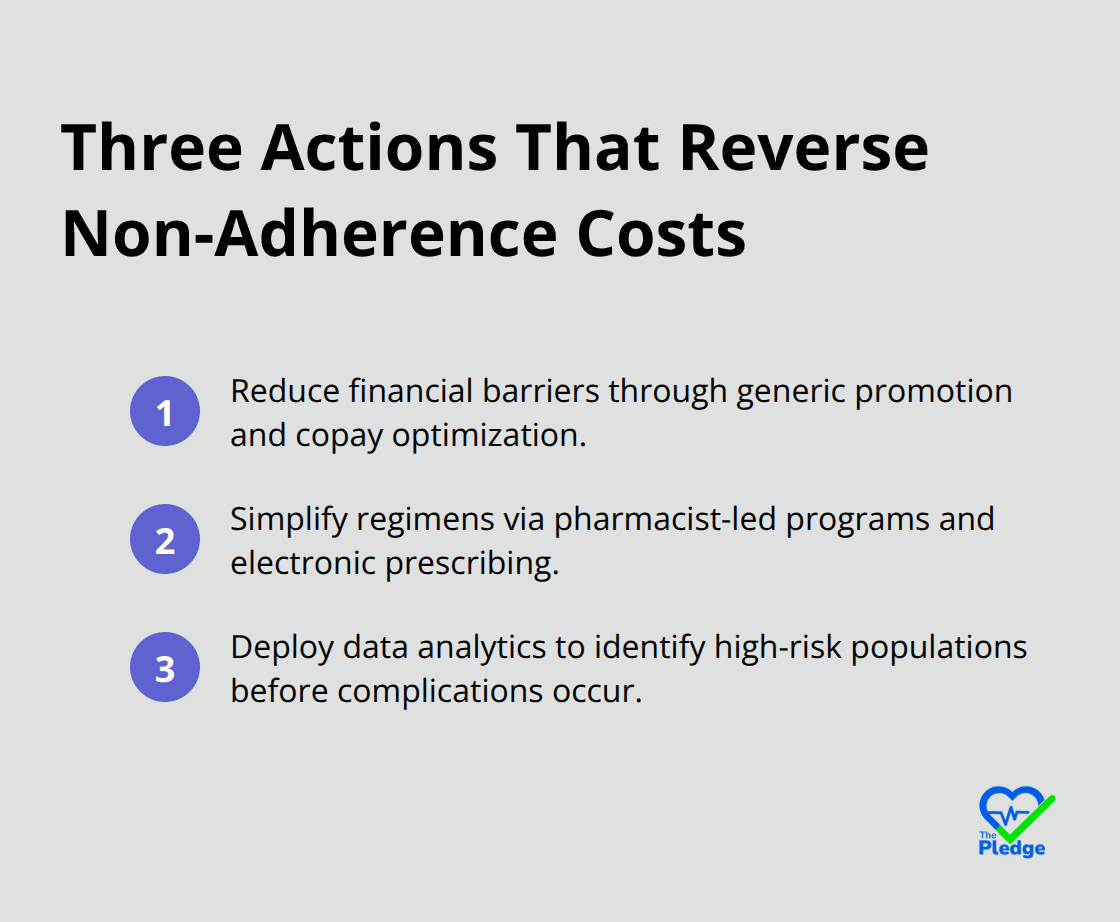
Medication adherence costs employers and insurers far more than most organizations realize, with non-adherence generating between $949 and $44,190 in annual costs per patient depending on disease group. Inpatient hospitalizations and emergency visits drive the largest financial impact, yet most organizations treat adherence as an individual patient responsibility rather than a system problem. Three simultaneous actions reverse this trend: reduce financial barriers through generic promotion and copay optimization, simplify regimens through pharmacist-led programs and electronic prescribing, and deploy data analytics to identify high-risk populations before complications occur.
Organizations that succeed invest in infrastructure and cross-stakeholder coordination to address adherence systematically. The return on this investment proves substantial-improving adherence reduces hospitalizations, emergency department visits, and disease complications while simultaneously boosting employee health outcomes and productivity. We at The Pledge built a platform to address these barriers through centralized health data, personalized reminders, and real-time medication management that integrates seamlessly with existing health plans.
If your organization is ready to stop losing money to preventable nonadherence, explore how The Pledge transforms medication management at scale. Our AI-driven system simplifies care navigation and removes the friction that causes patients to abandon their medications. Contact us today to learn how we help employers and insurers protect their healthcare budgets.