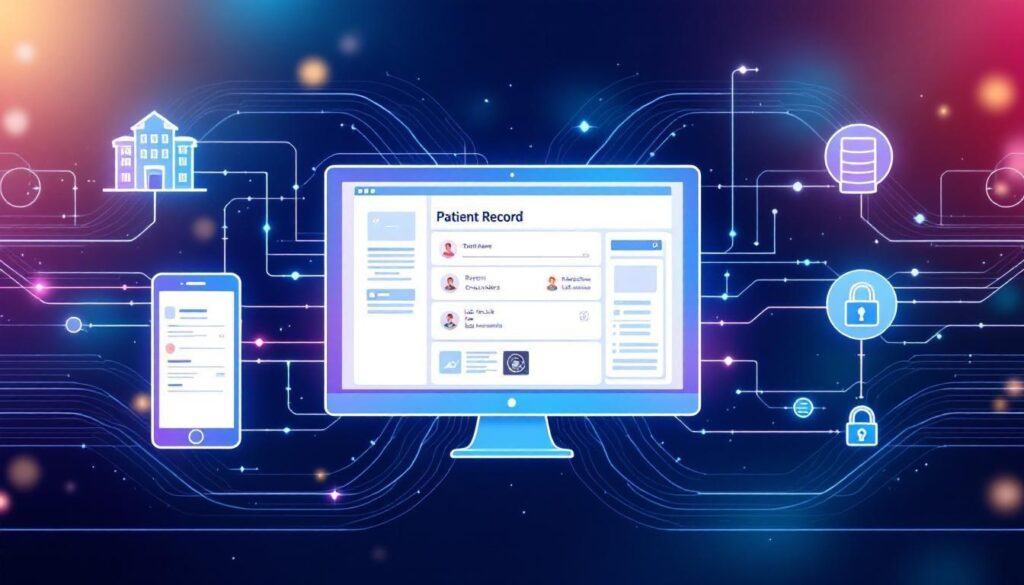
A patient’s medical history shouldn’t be scattered across dozens of disconnected systems. Yet today, most people have no single place to see their complete health picture-their medications, test results, allergies, and past treatments all live in separate databases.
At The Pledge, we’ve seen firsthand how unified patient records eliminate this fragmentation. When your health information flows seamlessly between providers, care becomes faster, safer, and more coordinated.
Why Healthcare Data Stays Trapped in Silos
The average hospital uses 16 disparate electronic systems that rarely communicate with each other, according to industry research. This fragmentation isn’t a minor inconvenience-it’s a structural problem built into how healthcare infrastructure was designed decades ago. Most health systems grew organically, adding new software solutions whenever a specific need emerged. A hospital might use one system for radiology, another for lab results, a third for pharmacy records, and yet another for billing. None of these systems were built to talk to each other, and retrofitting them now is expensive and technically complex.
Legacy Systems Block Data Flow
Healthcare organizations face a painful choice: replace entire systems at enormous cost or accept data that remains locked in separate databases. Replacing an EHR system can cost hospitals millions of dollars and take years to implement. The 21st Century Cures Act pushed for interoperability standards like HL7 FHIR, which improved interoperability success rates by about 40% according to the HIMSS 2024 Interoperability Assessment. Yet adoption remains uneven. Many older systems predate these standards entirely, and vendors sometimes lack incentive to make their products talk to competitors. This is why 86% of healthcare providers report regular gaps in patient information that directly impact clinical decision-making. When a cardiologist cannot see that a patient already takes a blood thinner prescribed by their primary care doctor, dangerous drug interactions go undetected.
Incompatible Data Formats Create Manual Work
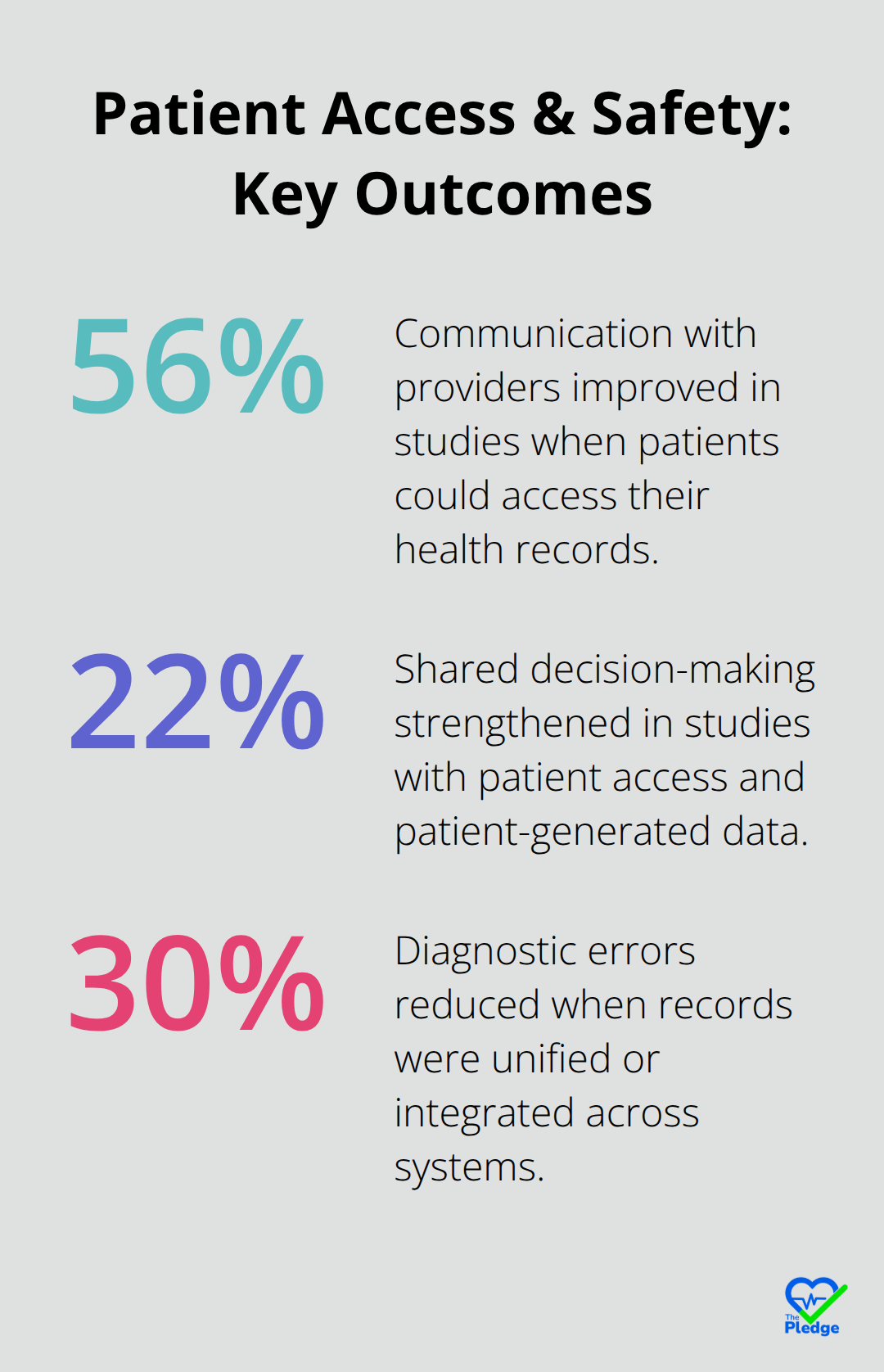
Different providers store information in incompatible formats, making data sharing technically difficult even when organizations want to collaborate. A test result from one lab appears as a PDF image, another as structured data, and a third as free-form text notes. Clinicians spend countless hours manually transcribing information between systems or requesting paper records. This manual work introduces transcription errors and delays care. Research from the Journal of the American Medical Association found that integrated health record systems can reduce diagnostic errors by as much as 30%, yet most patients never experience this benefit because their providers cannot access integrated information. Worse, patients themselves have no single place to view their complete history. They receive results through email from one provider, a patient portal from another, and a printed summary from a third.
Patient Engagement Suffers Without Access
When patients cannot easily access their own health information, they disengage from their care. A 2024 systematic review in JMIR examined 18 primary studies across multiple countries and found a positive association between patient access to electronic health records and engagement across six distinct outcome domains. Healthcare communication with providers improved in 56% of studies when patients could access their records. Shared decision-making strengthened in 22% of studies through patient-generated data and better information sharing. Yet fragmented systems prevent this access from happening.
Patients struggle to understand their own health status or share accurate information across their care team. They cannot track their medications, lab results, or treatment history in one place. This fragmentation undermines the very engagement that drives better health outcomes and lower costs-setting the stage for how unified records transform the entire care experience.
How Unified Records Eliminate Wasted Care
Stopping Duplicate Testing Before It Starts
Unified patient records directly attack the most expensive problem in healthcare: duplicate testing and fragmented decision-making. When a patient moves between providers, each one often orders the same tests again because they cannot access prior results. A patient with high cholesterol sees their primary care doctor, gets bloodwork, then visits a cardiologist who orders identical labs because the results never reached their system. Franciscan Health, a 14-hospital system across Indiana, Illinois, and Michigan, tackled this exact problem through unified records that consolidated EMR data and external information into a single patient view. The result was measurable: care coordination improved across their pulmonology, cardiology, and intensive care pods, where clinicians could see exactly which data had been used in prior encounters. This eliminates redundant testing and accelerates diagnosis.
Accelerating Clinical Decisions With Complete Context
When providers share unified records, they make faster decisions with confidence. A cardiologist reviewing a unified record sees not just recent test results but the patient’s complete medication history, allergies, and previous treatment responses. This context matters. Research shows unified records can reduce diagnostic errors by 30%. Faster decisions also mean faster treatment-critical in emergencies where minutes determine outcomes. Medication management becomes substantially safer when all providers access the same record. Drug interactions that slip through fragmented systems become visible in a unified view. A patient taking a blood thinner prescribed by one doctor cannot accidentally receive a conflicting medication from another if both providers see the same medication list in real time.
Building Implementation Momentum Through Measurement
Healthcare organizations implementing unified records need to start with concrete priorities. First, inventory your existing systems and identify which data sources matter most for your patient population. Second, adopt interoperability standards like HL7 FHIR.
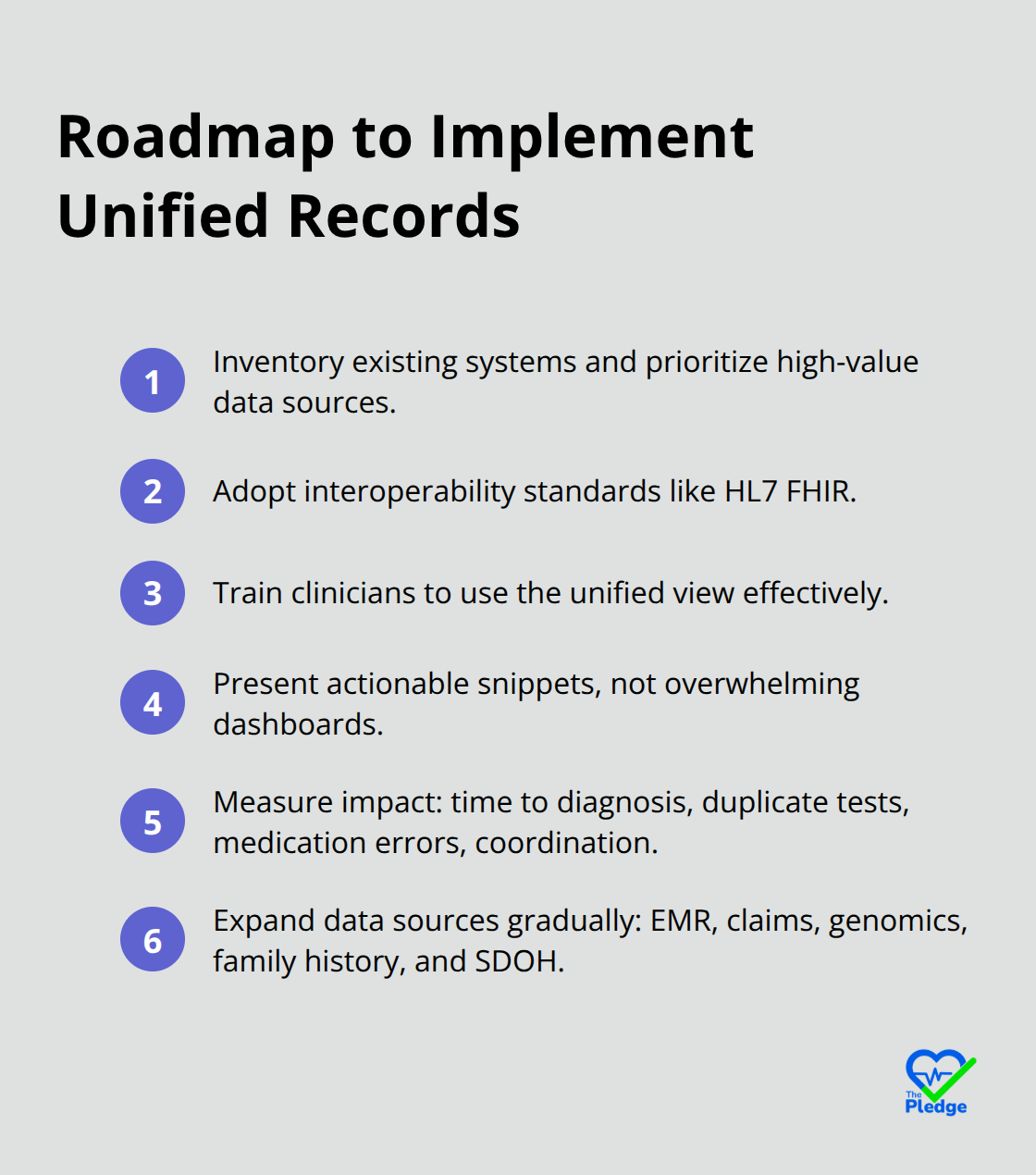
Third, train clinicians specifically on how to use the unified view-overwhelming them with data defeats the purpose. Present actionable information in digestible snippets rather than comprehensive dashboards. Franciscan Health discovered this lesson: success depends on education and showing clinicians exactly what information answers their immediate clinical question.
Fourth, measure impact on specific metrics: time to diagnosis, duplicate test reduction, medication error rates, and care coordination scores. Without measurement, you cannot prove value or sustain organizational commitment. Finally, expand your data sources gradually. Start with EMR and claims data, then add genomic information, family health history, and social determinants of health as your system matures. This phased approach reduces implementation risk while building momentum toward the next critical challenge: ensuring patients themselves can access and control their own health information.
What Unified Records Actually Cost You
Fragmented healthcare drains money in ways most organizations never fully quantify. Duplicate testing alone costs the healthcare system substantial sums annually in missed opportunities. When a patient sees multiple providers without a unified record, each orders the same labs, imaging, and diagnostic procedures because they cannot access prior results. Franciscan Health discovered this firsthand when they unified records across their 14-hospital system and immediately identified redundant procedures that could be eliminated.
Administrative Waste From Manual Data Transfer
Beyond duplicate testing, fragmented records create substantial administrative waste. Staff spend hours manually transferring information between systems, calling other providers for missing records, and reconciling conflicting data. This manual work proves expensive and error-prone. When unified records eliminate this friction, organizations recover staff time and redirect those hours toward actual patient care. The financial impact extends to medication safety as well.
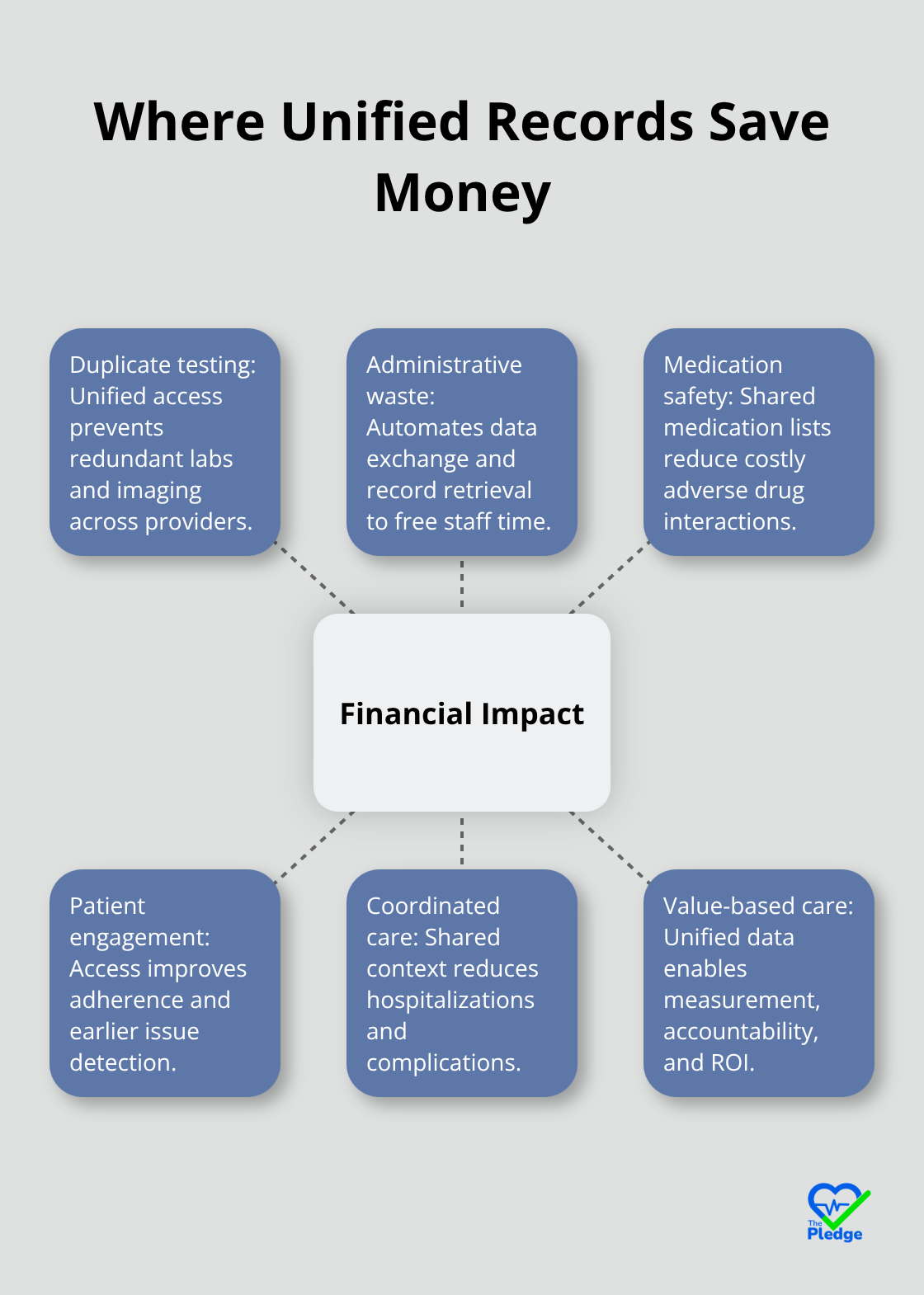
Preventable adverse drug interactions cost healthcare systems an estimated 290 billion dollars annually. Unified records make drug interactions immediately visible, preventing expensive hospitalizations from medication errors that fragmented systems allow to slip through.
Patient Engagement Reduces Long-Term Costs
Patient engagement directly impacts costs in measurable ways. Research examining 18 primary studies found that when patients could access their health records, healthcare communication with providers improved in 56% of studies, and shared decision-making strengthened in 22% of studies. Engaged patients follow treatment plans more consistently, catch health problems earlier, and avoid expensive emergency interventions. A patient who can track medications and lab results in one place takes prescriptions more reliably. A patient who understands their condition because they accessed clear summaries of test results and treatment information makes better lifestyle choices. These behavioral changes compound into significant cost reductions over time.
Coordinated Care Prevents Expensive Fragmentation
Organizations that implement unified records with strong patient access features see measurable improvements in medication adherence, preventive care engagement, and health outcomes. Coordinated treatment plans across providers eliminate the expensive fragmentation where one specialist prescribes a treatment that conflicts with another’s approach. When cardiologists, pulmonologists, and primary care doctors see the same complete patient record, they make decisions together rather than in isolation. This coordination prevents hospitalizations, reduces complications, and produces better health outcomes.
Measuring Financial Returns Through Specific Metrics
The most successful implementations measure specific metrics: time from diagnosis to treatment initiation, readmission rates within 30 days, medication error incidents, and cost per patient per year. Organizations that track these numbers consistently see unified records deliver measurable financial returns while simultaneously improving the quality of care patients actually experience. Healthcare leaders expecting revenue gains from value-based care in 2025 recognize that unified records form the foundation for capturing that value. Without unified data, organizations cannot identify which interventions work, which patients need help most, or where waste occurs. With unified records, every dollar spent on care becomes visible and accountable.
Final Thoughts
Fragmented healthcare data does not have to persist. The technology to unify patient records exists today, and organizations that implement it gain immediate advantages: faster diagnoses, eliminated duplicate testing, safer medication management, and engaged patients who understand their own health. Legacy systems require investment to replace or integrate, staff need training to use unified records effectively, and clinicians must learn to trust data presented in actionable snippets rather than overwhelming dashboards-yet these challenges have concrete solutions.
The healthcare industry moves toward unified patient records because the financial and clinical case proves undeniable. Organizations that centralize health data reduce costs through eliminated redundancy and prevent expensive medication errors. Patients who access their complete health information engage more consistently with their care, follow treatment plans more reliably, and catch problems earlier.
Providers who see unified patient records make faster, safer decisions with full context about each patient’s history and current medications. We at The Pledge recognize that seamless data integration forms the foundation for modern healthcare. Explore how The Pledge simplifies health management and delivers the seamless experience patients deserve.
![[Guide] Incentives That Drive Preventive Health Participation](https://thepledge.app/wp-content/uploads/emplibot/Guide_-Incentives-That-Drive-Preventive-Health-Participation_1783650286-300x168.jpeg)