

Corporate mental health programs aren’t just good for employees-they’re smart business investments. Companies that track mental health ROI discover concrete financial gains through reduced absenteeism, lower healthcare costs, and stronger retention rates.
At The Pledge, we’ve seen firsthand how organizations struggle to quantify these benefits. This guide walks you through the metrics and tools that actually work.
The Real Financial Impact of Mental Health Investment
Unproductive Labor Costs More Than You Think
Mental health problems drain company finances in ways that extend far beyond sick days. When an employee struggles with depression or anxiety, they show up mentally absent, making mistakes and missing deadlines. Unproductive labor costs significantly impact company finances, which means untreated mental health conditions erode your bottom line constantly. This presenteeism-showing up but not performing-often costs more than absenteeism because it remains invisible on payroll records.
Turnover Expenses Multiply the Damage
Burnout accounts for 15–20% of involuntary turnover according to Gallup, and replacing a single employee costs between 50–200% of their annual salary depending on the role. A company with 500 employees and a 20% turnover rate tied to burnout loses millions annually in recruitment and training costs alone. The financial case for mental health programs isn’t theoretical-it’s measurable and immediate.
Healthcare Claims Drop When Mental Health Improves
Healthcare costs reveal the clearest ROI picture. About 75% of medical expenses stem from preventable conditions, and unaddressed mental health conditions inflate costs across emergency room visits, inpatient care, disability claims, and chronic illness management. When employers implement effective mental health support, medical claims fall noticeably. A JAMA Network Open study found employers using modern mental health platforms achieved a 1.9x ROI, with employers saving nearly two dollars in health plan costs for every dollar spent. Real-world data from disease-management focused programs shows even stronger returns-the RAND Wellness Programs Study found disease-management components alone delivered $3.80 in healthcare savings for every $1 invested.
Productivity Gains Compound the Savings
Higher engagement in mental health programs directly correlates with fewer absences, better focus during work hours, and reduced presenteeism costs. Organizations that prioritize mental health see employees showing up with more energy and better mood, which improves customer interactions and output quality. When you combine reduced medical claims, recovered productivity hours, and lower turnover costs, mental health ROI becomes your strongest cost-containment lever-far outperforming generic wellness initiatives that lack mental health depth.
The question shifts from whether mental health programs pay for themselves to which metrics actually capture that value. Understanding what to measure separates programs that deliver real returns from those that simply consume budget.
What Metrics Actually Matter for Mental Health ROI
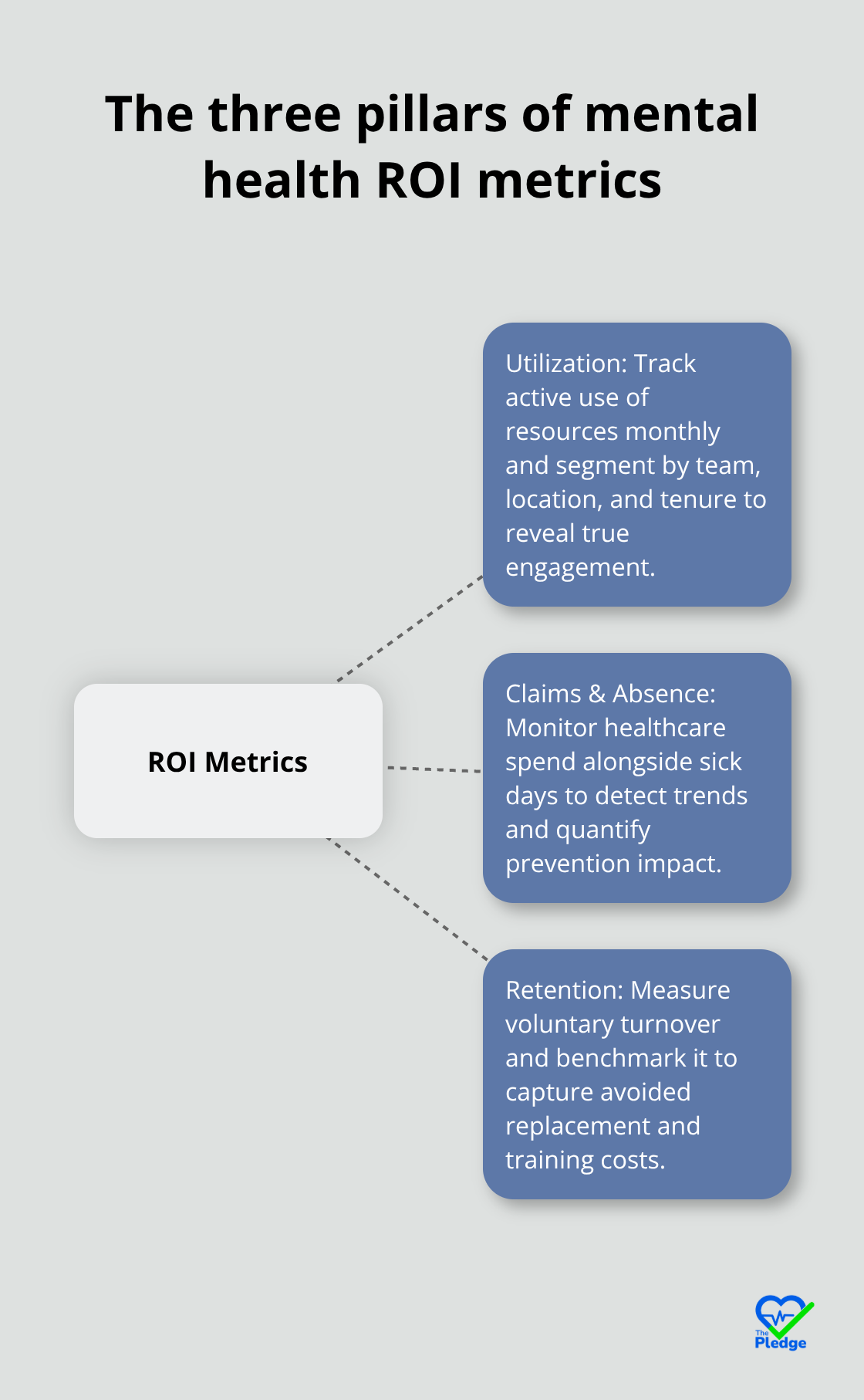
Tracking mental health ROI requires abandoning vanity metrics and focusing on what directly impacts your bottom line. Many organizations measure program participation alone and call it success, but high enrollment means nothing if employees aren’t using mental health resources or if healthcare costs remain flat. Companies waste budget on programs that look impressive on dashboards but fail to move the needle on actual health outcomes. The metrics that matter fall into three distinct categories, and each one tells a different part of your financial story.
Utilization Rates Reveal True Engagement
Enrollment numbers mislead. Employee Assistance Programs utilization rates average around 5–7%, yet employers often celebrate 80% sign-up rates as proof of success. Modern mental health platforms achieve 25% or higher utilization, which reveals the difference between offering a service and actually connecting employees with care. You should track your utilization rate monthly and segment it by department, location, and employee tenure to identify where mental health resources resonate and where engagement stalls.
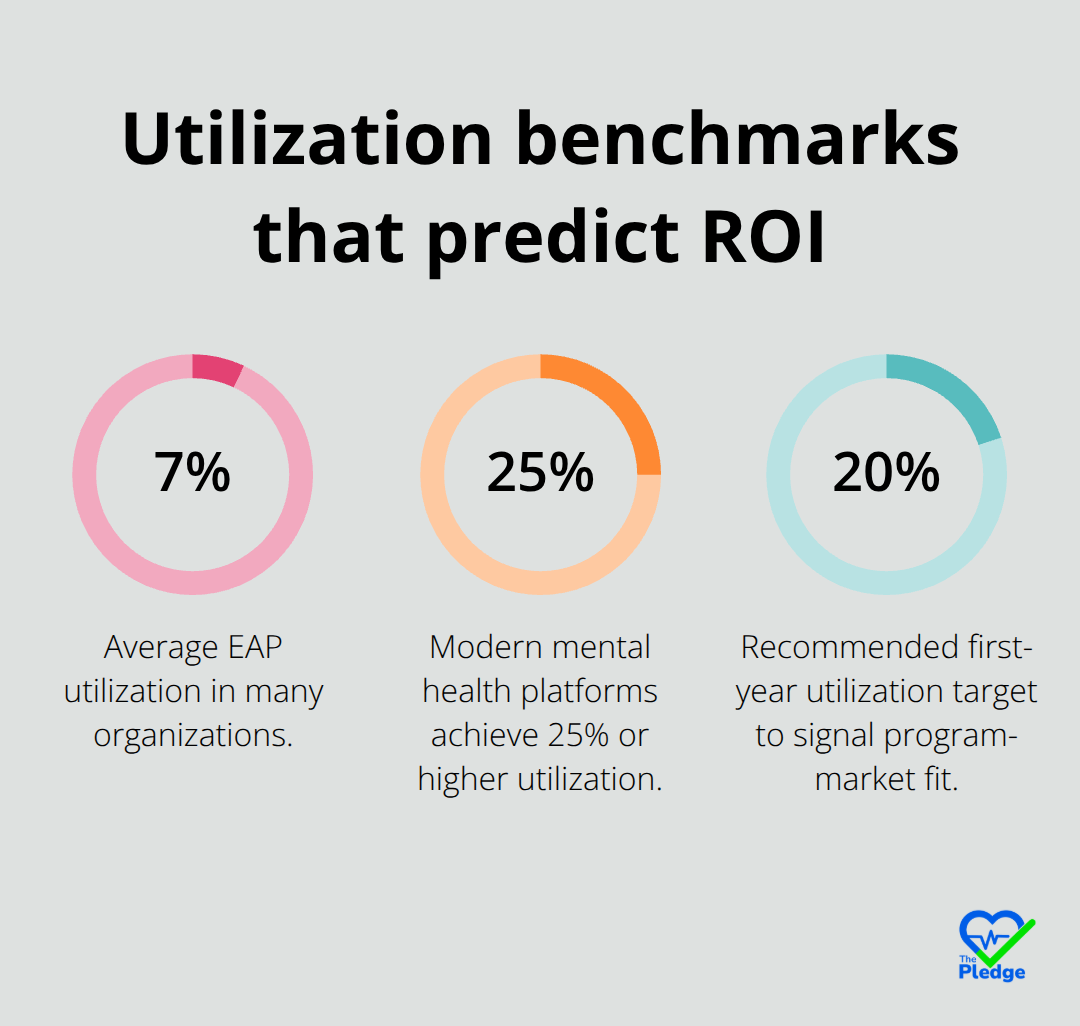
If your utilization hovers below 15%, your program design doesn’t match employee needs or barriers prevent access. This metric also predicts your ROI potential-higher utilization typically correlates with stronger cost savings and productivity gains because more employees receive treatment that reduces their healthcare claims and absence rates. You should set a target of at least 20% utilization within the first year and treat months below that as a signal to adjust your program offerings, improve communications, or remove friction from the enrollment process.
Claims and Absence Data Tell Complementary Stories
Healthcare claims data and absenteeism reveal different but connected insights. Claims data shows whether mental health investment reduces medical expenses through lower emergency room visits, fewer inpatient admissions, and reduced pharmacy costs tied to untreated conditions. The RAND Wellness Programs Study found disease-management focused interventions saved $136 per member per month in medical claims. Absenteeism data reveals how much productivity you recover when employees receive mental health support-fewer sick days directly translate to labor hours regained.
The real insight emerges when you compare these metrics together. An employee with declining mental health typically shows rising healthcare claims before missing work, so tracking both metrics lets you identify at-risk employees early and measure whether your intervention prevented absence entirely. You should measure ROI by calculating your monthly healthcare cost per employee before program launch and again after six months, twelve months, and eighteen months of operation. Similarly, benchmark your absence rate against industry standards and your own historical data. The strongest ROI programs show both declining medical claims and stable or declining absence rates within twelve months. If claims fall but absences rise, your program treats acute crises rather than prevents them. If absences fall but claims remain flat, employees may work through health conditions that will eventually surface as larger problems.
Retention Rates Capture Hidden Financial Value
Employee retention directly measures whether your mental health investment stops people from quitting. Burnout-driven turnover costs around 200% of salary for leaders and managers, with replacement costs varying by role. This means every employee you retain through effective mental health support represents tens of thousands of dollars in avoided recruitment, hiring, and training costs. You should track your overall voluntary turnover rate and segment it by tenure, department, and job level.
Companies with strong mental health programs typically see turnover decline within the first year of implementation, particularly among mid-career employees aged 30–45 who face the highest burnout risk. You should compare your turnover rate to industry benchmarks for your sector-if your rate exceeds the benchmark, mental health investment becomes a retention lever you cannot ignore. The financial impact is immediate and substantial. A company with 500 employees experiencing 20% turnover costs roughly $2.5 million to $10 million annually in replacement costs. Even a 2–3 percentage point reduction in turnover from mental health investment pays for the entire program budget. You should measure retention monthly and flag departments where turnover spikes, as these areas likely need targeted mental health interventions or management training to support employee well-being.
These three metrics form the foundation of your ROI story, but they only reveal impact if you collect and analyze them consistently. The next step involves selecting the right tools and systems to capture this data without creating administrative burden for your HR team.
Building Your Mental Health Measurement System
Measuring mental health ROI fails without the right infrastructure. Many organizations collect data sporadically, rely on manual spreadsheets, or pull metrics from disconnected systems, which guarantees incomplete pictures and missed insights. You need three complementary approaches working together: baseline assessments that establish where employees start, continuous tracking systems that monitor progress in real time, and direct employee feedback that reveals what your data might miss. The goal is creating a system you can maintain without overwhelming your HR team, which means prioritizing tools that integrate with systems you already use rather than building parallel processes.
Establish Baseline Assessments Before Program Launch
Baseline assessments establish your starting point and become your most valuable comparison data. Without knowing your mental health status, utilization patterns, and healthcare costs before implementing your program, you cannot prove what changed afterward. Conduct a baseline assessment thirty to sixty days before launching mental health initiatives. This assessment should include three components: current healthcare claims data for the past twelve months broken down by category such as emergency room visits, inpatient admissions, mental health claims, and pharmacy costs; absenteeism records showing sick days taken and patterns by department or job level; and a pulse survey asking employees about stress levels, burnout, job satisfaction, and whether they currently use mental health resources. The pulse survey should be brief-five to ten questions maximum-because longer surveys tank response rates. Keep the baseline survey anonymous to encourage honest responses about mental health struggles. Once you launch your program, conduct identical assessments at six months and twelve months so you can directly compare the same metrics. This before-and-after comparison becomes your clearest ROI narrative because it isolates the impact of your specific intervention rather than relying on industry benchmarks that may not match your workforce.
Deploy Real-Time Dashboards for Automatic Progress Tracking
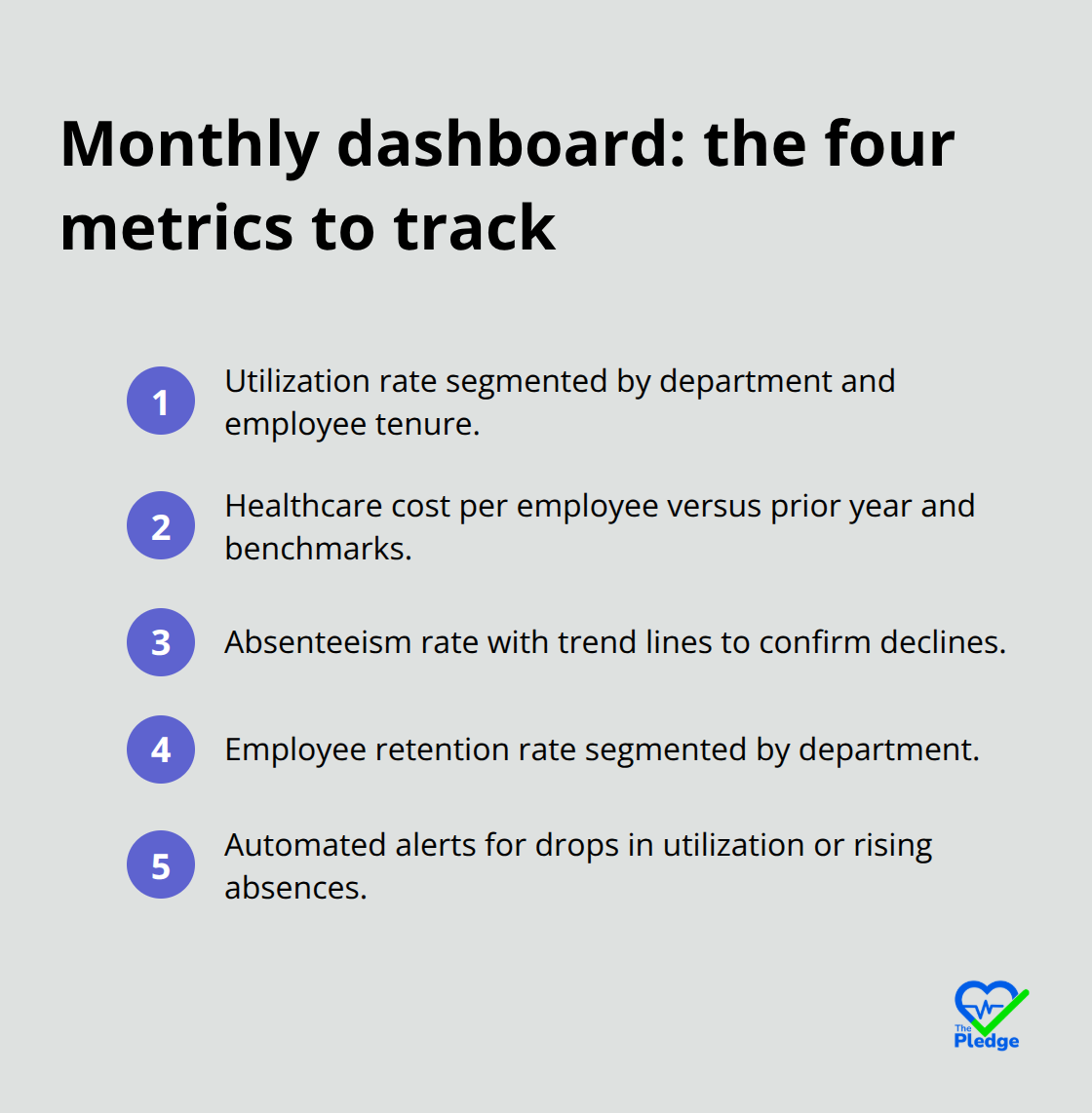
Real-time tracking systems eliminate the lag that makes traditional quarterly ROI reports obsolete. You should implement a dashboard that pulls data directly from your HRIS system, claims administrator, and mental health platform so metrics update automatically rather than requiring manual compilation. The dashboard should display four core metrics updated monthly: utilization rate broken down by department and employee tenure to show where your program resonates; healthcare cost per employee compared to the previous year and industry benchmarks; absenteeism rate with trend lines showing whether absence is declining; and employee retention rate segmented by department. The most actionable dashboards also flag anomalies-for example, if utilization drops below your target for two consecutive months or if a specific department shows rising absence rates despite program availability. These alerts signal that you need to investigate barriers or adjust your approach.
Many organizations use their existing benefits administration platforms which often include basic analytics, but if your current system lacks sufficient functionality, dedicated mental health platforms or modern EAP providers offer real-time dashboards specifically designed for ROI tracking. The critical requirement is automating data collection so you review metrics monthly rather than annually. Monthly review cycles let you adjust program offerings, improve communications, or target interventions in struggling departments while the data is still fresh.
Collect Employee Feedback to Uncover Hidden Barriers
Quantitative metrics tell you whether your program works financially, but qualitative feedback reveals why employees do or do not engage and what barriers prevent utilization. Conduct brief pulse surveys quarterly asking employees three questions: whether they are aware of mental health resources available to them, whether they have used these resources in the past three months, and what would increase their likelihood of using them. The third question is critical because it uncovers specific barriers-perhaps employees hesitate because they fear stigma, cannot access services during work hours, do not know how to enroll, or do not believe the resources match their needs. If multiple employees cite the same barrier, you have a concrete problem to solve rather than guessing at solutions. Complement quarterly pulse surveys with semi-annual focus groups bringing together eight to twelve employees from different departments and job levels. Focus groups should last thirty minutes and explore two topics: what mental health challenges most impact their work and what your organization could do better. These conversations often surface issues that employee surveys miss because employees explain their thinking and build on each other’s comments. Document themes from focus groups and share findings with leadership alongside your quantitative metrics. This combination of hard data and employee voice creates a compelling case for expanding mental health investment because it demonstrates both financial impact and genuine employee benefit.
Final Thoughts
Measuring mental health ROI requires discipline and consistency, but the payoff justifies the effort. You establish baseline metrics before launching your program, track utilization and healthcare costs monthly, and monitor retention rates by department. This combination of quantitative data and qualitative insights reveals whether your mental health investment actually moves the needle on your bottom line.
Organizations that implement effective mental health programs see healthcare claims decline, absenteeism drop, and turnover stabilize within twelve months. A 2–3 percentage point reduction in turnover alone pays for most mental health initiatives, while employees who receive mental health support show up with more energy and focus, which improves customer interactions and strengthens team dynamics. These intangible gains compound over time, creating a workplace where people want to stay and perform at their best.
Your measurement system should evolve as your program matures. Start with the three core metrics-utilization, healthcare costs, and retention-and add sophistication over time as real-time dashboards replace quarterly reports and segmented analysis reveals which departments benefit most from your interventions. The Pledge simplifies health management by integrating employee health information and enabling real-time tracking of wellness initiatives, so you can start your mental health ROI measurement journey today.





![[Guide] Incentives That Drive Preventive Health Participation](https://thepledge.app/wp-content/uploads/emplibot/Guide_-Incentives-That-Drive-Preventive-Health-Participation_1783650286-300x168.jpeg)