![[Guide] Incentives That Drive Preventive Health Participation](https://thepledge.app/wp-content/uploads/emplibot/Guide_-Incentives-That-Drive-Preventive-Health-Participation_1783650286-1024x573.jpeg)
Preventive health incentives work. Yet most employees still skip routine checkups, screenings, and wellness visits-costing employers billions in preventable claims.
At The Pledge, we’ve seen firsthand that the right incentive strategy changes behavior. This guide shows you which approaches actually move the needle on participation rates and long-term health outcomes.
Why Employees Skip Preventive Care
Out-of-pocket costs and cost-sharing barriers in preventive care remain the single biggest reason employees avoid preventive care. Eliminating cost-sharing barriers increases preventive visits, yet many plans still burden employees with deductibles and copays before preventive benefits kick in. A manufacturing company initially saw only 29% of employees completing annual wellness exams, largely because workers didn’t understand that many screenings were covered at no cost. Once the company clarified this through a targeted communication campaign, participation jumped to 61% over five years. The problem isn’t always that preventive care costs too much-it’s that employees don’t know it’s free.
The Cost Clarity Problem
Most employees assume preventive care costs money, even when their plan covers it fully. This misunderstanding is expensive for employers. Simply sending employees a one-page sheet listing covered preventive services without cost increased screening rates significantly. Digital platforms that send automated reminders tied to specific benefits-like alerting an employee that their mammogram is covered-bridge this gap far more effectively than annual benefits guides. Real-world programs like Kaiser Permanente’s Federal Health Plan and Blue Cross Blue Shield’s MyBlue address this by integrating cost information directly into their apps, showing employees exactly what they owe before scheduling.
Time as the Real Barrier
Scheduling friction kills participation more than cost. Offering on-site screenings during work hours or flexible telehealth options removes the time excuse entirely. One employer that partnered with a provider to offer lunch-hour blood work and biometric screenings saw preventive screening rates jump 28% year-over-year.
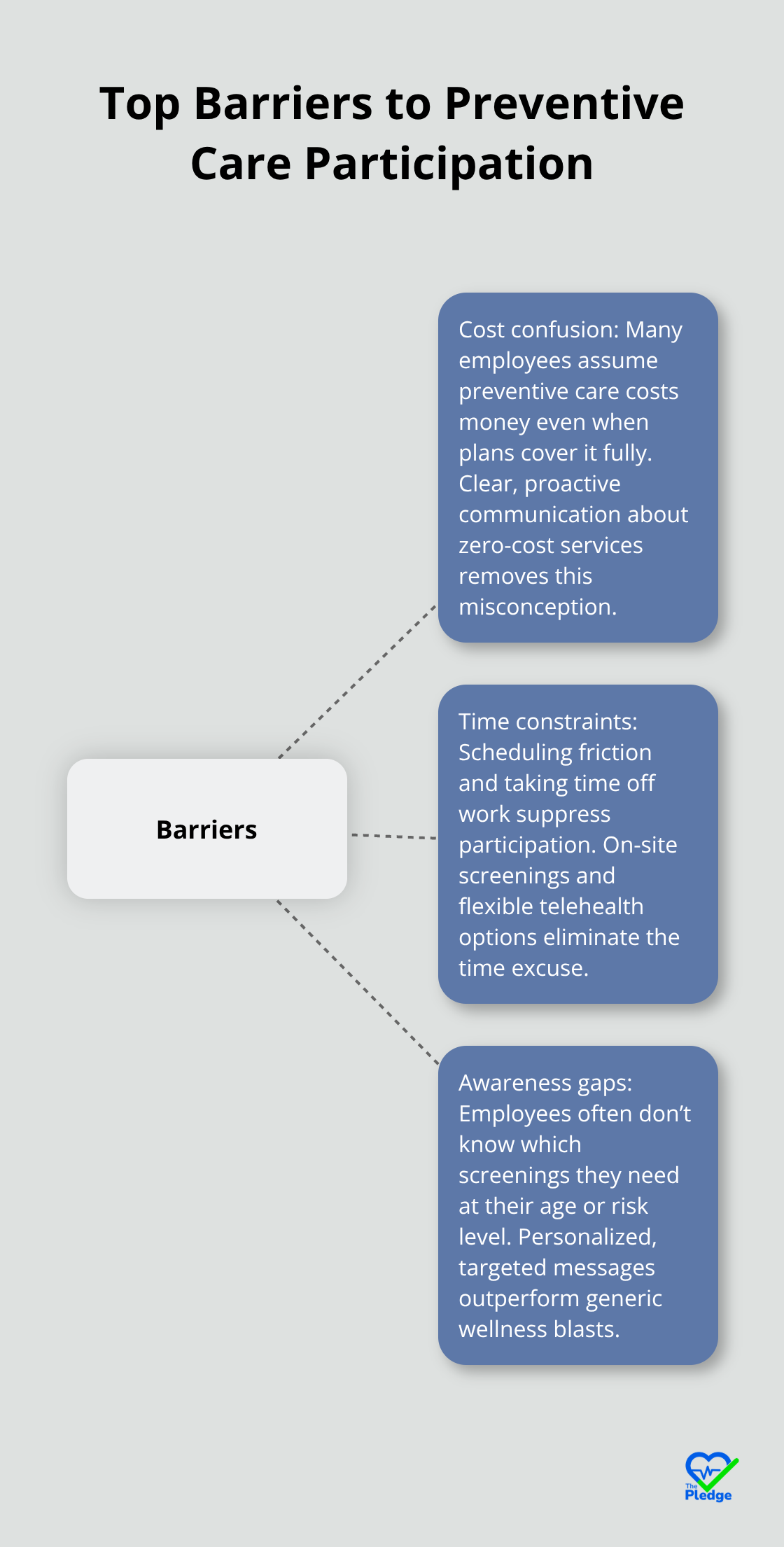
The screening took 15 minutes and happened at the employee’s workplace. Another practical approach involves mailing screening kits directly to employees for at-home completion, which reduces scheduling friction for services like colorectal cancer screening. Studies show pairing mailed kits with incentives yields stronger participation than incentives alone.
Health Risk Awareness Gaps
Many employees underestimate their health risks or don’t know which screenings they actually need. A 45-year-old might skip a colonoscopy because they feel healthy, unaware that colorectal cancer screening recommended starting at age 45 according to current guidelines. Without clear, personalized messaging about individual risk factors and recommended screenings, employees default to inaction. Employers that send targeted communications highlighting specific screening recommendations based on age and health history see higher completion rates than those relying on generic wellness messaging.
These three barriers-cost confusion, time constraints, and awareness gaps-explain why participation remains low even when coverage is comprehensive. The next section shows how strategic incentives address each barrier and move employees from inaction to engagement.
Incentive Strategies That Boost Participation
Financial Rewards Hit Harder When They Arrive Automatically
Financial incentives work fastest, but they work best when paired with friction reduction. A manufacturing company that implemented UMR’s Live Well Reward$ program saw wellness exam participation jump from 29% to 61% over five years. The program offered employees significant discounts on next year’s health insurance premiums for completing preventive screenings. Points accumulated automatically when claims were processed-no manual tracking, no employee paperwork required.
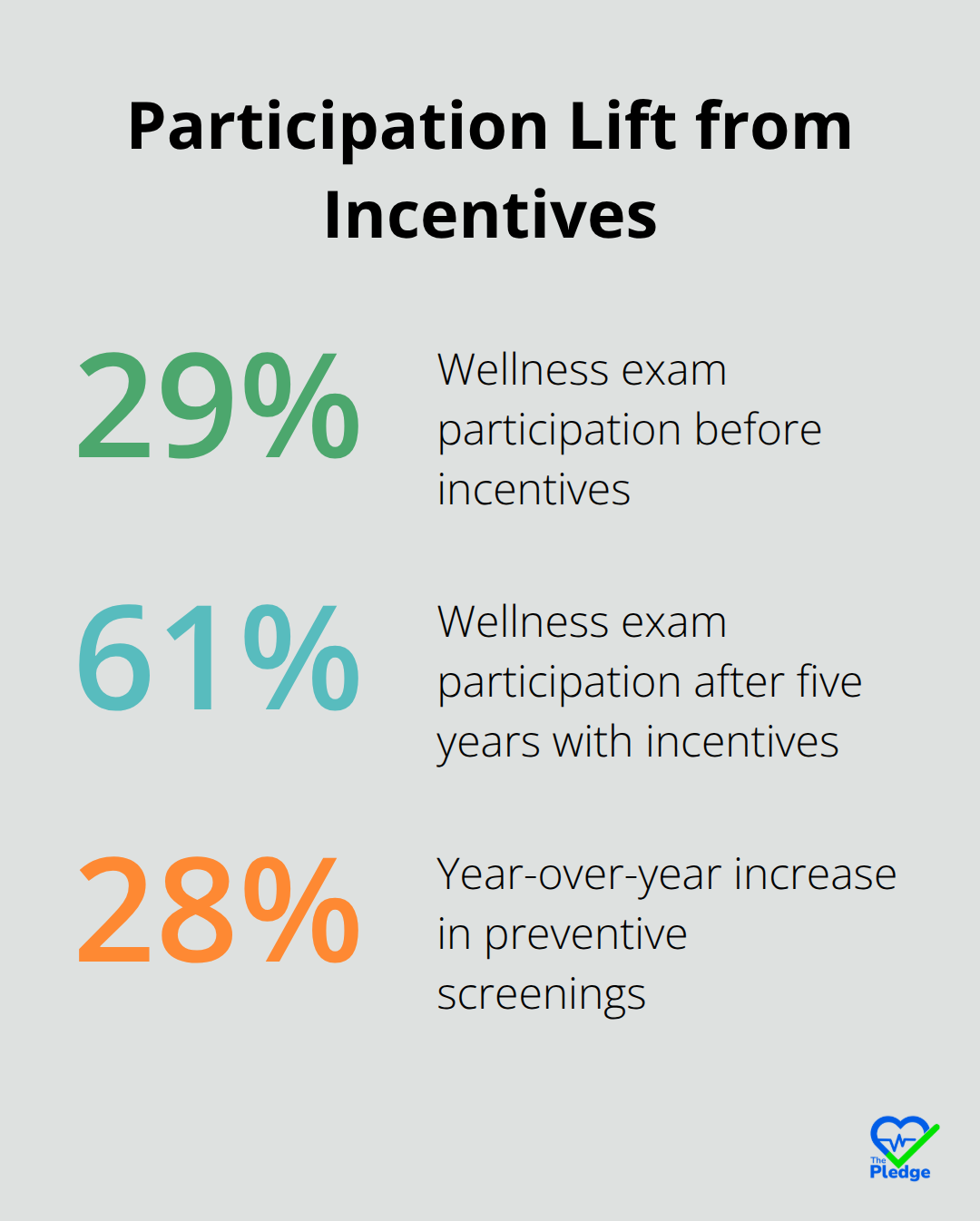
Employees earned discounts on cholesterol checks, diabetes screenings, colonoscopies, and mammograms. Preventive screenings increased 28% year-over-year, with the largest gains in screenings that directly catch early-stage disease.
The key insight: employees respond to financial rewards tied directly to wallets, especially when the reward arrives automatically without extra effort. Workplace wellness programs like Kaiser Permanente’s Federal Health Plan offer roughly $150 for completing health goals, while Blue Cross Blue Shield’s MyBlue provides up to $120. These aren’t massive sums, but they feel meaningful when stacked across a year. Small incentives under $10 fail to move the needle on complex behaviors like colorectal cancer screening. The threshold appears to sit somewhere between $20 and $100 depending on the screening type and population.
Gamification Requires Simplicity to Succeed
Tiered status systems like Bronze, Silver, Gold, and Diamond create psychological momentum. Employees see a clear path to the next level and keep accumulating points. However, complexity kills participation. Discovery Health’s South African incentive program showed that when reward mechanics become unclear or require too many steps, enrollment drops and people abandon the program entirely.
The most effective programs automate everything: claims trigger points, points convert to rewards, and employees see their progress in real time through an app. Pairing incentives with biometric screening options removes the final barrier. Mailed colorectal cancer screening kits combined with modest financial incentives outperform incentives alone.
Personalized Messaging Outperforms Generic Challenges
Targeted communications drive participation far better than broad health challenges. Sending an employee a message stating “Your age group should complete a colonoscopy and we’ll give you $50 for scheduling it” generates higher response rates than generic wellness challenges. Personalized messaging matters more than social competition because it speaks directly to individual risk factors and specific screening recommendations based on age and health history.
The strongest programs combine three elements: automatic reward mechanics, clear tiered progression, and personalized health messaging tied to individual risk factors. These components work together to remove barriers, clarify value, and motivate action without requiring employees to navigate complex systems or compete with colleagues.
Measuring ROI That Actually Matters
Connect Participation to Real Cost Savings
Tracking preventive care incentives requires measuring three distinct layers: whether employees actually participate, whether participation reduces downstream healthcare costs, and whether health outcomes genuinely improve. Most employers stop at layer one and declare victory when participation rates climb. That’s a mistake. Companies celebrate a jump from 29% to 61% participation in wellness exams without understanding what that participation actually saved or whether it stuck around. The real ROI emerges only when you connect participation to claims data, compare employees who engage with those who don’t, and measure outcomes over years rather than quarters.
Start by isolating the cost of the incentive program itself against measurable savings. The manufacturing company that implemented UMR’s Live Well Reward$ program spent money on premium discounts for participants, yet preventive screenings increased 28% year-over-year. That’s the baseline question: did the incentive spending pay for itself through reduced emergency room visits, fewer advanced-stage disease diagnoses, and lower chronic condition management costs? Early detection from increased cancer screenings and diabetes testing typically reduces treatment costs substantially, but you need actual claims data to prove it. Set up a control group-employees who didn’t participate in the incentive program-and compare their total healthcare spend against participants over a 24-month window. The AHRQ research on economic incentives found that one study estimated a cost of just $3 per additional immunization when using an incentive, meaning the program paid for itself almost immediately through prevented illness. Your numbers might look different depending on which screenings you incentivize, but the principle holds: measure the total cost of incentives against the total cost of care for incentivized versus non-incentivized employees.
Track Repeat Engagement, Not Just Initial Participation
Participation metrics alone mislead you. An employee who completes one colonoscopy because of a $50 incentive might never schedule another one after the reward ends. Programs that achieve sustained engagement show different characteristics than one-time boosters. Discovery Health’s South African program tracked enrollment over multiple years and found 7.5% annual dropout, meaning roughly one in thirteen participants left each year. That matters because sustained participation compounds savings-someone who gets screened every three years generates more value than someone screened once. Track not just initial participation but repeat engagement. If your incentive program drives 500 employees to get screened in year one but only 300 return in year two without additional incentives, your long-term ROI calculation changes dramatically. Programs that combine automatic reward mechanics with personalized messaging see higher retention. Employees who receive targeted alerts stating their age group should complete a colonoscopy and the company will reward completion participate more consistently than those in generic wellness challenges.
Measure Healthcare Utilization Shifts Over Time
Healthcare utilization patterns reveal whether incentives actually shift behavior or just shift timing. An employee might schedule a mammogram two months earlier because of an incentive but would have scheduled it anyway. That’s not real ROI-that’s acceleration. Real ROI shows up in metrics like emergency department visits per incentivized employee, hospital admissions for preventable conditions, and treatment intensity for chronic diseases. Employees who complete preventive screenings consistently show lower rates of advanced-stage cancer diagnoses, fewer diabetic complications, and fewer hypertensive crises. The Medicaid Incentives for the Prevention of Chronic Diseases program issued five-year grants to participating states, with final evaluation data showing measurable reductions in preventable hospitalizations among incentivized populations. Your claims system should flag these outcomes automatically-total admissions, admission reasons, length of stay, and cost per admission for participants versus non-participants. If your preventive care incentive program drives participation but doesn’t shift these utilization metrics within 18 months, the program isn’t working at the outcome level.
Document Health Outcome Improvements Through Claims Data
Document health outcome improvements through claims-based metrics rather than self-reported surveys. Employees completing diabetes screenings should show up in your claims data as having more HbA1c tests, more endocrinology visits, and more antidiabetic medication fills-all signs of active disease management. Employees completing cholesterol screening should show increased statin prescriptions if they have elevated lipids. These aren’t theoretical improvements; they’re measurable shifts in treatment patterns that correlate with better long-term health. Calculate the percentage of employees with diagnosed conditions who are actually on recommended medications before and after your incentive program launches. Many employers find that incentivizing screening uncovers undiagnosed hypertension or diabetes, which then requires treatment-that’s not a cost savings initially, but it becomes one within three to five years as these conditions are managed proactively instead of presenting as emergencies. Build financial models that account for this lag. Year one of a preventive incentive program might show increased costs as newly diagnosed conditions enter treatment. Year three typically shows net savings as complications decline.
Final Thoughts
The most effective preventive health incentive programs combine three core elements: automatic reward mechanics that require zero employee effort, clear financial value tied directly to employee wallets, and personalized messaging that addresses individual risk factors rather than generic health challenges. Programs that integrate these components drive participation from 29% to 61% and boost preventive screenings by 28% year-over-year, with financial rewards between $20 and $100 per screening moving behavior most effectively. Employers that clarify coverage through digital platforms, offer on-site or telehealth screening options, and send targeted age-based messaging sustain these gains long-term while addressing the three barriers that kill participation: cost confusion, scheduling friction, and awareness gaps.
Real ROI emerges only when employers measure beyond participation rates and examine claims data showing reduced emergency department visits, fewer advanced-stage disease diagnoses, and lower treatment intensity for chronic conditions. Early detection from increased screenings compounds savings over three to five years as preventable complications decline, with employees who engage consistently showing measurable shifts in treatment patterns-more HbA1c tests for diabetes management, increased statin prescriptions for cholesterol control, and proactive medication adherence that prevents crises. Programs that rely solely on incentives without removing structural barriers see participation spike initially then plateau or decline, making the combination of incentive design with friction reduction essential for sustained impact.
The path forward combines strategic incentive design with technology that centralizes health data and sends personalized reminders tied to individual preventive care needs. The Pledge integrates health information, delivers real-time reminders, and coordinates care across employees, providers, and employers to transform preventive health incentives into sustained behavior change that drives measurable cost savings and genuine health improvements.
![[Guide] Incentives That Drive Preventive Health Participation](https://thepledge.app/wp-content/uploads/emplibot/Guide_-Incentives-That-Drive-Preventive-Health-Participation_1783650286-300x168.jpeg)