

Workplace stress management directly affects your bottom line. When employees experience chronic stress, healthcare costs spike-both from increased medical claims and lost productivity.
At The Pledge, we’ve seen firsthand how organizations that prioritize stress reduction save money while improving employee wellbeing. This guide shows you exactly how.
How Stress Damages Employee Health
The Direct Health Toll of Chronic Workplace Stress
Chronic workplace stress doesn’t just make employees miserable-it systematically damages their bodies and minds in measurable ways. According to research from Harvard Business School, workplace stress contributes to approximately 120,000 deaths annually in the United States and accounts for 5-8% of national healthcare spending. Stress triggers direct physiological damage through elevated cortisol and inflammation, while simultaneously driving unhealthy behaviors like alcohol use, overeating, and poor sleep that compound the harm.
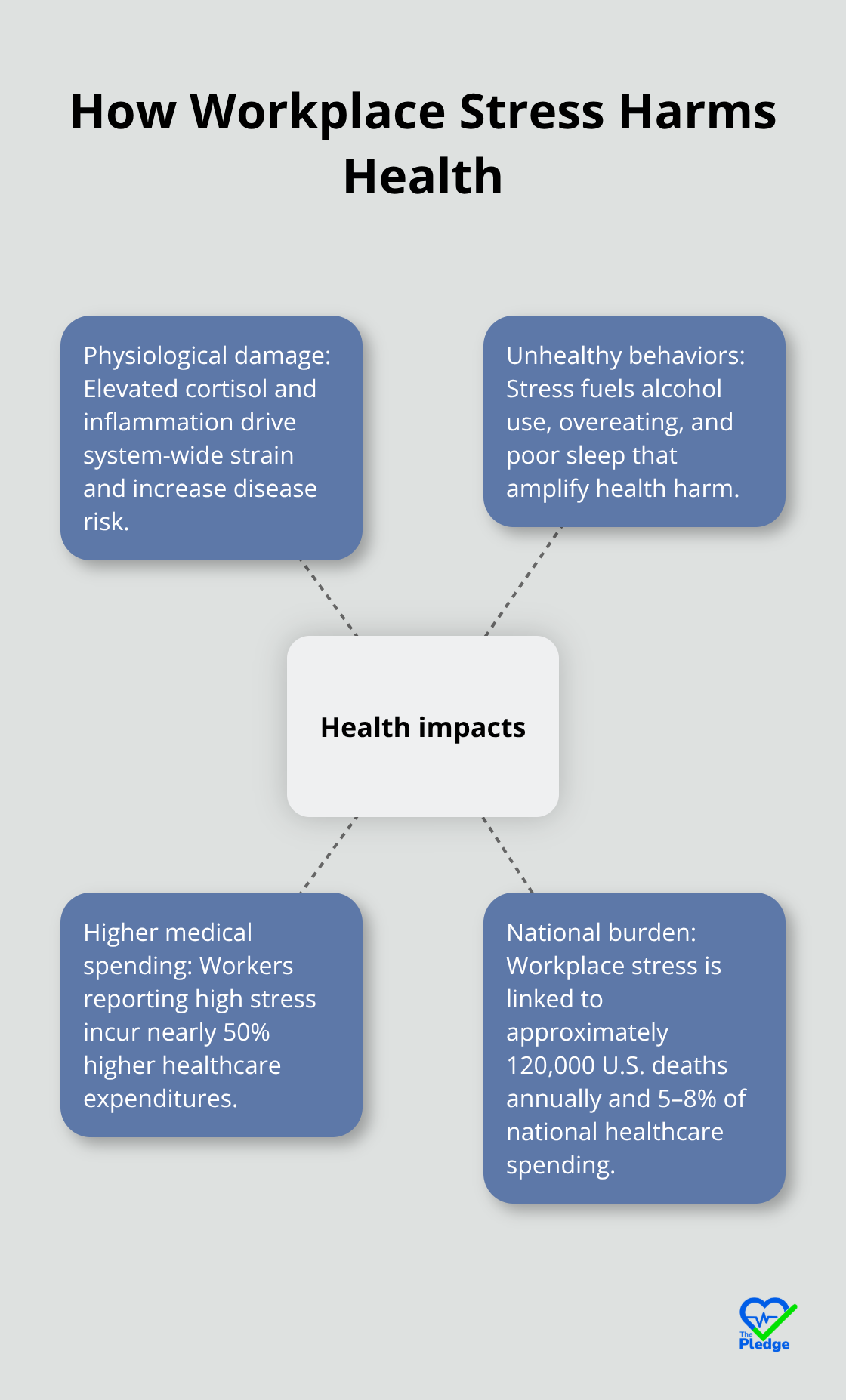
Healthcare expenditures run nearly 50% higher for workers reporting high stress levels, which explains why employers face such staggering costs when they ignore this problem.
Physical conditions tied to workplace stress include cardiovascular disease, hypertension, and weakened immune function, making employees vulnerable to infections and chronic illness. Insurance claims for stress-related industrial accidents cost nearly twice as much as non-stress-related claims, reflecting both the severity of stress-induced injuries and the compounding effect of mental distress on physical recovery.
Mental Health Deterioration and Financial Impact
Depression alone accounts for nearly 10 sick days per employee annually, and it’s the single largest predictor of work-related performance problems. When employees struggle with depression or anxiety, mental health deteriorates faster under sustained pressure, with burnout accounting for 15-20% of involuntary turnover according to Gallup research. For every dollar spent treating depression, another 53 cents disappears through absenteeism, presenteeism, and disability payments.
The connection between stress and preventable diseases is direct: high work demands alone generate roughly $48 billion annually in additional healthcare spending, while job insecurity and lack of control each contribute approximately $30 billion. Organizations that fail to address these health consequences essentially subsidize a deteriorating workforce while watching productivity collapse.
Comprehensive Wellness Programs Deliver Measurable Returns
The path forward requires treating stress reduction as a core health intervention, not a peripheral benefit. Comprehensive wellness programs that integrate mental health support, stress management coaching, and behavioral health referrals deliver a 3.6x ROI and $359 in savings per engaged employee per year. The most effective programs combine personalized health assessments with point-of-care biometric screening, nurse coaching, individualized wellness engagement plans, and direct referrals to behavioral health and employee assistance programs.
Organizations must recognize that traditional health programs fail when employees are too stressed to engage with them-the integration matters as much as the individual components.
Organizational Changes That Reduce Stress
Implementing these changes requires management practice overhauls alongside wellness initiatives: increasing employee control over work, balancing demands with realistic deadlines, providing predictable scheduling, and expanding access to flexible work arrangements all reduce stress-related health risks measurably. Leadership training that teaches managers to recognize and mitigate workplace stressors proves essential, as does measuring and tracking stressors to quantify the ROI of interventions. The data is unambiguous: investing in stress reduction now prevents the cascade of health problems that drain healthcare budgets for years.
These organizational shifts set the stage for the specific strategies that produce the strongest results-strategies we’ll examine in the next section.
The Real Price Tag of Workplace Stress
Direct Healthcare Costs Spike Under Stress
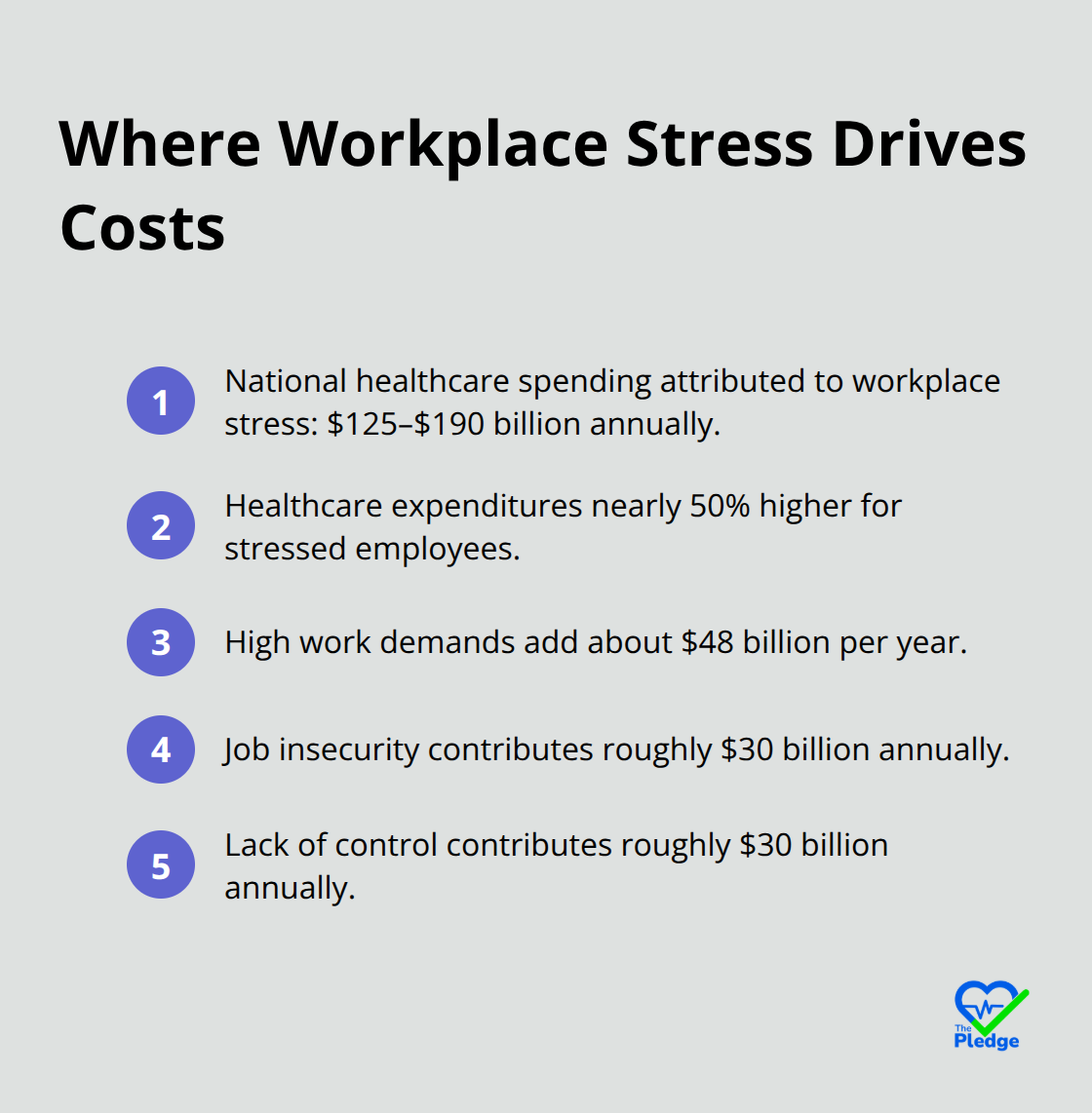
Workplace stress creates measurable financial damage across healthcare systems and employer budgets. The numbers demand attention. According to Harvard Business School research, workplace stress accounts for 5-8% of national healthcare spending, translating to an estimated $125 billion to $190 billion annually in direct medical costs and indirect expenses. A single stressed employee generates healthcare expenditures nearly 50% higher than a non-stressed peer, meaning your workforce’s stress levels directly correlate to your insurance premiums, claims processing, and long-term healthcare obligations. High work demands alone drive approximately $48 billion in annual healthcare spending, while job insecurity and lack of control each contribute roughly $30 billion. These costs concentrate among your highest-value employees-the ones you can least afford to lose to burnout or health crises.
Indirect Costs Compound Through Lost Productivity
The indirect financial damage runs deeper than medical claims. Depression costs employers significant expenses through absenteeism and presenteeism, with presenteeism inflicting the real damage: employees showing up but delivering minimal output. For every dollar spent treating depression, another 53 cents vanishes through absenteeism, presenteeism, and disability payments. Burnout accounts for 15-20% of involuntary turnover according to Gallup, and replacing an average employee costs 120-200% of their annual salary. A large company loses more than $3.6 million yearly to absenteeism alone.
Insurance and Workers Compensation Claims Rise
Insurance claims for stress-related industrial accidents cost nearly twice as much as non-stress-related claims, reflecting both severity and slower recovery. These costs compound silently across payroll systems, insurance reconciliations, and workers compensation claims-areas most finance teams don’t directly link to workplace stress. The lack of health insurance contributes approximately $40 billion in stress-related healthcare costs, while work-family conflict adds another $24 billion.
The Strategic Choice Ahead
Organizations that treat stress reduction as optional rather than strategic subsidize their own healthcare inflation year after year. The financial case for intervention has never been clearer. What separates high-performing organizations from the rest isn’t awareness of these costs-it’s action on proven strategies that actually move the needle on both employee health and spending.
Proven Strategies to Reduce Workplace Stress and Lower Healthcare Spending
Integrated Wellness Programs Deliver Measurable Returns
Comprehensive wellness programs produce results when they combine mental health support, stress management coaching, and behavioral health referrals into a unified system rather than scattered initiatives. The UR Wellness program, which serves healthcare and education sectors, generated a 4.90 ROI per dollar spent with annual savings of $1,224 per employee across all risk groups. For employees at cardiovascular risk, the ROI climbed dramatically to $35.40 per dollar for at-risk males and $19.20 for at-risk females, demonstrating that targeted stress-reduction efforts produce outsized financial returns. The program’s success relied on personalized health assessments, point-of-care biometric screening with nurse coaching, individualized wellness engagement plans that included 10-year cardiovascular disease risk calculations, and direct referrals to behavioral health and employee assistance programs.
This integration matters more than individual components because stressed employees often lack the capacity to navigate fragmented wellness offerings. A global logistics provider with 45,000 employees across 400 warehouses implemented a similar model through WellSteps Foundations since 2015, using mobile apps and online program centers to standardize stress-reduction activities across dispersed locations. Participants earned rewards points that converted to healthcare premium savings, linking wellness engagement directly to cost reductions. The program achieved measurable outcomes in nutrition, activity levels, and stress management while maintaining engagement across multiple shifts and locations.
Flexible Work Arrangements Address Root Causes
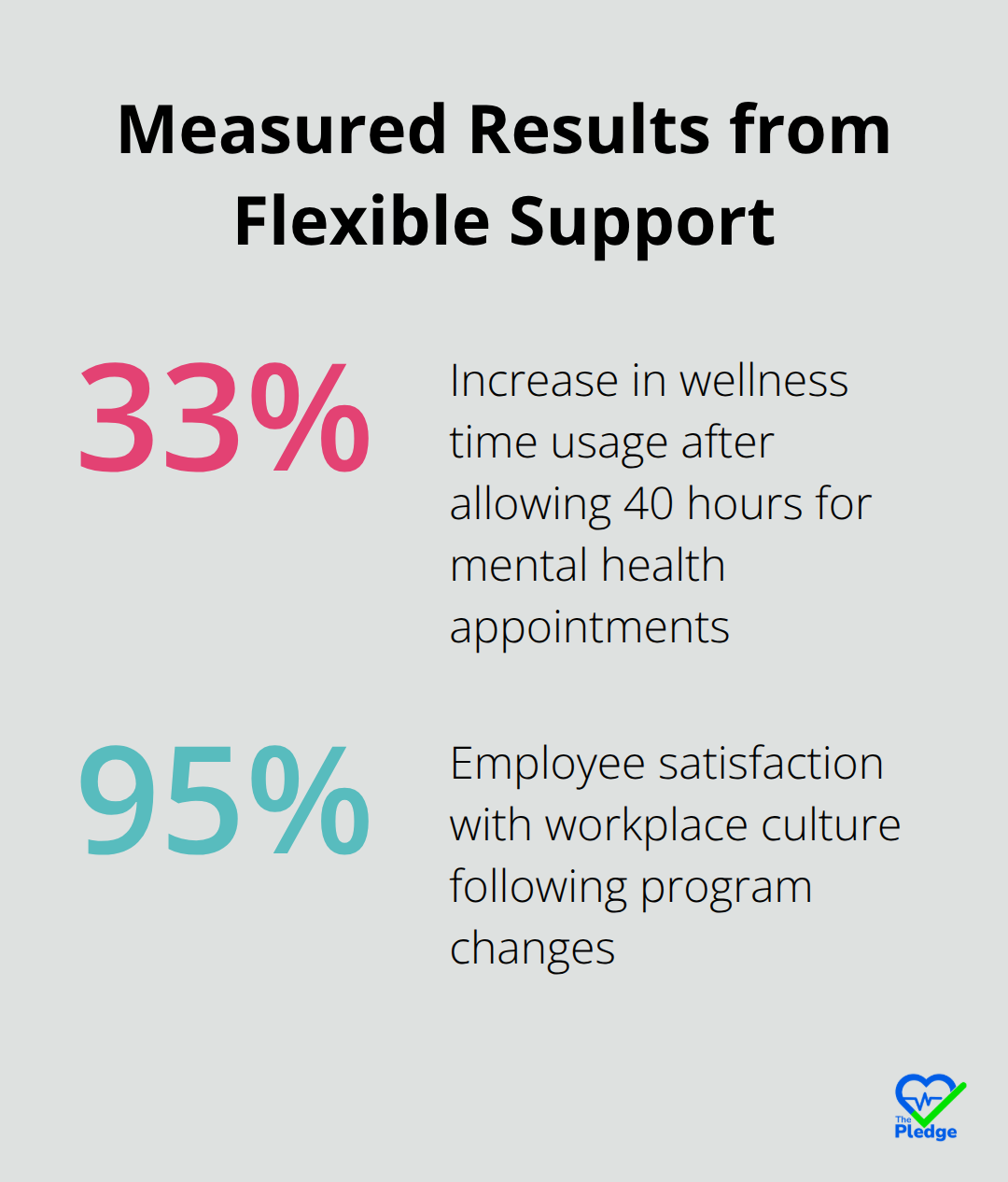
Flexible work arrangements and manager training address the organizational structures that generate stress in the first place, making them non-negotiable investments. Redesigning jobs to increase employee control, balance demands, and provide predictable scheduling directly reduces stress-related health risks according to research from Harvard Business School. Power Home Remodeling implemented employee assistance services that allowed workers up to 40 hours for mental health appointments without using vacation time, resulting in a 33 percent increase in wellness time usage and 95 percent employee satisfaction with workplace culture.
Baptist Health South Florida created a dedicated well-being team with pastoral care, crisis intervention, and a financial hardship fund, recognizing that stress extends beyond work demands into personal circumstances. These interventions require leadership buy-in that ties wellness to retention and business outcomes. Organizations that fail to invest in flexible arrangements essentially force employees to choose between their health and their paycheck.
Manager Training Transforms Workplace Culture
Manager training that teaches leaders to recognize and mitigate workplace stressors proves essential because individual wellness programs cannot overcome a toxic management culture. Leaders who understand stress triggers can redesign workflows, adjust deadlines, and create psychological safety that prevents burnout before it starts. Organizations must measure and track stressors systematically to quantify ROI and justify continued investment in stress-reduction initiatives rather than treating them as discretionary expenses. The data shows that organizations combining comprehensive wellness programs with structural changes and leadership development achieve the strongest results on both employee health and healthcare spending.
Final Thoughts
The evidence proves that workplace stress management directly impacts both employee health and organizational finances. Organizations that reduce workplace stress see immediate returns through lower healthcare claims, decreased absenteeism, and improved productivity. Comprehensive stress-reduction programs generate ROI ranging from 3.6x to 4.90x per dollar invested, with annual savings exceeding $1,200 per employee.
Implementation starts with measuring your current state-track stress levels, healthcare spending patterns, and turnover rates to establish a baseline. Then prioritize the changes that address your organization’s specific stressors, whether that’s workload management, scheduling flexibility, or mental health access. Leadership commitment matters more than budget size; organizations with executive sponsorship achieve faster adoption and stronger results.
We at The Pledge understand that managing employee health requires more than wellness programs. Our platform integrates seamlessly with existing health plans, providing real-time health insights and personalized reminders that support preventative care. Start today with The Pledge to assess your organization’s stress drivers, secure leadership buy-in, and implement integrated solutions that improve both employee wellbeing and healthcare spending.





![[Guide] Incentives That Drive Preventive Health Participation](https://thepledge.app/wp-content/uploads/emplibot/Guide_-Incentives-That-Drive-Preventive-Health-Participation_1783650286-300x168.jpeg)