

Employee burnout costs U.S. companies an estimated $322 billion annually in lost productivity. Yet many organizations still treat wellness as a nice-to-have rather than a strategic investment.
At The Pledge, we believe burnout prevention for employers starts with understanding the real numbers. When you invest in comprehensive wellness programs, you’re not just improving employee wellbeing-you’re protecting your bottom line.
What Does Burnout Actually Cost Your Organization
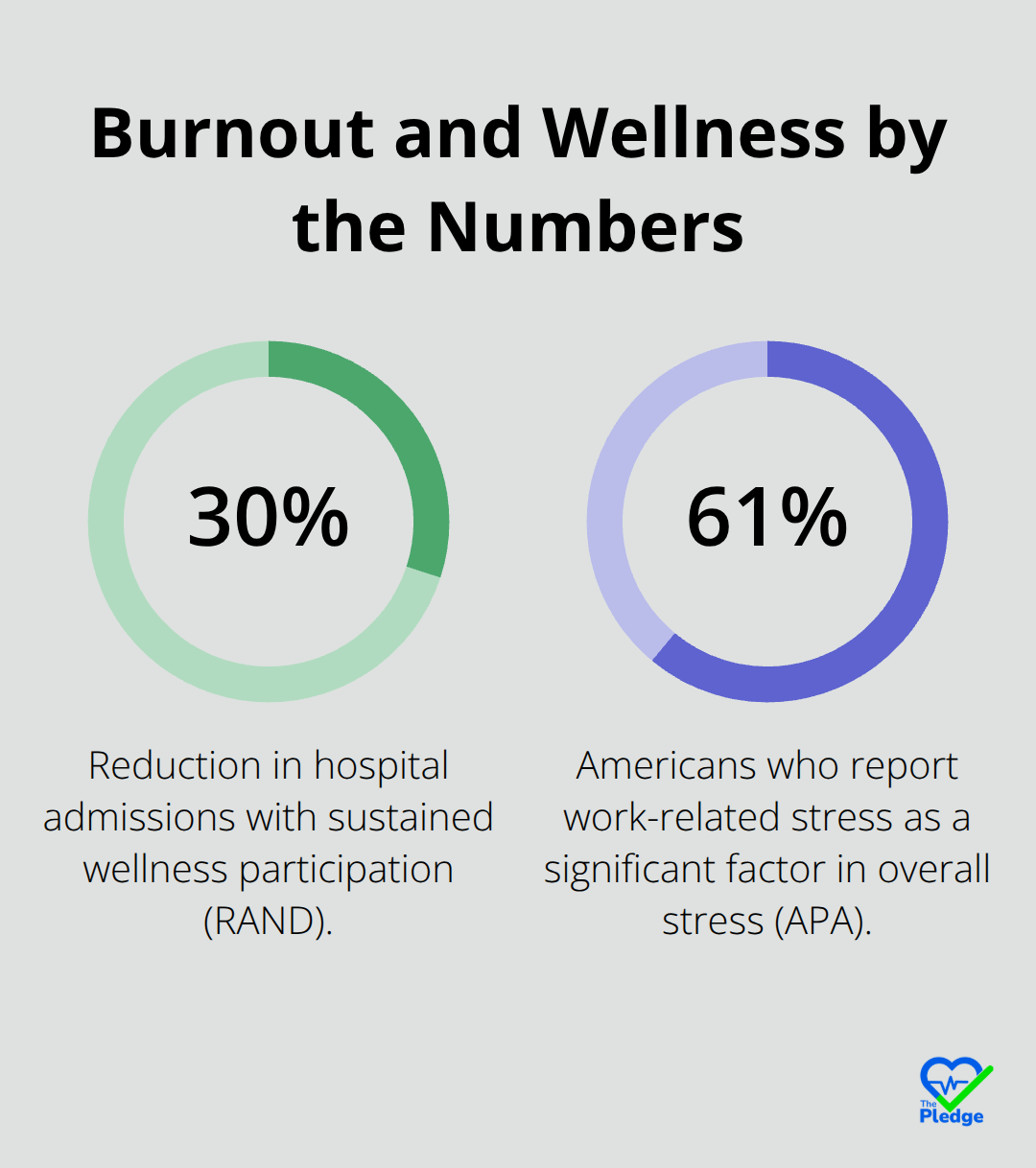
When you examine what burnout actually drains from your organization, the numbers become harder to ignore. The American Institute of Stress reports that job stress costs U.S. companies over $300 billion annually through accidents, absenteeism, turnover, and direct medical expenses. Your specific organization’s burnout rate directly correlates to how much you hemorrhage in healthcare costs and lost output. According to research from RAND Corporation, organizations with sustained wellness participation see a 30% reduction in hospital admissions and $136 saved per member per month in medical claims. That’s not theoretical savings-those are real cost reductions that show up in your annual benefits spend. The American Psychological Association found that 61% of Americans report work-related stress as a significant factor in their overall stress levels, which means your workforce isn’t compartmentalizing these problems.
Healthcare Expenses Rise When Burnout Goes Unaddressed
Burnout doesn’t just affect productivity metrics. It directly inflates your healthcare spend because burned-out employees use more medical services, take more sick days, and develop chronic conditions at higher rates. When employees transition from high-risk to low-risk health status through structured wellness interventions, medical claim costs decline measurably. A Harvard Business Review case study tracked 185 workers in a six-month program and found that high-risk individuals moved to low-risk status, reducing medical claim costs by $1,421 per participant. That’s the ROI you’re looking for: $6 saved for every $1 invested. The RAND Corporation’s 10-year wellness data showed that disease management programs-the interventions targeting chronic conditions like diabetes, heart disease, and depression-accounted for 86% of hard healthcare cost savings. If your organization isn’t targeting burnout-related health risks through disease management and mental health resources, you’re leaving massive savings on the table.
Retention and Productivity Losses Accelerate Without Intervention
Burnout doesn’t create gradual decline; it creates turnover. Randstad research shows 60% of employees would leave their job over a bad manager, while 58% would stay with a great one. That gap is burnout in action. When you combine poor management with unsustainable workloads and inadequate recovery time, retention becomes your biggest hidden cost. Replacing a single employee costs 50-200% of their annual salary depending on role and industry. If your organization has even moderate burnout across 20% of your workforce, you’re looking at turnover costs that dwarf what you’d invest in a comprehensive wellness strategy. The productivity drain compounds because burned-out employees who stay become disengaged-they show up physically but contribute at reduced capacity. The Wharton pilot study on capacity-building interventions showed that 41% of respondents dreaded work before intervention, and that dropped to 19% afterward. More telling: 91% felt productive at work after the program versus 67% before (a 24-percentage-point swing in actual work effectiveness). When you multiply that across your entire organization, you’re talking about meaningful gains in output and quality.
Why These Costs Matter Now
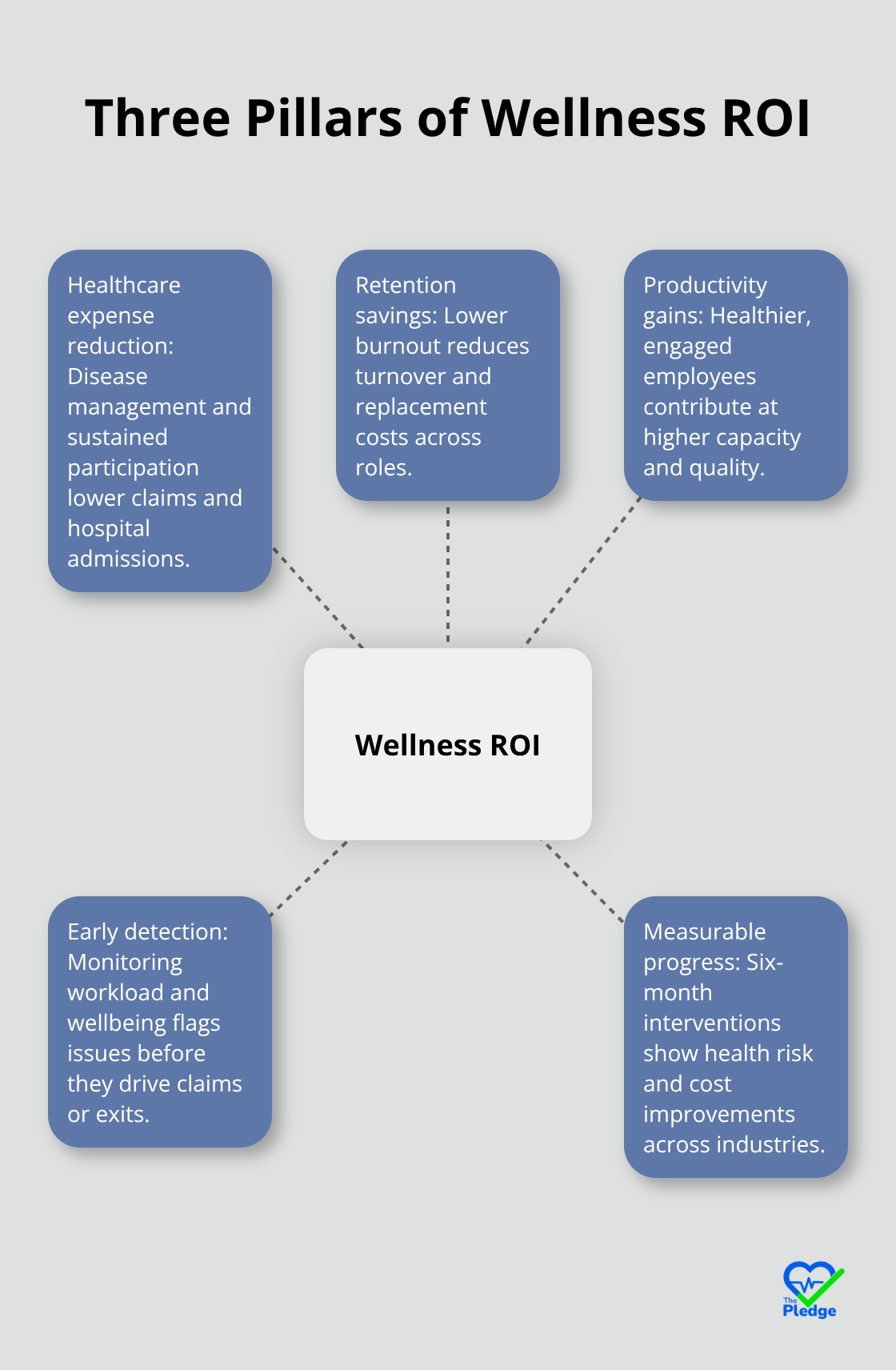
The financial case for wellness investment rests on three pillars: healthcare expense reduction, retention savings, and productivity gains. Most employers offering wellness programs (56% according to RAND) include disease management components specifically because they move the needle on costs. Organizations that measure and act on burnout indicators-workload levels, vacation usage, and wellbeing signals-identify problems before they compound into turnover and medical claims. The data shows that six-month interventions produce measurable improvements in health risk status and cost savings, supporting burnout reduction efforts across diverse industries and workforce sizes.
Understanding these costs positions you to make the case for wellness investment internally. The next step is building a strategy that actually addresses the root causes of burnout in your organization, not just treating the symptoms.
Building Your Wellness Strategy Without Guessing
Start With Data, Not Assumptions
The biggest mistake organizations make is launching a wellness program without understanding what actually drains their workforce. You need data before you spend money. Run a health risk assessment across your employee population to identify which health conditions, stress levels, and behavioral patterns drive your costs and burnout. RAND Corporation data shows that 80% of employers with wellness programs use Health Risk Assessments and biometric screening, and for good reason-these tools reveal where your actual problems live. If 40% of your workforce has uncontrolled hypertension or depression, a generic yoga class won’t move your needle.
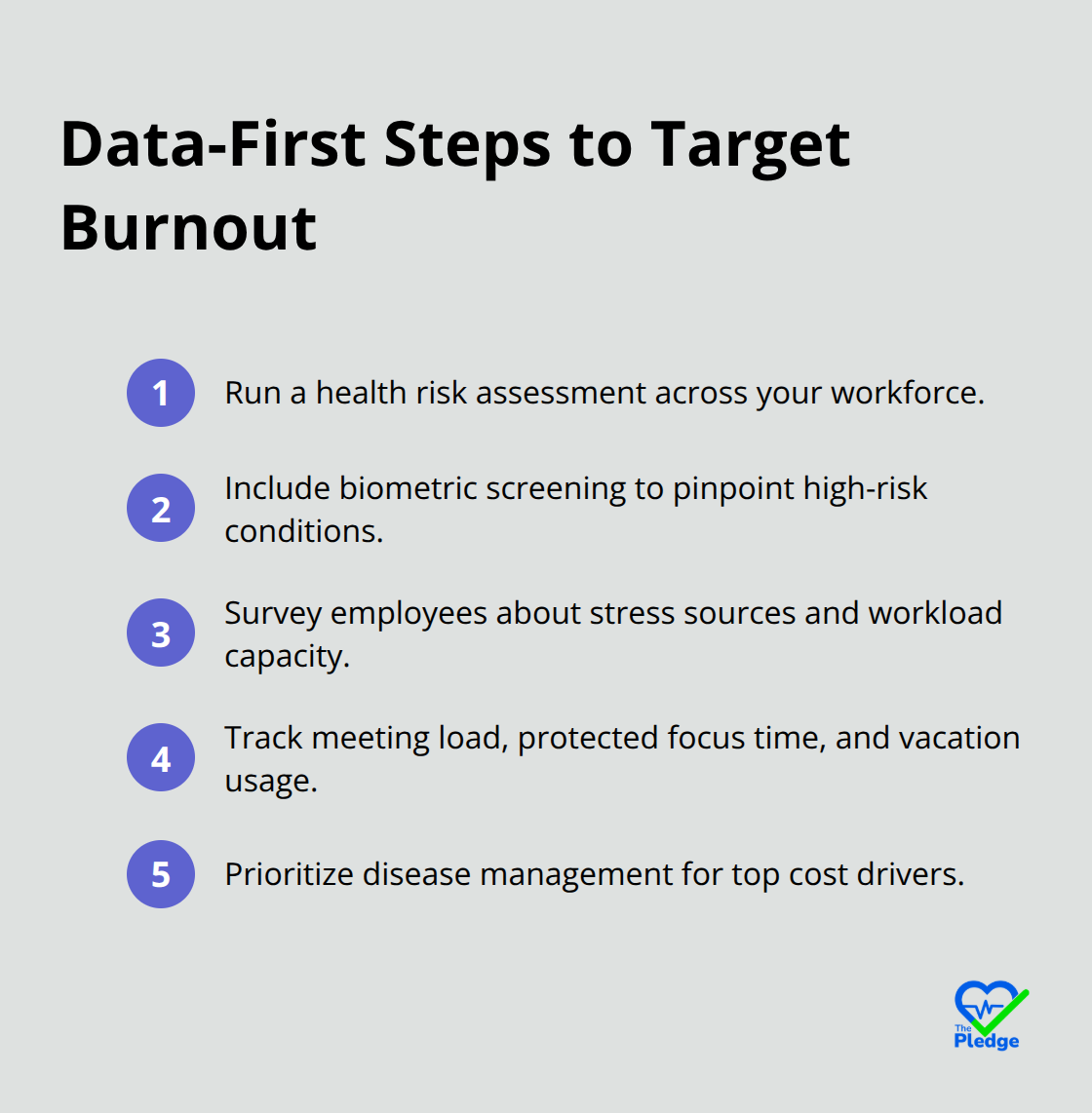
A targeted disease management program for those conditions will.
The BMJ Open systematic review of workplace interventions found that 29 out of 33 studies showed positive outcomes when programs matched the actual health needs of the population, but only when organizations moved beyond one-size-fits-all approaches. Survey your employees directly about their stress sources, workload capacity, and what recovery looks like for them. Ask about meeting load, protected focus time, and whether they take vacation. These operational signals matter more than generic wellness offerings because they show you where burnout gets manufactured in your daily work rhythms.
Layer In Mental health resources and Stress Management
Once you’ve diagnosed your specific burnout drivers, add mental health resources and stress management tools that address root causes, not just symptoms. The Wharton pilot study showed that capacity-building coaching combined with structural work changes-like protected focus time and clearer prioritization-moved 41% of people who dreaded work down to 19%. That’s the kind of impact you’re looking for.
Implement an Employee Assistance Program with mental health counseling; the ROI exceeds $8 for every $1 invested according to Morneau Shepell data. Pair that with stress-management modules delivered in short, accessible formats because employees won’t complete hour-long programs during their workday. Walking meetings of about 20 minutes with clear agendas help employees recharge while maintaining productivity, and this tactic works especially well for small groups handling updates and problem-solving.
Enforce Structural Changes and Recovery Time
Then tackle the structural piece: flexible work arrangements and genuinely protected recovery time. Organizations that allow remote work reduce commuting stress and give employees time-management flexibility. Implement clear hybrid policies so people aren’t guessing about expectations. More important, enforce norms around after-hours work and vacation usage. The U.S. Travel Association found that 52% of workers didn’t take all their vacation days in 2017, which signals a culture problem, not an employee problem. Set a leadership example by shutting down before holidays and protecting your own time off. When leaders model recovery, employees follow.
Prioritize Disease Management and Incentivize Participation
RAND data shows that incentives drive participation-69% of employers use financial rewards for wellness engagement-so consider small incentives for completing health screenings or attending stress-management sessions. Disease management programs targeting chronic conditions should account for the largest portion of your investment because they drive 86% of hard healthcare savings according to RAND’s 10-year analysis. Pair these with lifestyle management components like nutrition support and fitness programs, but measure participation and outcomes quarterly so you know what’s working and what’s wasting budget.
The real power emerges when you stop treating wellness as a standalone benefit and start treating it as a system that addresses how work actually gets done. Your next step involves measuring whether these investments actually stick and produce the financial returns you’re counting on.
Proving Your Wellness Investment Actually Works
Separate Disease Management From Lifestyle Metrics
Tracking whether your wellness program delivers real value requires measuring three distinct outcomes: participation rates, healthcare cost changes, and retention improvements. Most organizations measure the wrong things. They track how many employees attended a yoga class or completed a health screening and call that success. That’s participation theater. What matters is whether those activities moved health costs down, kept people in their seats, and improved how much work they actually accomplish. Lifestyle management can reduce health risks such as smoking, obesity, and lack of physical activity. If you invested $200,000 in your wellness program and 15% of that went to disease management targeting diabetes and depression while 85% went to gym memberships, you’re measuring the wrong outcome. Track disease management participation and outcomes separately, then compare the cost per participant against the medical claim reduction you see in that cohort.
Monitor Medical Claims and Cost Reduction Quarterly
Healthcare cost reduction is where the financial case becomes concrete. A Harvard Business Review case study found that J&J’s leaders estimate that wellness programs have cumulatively saved the company $250 million on health care costs over the past decade. That’s significant cost reduction from sustained intervention. RAND’s 10-year wellness data found organizations with sustained participation achieved a 30% reduction in hospital admissions and $136 saved per member per month in medical claims. Start measuring medical claims 90 days after employees enter your program, not immediately, because health changes take time to show up in claims data. Pull quarterly reports comparing claims costs for program participants against non-participants in your organization. If your non-participants show $1,200 in monthly claims and your active program participants show $1,064, that $136 monthly difference per person compounds to serious annual savings. Track this metric for at least 18 months because the RAND data suggests long-term participation produces the strongest cost reductions.
Calculate Retention Value and Turnover Savings
Employee retention directly connects to your bottom line and wellness investment. Measure voluntary turnover specifically among employees who participated in your wellness program versus those who didn’t. If your overall turnover is 18% but wellness program participants show 12% turnover, that difference translates to retention value. Calculate the cost of replacing those retained employees (typically 50-200% of salary depending on role) and compare it against your wellness program investment. A Wharton pilot study showed that 41% of employees dreaded work before capacity-building intervention, dropping to 19% afterward. That reduction in dread correlates directly to retention. Track this through pulse surveys or exit interview data asking whether workload, recovery time, and management support influenced their decision to stay or leave.
Combine Metrics to Calculate True ROI
The strongest ROI emerges when you combine all three metrics. RAND found organizations with disease management components achieved an overall ROI of $1.50 for every $1 invested, but disease management alone showed $3.80 ROI. That’s your target: focus 40-50% of your wellness budget on disease management for conditions driving your claims costs, measure the cost reduction quarterly, and compare it against retention savings and productivity gains from the lifestyle and stress-management components. Organizations that measure and act on burnout indicators-workload levels, vacation usage, and wellbeing signals-identify problems before they compound into turnover and medical claims. The data shows that sustained wellness interventions produce measurable improvements in health risk status and cost savings, supporting burnout reduction efforts across diverse industries and workforce sizes.
Final Thoughts
Wellness investment prevents burnout because it addresses the actual mechanisms that drain your workforce: unsustainable workload, operational friction, and inadequate recovery. The financial case is no longer theoretical. Organizations that implement comprehensive wellness strategies see measurable reductions in healthcare costs, meaningful improvements in retention, and significant gains in employee productivity. A Harvard Business Review case study showed $6 saved for every $1 invested, while RAND Corporation’s 10-year data demonstrated $136 in monthly medical claim savings per participant and a 30% reduction in hospital admissions.
Burnout prevention for employers requires three concrete actions. First, diagnose your specific burnout drivers through health risk assessments and direct employee feedback about workload, meeting load, and recovery time. Second, layer in disease management programs targeting the conditions driving your claims costs, paired with mental health resources and stress-management tools that address root causes. Third, enforce structural changes like flexible work arrangements and genuinely protected recovery time, then measure outcomes quarterly across healthcare costs, retention, and productivity.
Wellness becomes sustainable when you stop treating it as a standalone program and start treating it as part of how work actually gets done. If you’re ready to move beyond generic wellness offerings and implement a system that centralizes health data, tracks outcomes in real time, and drives measurable engagement, The Pledge can help you coordinate care and simplify health management across your entire workforce.