
Your employees’ medical records are scattered across different doctors’ offices. Their care teams rarely talk to each other. Preventative care gets missed.
At The Pledge, we’ve seen how a care guidance platform fixes these problems by bringing everything together in one place. When health data is centralized, coordination improves, costs drop, and employees actually stay healthier.
Why Your Employees’ Health Data Stays Fragmented
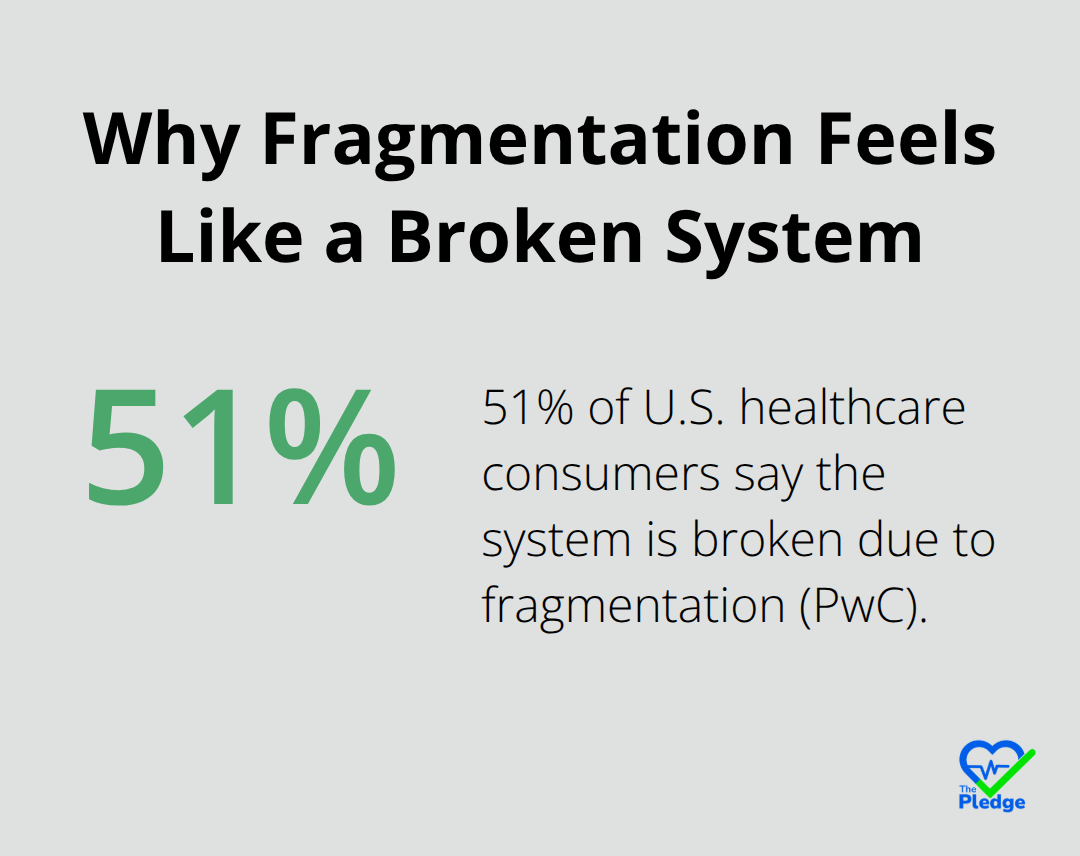
Your employees visit their primary care doctor, see a cardiologist at a different hospital system, and fill prescriptions at three different pharmacies. None of these providers can see what the others are doing. According to research from PwC, 51% of healthcare consumers say the system is broken, and fragmentation is a primary reason. When medical records live in separate silos, care teams operate independently rather than as a coordinated unit. A patient with diabetes might receive conflicting medication advice from their endocrinologist and their primary care physician simply because neither has access to the other’s notes. This isn’t a minor inconvenience-it directly impacts health outcomes and drives unnecessary costs.
The Administrative Burden Falls on Employees
Fragmentation forces employees to become their own care coordinators, a role they’re not equipped to handle. They must remember which provider ordered which test, manually transfer records between offices, and repeat their medical history at every appointment. This administrative burden leads to missed follow-ups, duplicate testing, and preventative care falling through the cracks. A patient scheduled for a colonoscopy might miss the appointment because the reminder came through mail and got lost, while the provider’s system never connects with the employee’s calendar or phone. Meanwhile, employers absorb the cost of preventable hospitalizations and emergency room visits that could have been caught earlier with proper coordination.
Communication Gaps Create Clinical Risks
Poor communication between care teams creates direct clinical risks. An employee on blood thinners for atrial fibrillation visits an orthopedic surgeon for a knee injury, but the surgeon doesn’t know about the anticoagulation therapy because records didn’t transfer. The surgeon recommends a procedure that carries bleeding risks, and the employee ends up in the hospital. These gaps in communication happen thousands of times daily across American healthcare. Employees with chronic conditions like COPD or congestive heart failure are particularly vulnerable-they need coordinated monitoring across multiple specialists, but instead they get fragmented care.
The Productivity and Cost Impact
Research from PwC’s 2025 US Healthcare Consumer Insights Survey found that more than 40% of consumers have used virtual visits, yet most still experience disconnected care because their data isn’t unified. Employers lose productivity when employees spend time managing their health instead of working, and they lose more when preventable complications force employees into extended absences. The financial impact compounds: duplicate tests, unnecessary procedures, and delayed diagnoses all add up. A centralized platform that connects all of an employee’s health information-from lab results to medication lists to specialist notes-eliminates these coordination failures. This is where the transformation begins.
How a Care Guidance Platform Unifies Your Employees’ Health
Real-Time Data Integration Eliminates Fragmentation
A care guidance platform acts as the central nervous system of your employees’ healthcare, pulling together medical records, lab results, medication lists, and specialist notes into a single accessible location. Instead of a patient calling their cardiologist’s office to request records, waiting days for a fax, then manually uploading them to their primary care portal, everything syncs in real time. The platform integrates with providers’ electronic health record systems, insurance company data, and pharmacy records so that the moment a lab test comes back or a prescription is filled, that information appears in the employee’s health dashboard. This isn’t theoretical efficiency-it’s practical consolidation that removes hours of administrative friction. Research from PwC shows that employers and health systems need a unified data repository to identify variation and design efficient care pathways. A centralized platform delivers exactly this.
Coordinated Care Prevents Dangerous Gaps
Employees with chronic conditions like diabetes or COPD benefit most from this consolidation because their care involves multiple specialists monitoring the same metrics. When an endocrinologist can see that the primary care physician already adjusted insulin dosing last week, they don’t duplicate the intervention. When a pulmonologist views the employee’s recent ER visit notes, they understand the context for adjusting respiratory medications. Real-time coordination between providers eliminates conflicting medical advice and prevents dangerous drug interactions. Providers stop ordering redundant tests because they access complete lab histories instantly. Care coordination across teams makes faster, more informed decisions when they operate from the same dataset rather than fragmented records scattered across different systems.
Automated Reminders Drive Preventative Care Engagement
Personalized reminders transform preventative care from something employees hope to remember into something the platform actively manages. Instead of generic annual checkup notices, the system sends targeted reminders based on each employee’s specific health profile and gaps in care. An employee due for a colonoscopy receives a reminder that includes the actual appointment availability at their preferred location, eliminating the need to call and schedule separately. An employee with uncontrolled hypertension gets a reminder to check their blood pressure and sees their recent readings displayed alongside target ranges, creating accountability. The platform integrates with employees’ personal calendars and sends reminders through their preferred communication channel-text, email, or app notification-dramatically improving follow-through.
Measurable Impact on Cost and Utilization
Care navigation platforms deliver measurable impact on employer outcomes. A Northeast ACO using a unified care platform reported reductions in emergency department visits for COPD patients while serving more patients with the same care management team. That result came directly from better coordination, faster identification of at-risk patients, and timely interventions triggered by integrated data. When employees receive coordinated care with real-time visibility into their health metrics, preventable complications drop sharply, and unnecessary hospitalizations decline. The financial gains compound as fewer emergency visits translate into lower claims costs and reduced absenteeism.
Moving Beyond Data Integration to Outcomes
Consolidating health data solves the immediate problem of fragmentation, but the real power emerges when that unified information drives smarter clinical decisions and employee engagement. The next step involves understanding which employees face the highest risks and how to reach them with interventions that actually work.
What’s the Real Financial Impact of Care Unification
Early Intervention Cuts Costs Before Complications Emerge
Employers focus on premium increases and claims costs, but the genuine financial opportunity lies deeper. When health data fragments across providers, employees experience preventable complications that trigger expensive interventions. A care guidance platform eliminates this waste through early identification and coordinated action, delivering measurable cost reductions within months rather than years. The Northeast ACO using unified care coordination reported a 41.5% reduction in emergency department visits for COPD patients, a shift that directly translates to lower claims costs and reduced administrative burden on the same care team.
This isn’t theoretical savings-it’s concrete utilization reduction driven by better visibility into which employees need intervention before they deteriorate into acute episodes. When your organization consolidates health data, you identify patterns instantly: employees with uncontrolled diabetes before they develop complications, patients with early-stage heart disease before they require hospitalization, individuals missing preventative screenings before serious conditions emerge. Targeted interventions at these early stages cost a fraction of emergency care or advanced treatment.
Variation Reduction Drives Efficiency Across Your Workforce
A unified platform delivers the foundation for identifying variation and designing efficient care pathways. The financial case strengthens further because early intervention reduces absenteeism directly. Employees managing chronic conditions proactively miss fewer work days than those experiencing preventable exacerbations, and this productivity gain compounds across your workforce.
Engagement Amplifies Financial Returns
Employee engagement amplifies the financial impact beyond cost reduction. When employees actively engage with their health data, they follow treatment plans more consistently, attend preventative appointments, and report health issues earlier. This behavioral shift matters financially because engaged employees generate lower claims costs than disengaged populations.
Employers measuring ROI should track three metrics simultaneously: claims cost reduction from early intervention, productivity gains from reduced absenteeism, and engagement rates as a leading indicator of sustained health improvement. Organizations implementing care guidance platforms typically see measurable ROI within 12 months because the cost reductions from reduced emergency utilization appear immediately in claims data, while productivity improvements surface in attendance records and performance metrics.
Talent Retention Strengthens the Financial Picture
The competitive advantage extends beyond finances-employers offering coordinated, simplified health management attract and retain talent more effectively than those forcing employees to navigate fragmented systems independently. Talent retention itself reduces hiring and training costs substantially (an often-overlooked component of the total financial picture). When employees experience seamless care coordination and real-time access to their health information, they stay with their employer longer, reducing turnover costs.
Final Thoughts
Fragmented healthcare creates real costs for employers and real frustration for employees. A care guidance platform transforms this dynamic by centralizing health data, enabling coordinated decision-making, and driving engagement through personalized reminders and real-time visibility. The financial impact appears immediately: reduced emergency department visits, fewer preventable complications, lower absenteeism, and claims cost reductions within months rather than years.
Employers who implement centralized care coordination gain a competitive advantage in talent retention. Employees experience simplified health management instead of navigating disconnected systems independently, and they access their complete health picture in one place with timely reminders for preventative care. This experience matters when competing for talent in tight labor markets, as employees stay longer with employers who simplify their health management and strengthen organizational stability through reduced turnover costs.
The Northeast ACO’s 41.5% reduction in emergency department visits for COPD patients demonstrates what becomes possible when health data flows seamlessly across providers and care teams operate from unified information. Learn more about how The Pledge transforms health management for your workforce and discover the financial and talent retention benefits waiting on the other side of fragmentation.
![[Guide] Incentives That Drive Preventive Health Participation](https://thepledge.app/wp-content/uploads/emplibot/Guide_-Incentives-That-Drive-Preventive-Health-Participation_1783650286-300x168.jpeg)