
Your family’s health records are probably scattered across different doctors, hospitals, and clinics. When you need information fast-during an emergency or a specialist visit-finding the right documents becomes frustrating and time-consuming.
At The Pledge, we believe family health documentation should be organized in one place. Centralized records help you make better decisions, avoid duplicate tests, and catch health issues before they become serious problems.
Where Are Your Family’s Medical Records Right Now?
The Scattered Reality of Family Health Information
Most families have no idea where their health information actually lives. One child’s immunization records sit with the pediatrician. Last year’s lab work from a specialist is trapped in a hospital portal you haven’t logged into in months. Your spouse’s medication list exists only in their primary care doctor’s notes. When you need this information-during an emergency room visit, at a new specialist appointment, or when making a treatment decision-you call multiple offices, wait for faxes, and piece together a fragmented picture of your family’s health.
This fragmentation isn’t just inconvenient; medical records fragmentation impacts healthcare quality and patient safety. Patient data remains scattered across separate systems with no unified access. Your family’s information might live in five different portals, none of which talk to each other.
Real Problems Created by Disconnected Records
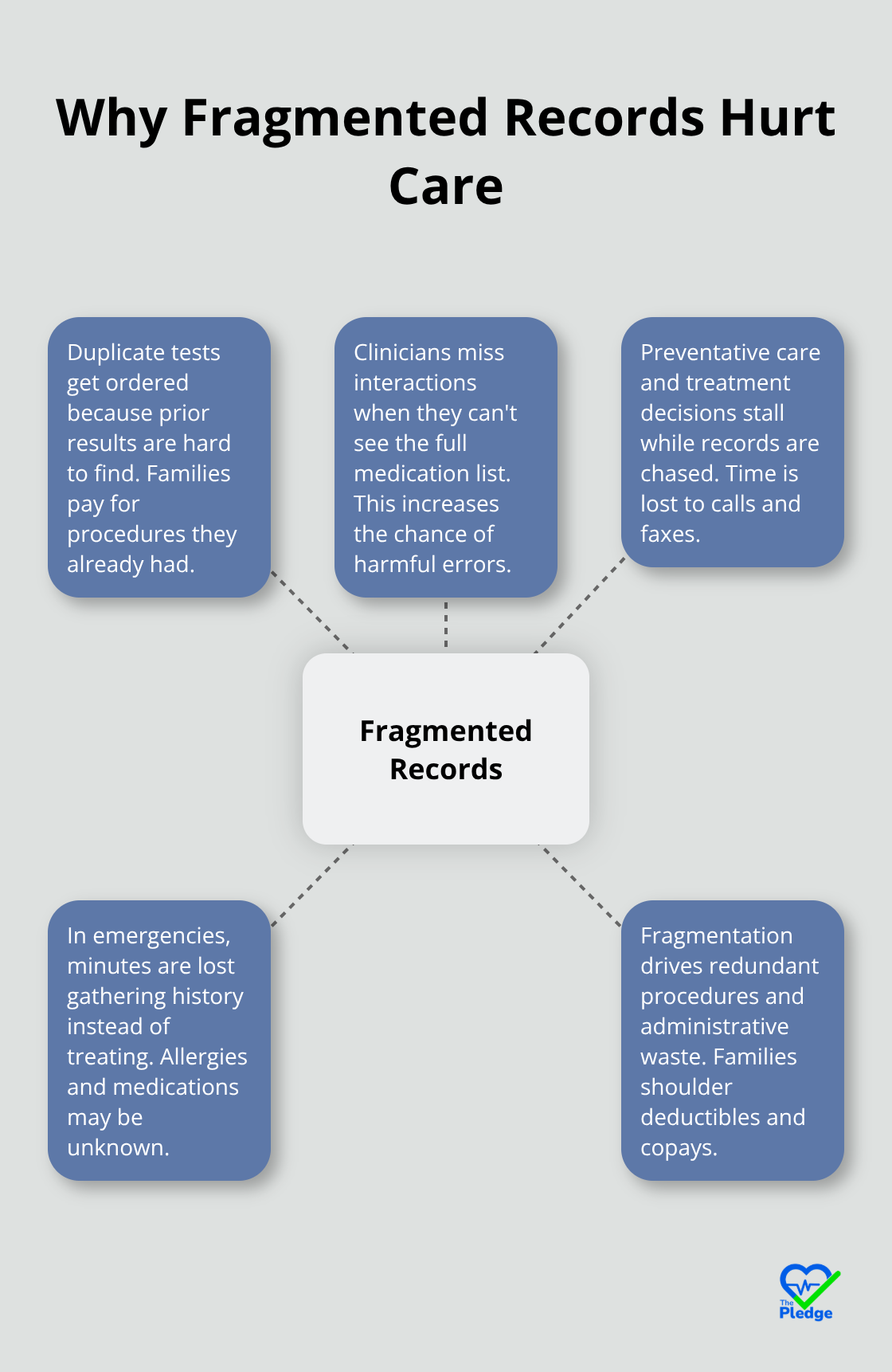
This creates measurable problems. Duplicate tests get ordered because no one can find the original results. Medication interactions go unnoticed because prescribers can’t see what other doctors prescribed. Preventative care gets delayed because screening records are impossible to track across multiple providers. Fragmented records lead to higher costs, redundant procedures, and missed opportunities to catch health problems early.
When an emergency happens-your child has a severe allergic reaction, your parent has a fall-precious minutes are lost searching for medical history instead of focusing on immediate treatment. Caregivers arrive at emergency rooms unable to tell clinicians about critical allergies or current medications simply because that information was locked away in disconnected systems.
How Fragmentation Undermines Chronic Care Management
The real cost of fragmentation extends beyond inconvenience to patient safety. Caregivers often over- or under-estimate what information providers actually have, leading to miscommunication about treatment plans and medication changes. When you coordinate care across multiple specialists for a chronic condition-managing your child’s asthma with a pediatrician, pulmonologist, and allergist-coordination improves care planning, diagnosis and treatment, and patient coaching to improve treatment adherence. Each provider works with incomplete information when records remain fragmented.
The World Health Organization framework emphasizes that families should be able to access and control their health data, yet current fragmented systems make this nearly impossible. Centralized documentation solves this problem by creating a single source of truth for every family member’s medications, allergies, chronic conditions, and medical history across all providers. When information lives in one organized place under your control, you share it instantly with new providers, reduce duplicate testing, spot medication conflicts before they happen, and respond faster during emergencies.
This isn’t about technology for its own sake-it’s about giving your family the information advantage that healthcare systems should have provided decades ago. The next step is understanding exactly how centralized documentation transforms the way you and your providers work together.
What Changes When Your Family’s Health Data Connects
Centralized health documentation transforms how your family interacts with healthcare providers. When all your records live in one accessible place, communication shifts from fragmented phone calls and lost paperwork to real-time coordination. A 2010–2019 evidence review found that electronic medical records reduce costs and improve healthcare quality, and centralized systems amplify these benefits by ensuring every provider sees the same current information. Instead of repeating your child’s allergy history to three different specialists, you share one verified record. Instead of waiting days for faxed test results, you access them immediately and forward them to whoever needs them.
Access Information When You Actually Need It
Real-time access to health data matters most during high-stakes moments. When your child arrives at an emergency room with an unknown reaction, the ER doctor needs medication history, allergies, and recent lab work instantly-not in two hours when records arrive through fax. Immediate access to complete medical history reduces medication errors and improves treatment decisions. A centralized system means caregivers pull up critical information from a phone or tablet in seconds. You know exactly what medications your aging parent takes because the list updates automatically when prescriptions change. You spot that two different doctors prescribed overlapping medications because you see everything in one place. During a secure telehealth appointment with a new specialist, you share the relevant records directly through a secure link instead of wasting time explaining your family’s medical history. Centralized documentation eliminates the burden of manual record management entirely.
Coordinate Care Across Specialists Without Information Loss
Managing chronic conditions across multiple providers requires perfect information flow. When your child has asthma managed by a pediatrician, pulmonologist, and allergist, each specialist needs to know what the others prescribed and observed. Fragmented records mean each provider makes decisions with incomplete data. Centralized documentation ensures that when the pulmonologist adjusts your child’s inhaler, the pediatrician and allergist see that change immediately and can adjust their own treatment plans accordingly. Families should participate actively in care coordination across multiple specialists, yet fragmented systems make this nearly impossible. With unified records, you become the coordinator-you see the full picture and alert providers to conflicts or gaps they might miss. You notice that your parent’s blood pressure medication interacts with a new antibiotic their urgent care doctor prescribed because you have access to both prescriptions in real time. You prevent a potentially serious drug interaction before it happens. This level of coordination doesn’t require constant communication with providers; it requires one system where information updates automatically and everyone works from the same source of truth.
Transform Your Role in Healthcare Decisions
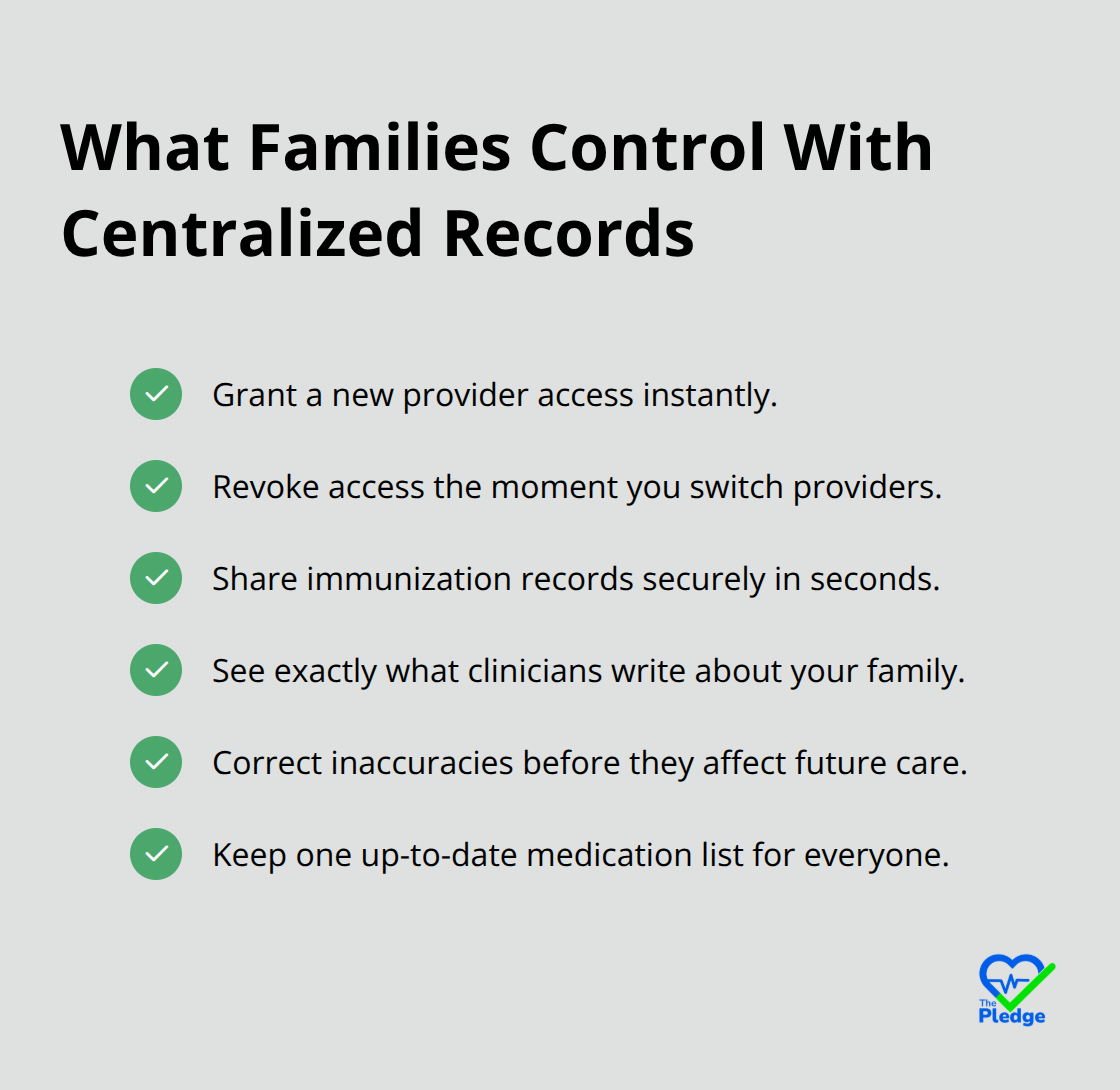
Centralized records shift power back to families. Instead of hoping providers have complete information, you control what gets shared and with whom. You grant access to a new pediatrician without repeating your child’s entire medical history. You revoke access instantly if you switch providers. You see exactly what notes clinicians write about your family members and can correct inaccuracies before they influence future care. This transparency strengthens the relationship between families and providers because both sides work from verified facts rather than incomplete recollections. When your parent’s three different doctors finally see the same medication list, treatment plans align instead of conflict. When your child’s school nurse needs immunization records, you share them securely in seconds rather than requesting official copies from the health department. The shift from fragmented chaos to organized control fundamentally changes how quickly and confidently your family navigates healthcare.
Stop Paying for Tests You Already Had
Duplicate testing ranks among the costliest failures of fragmented health records. When providers cannot access previous results, they order the same blood work, imaging, or diagnostic tests again. Electronic medical records reduce costs and improve healthcare quality, yet families still face redundant procedures because their records remain scattered. Stop paying for duplicate tests; unnecessary tests can cause patient discomfort, patient harm, and increase health care costs. When your child’s pediatrician orders a CBC (complete blood count) without knowing that the pulmonologist ordered one three weeks earlier, you pay twice. When your parent’s cardiologist repeats an echocardiogram because the hospital’s system does not connect to the clinic’s records, insurance covers some costs but your deductible resets. Centralized documentation eliminates this waste entirely. A unified record means your new specialist sees exactly what tests were completed, when they were completed, and what the results showed. No more ordering because information is missing. No more insurance claims for duplicate procedures. No more delays while waiting for old records to arrive through fax.
Medication Safety Requires Complete Information
Medication errors happen when prescribers cannot see the full picture of what a patient takes. Your primary care doctor prescribes an antibiotic without knowing your parent takes a blood thinner, creating a dangerous interaction. Your child’s allergy medication conflicts with a decongestant a different doctor prescribed, but nobody notices because the prescriptions exist in separate systems. These are not theoretical risks. Medication safety requires complete information across all providers, yet fragmented records make coordination impossible. Centralized documentation gives every provider instant access to current medications, supplements, over-the-counter drugs, and allergies. When a specialist considers a new prescription, they see immediately whether it conflicts with existing medications. When your parent’s dosage changes, all their doctors see the update in real time instead of learning about it months later during a routine appointment. You spot dangerous combinations yourself because you have access to the complete medication list. You notice that two different doctors prescribed overlapping pain medications or that a new prescription contradicts an allergy you documented years ago. This visibility prevents serious adverse events, reduces emergency room visits caused by drug interactions, and keeps your family safer than any fragmented system ever could.
Chronic Conditions Demand Coordinated Care Across Multiple Specialists
Managing a chronic condition across multiple providers requires perfect information flow between everyone involved in treatment. When your child has asthma managed by a pediatrician, pulmonologist, and allergist, each specialist needs to know what the others prescribed, observed, and adjusted. Fragmented records mean each provider makes decisions with incomplete data, leading to redundant treatments, conflicting recommendations, and wasted time. Centralized documentation ensures that when the pulmonologist adjusts your child’s controller medication, the pediatrician and allergist see that change immediately and can adjust their own treatment plans accordingly. You coordinate care without constant phone calls because information updates automatically. You prevent one specialist from undoing another’s work because everyone works from the same source of truth. You spot patterns across providers that no single doctor might notice alone. Your parent’s diabetes management improves because their endocrinologist, primary care doctor, and cardiologist all see the same glucose readings, medication adjustments, and lab work in real time.
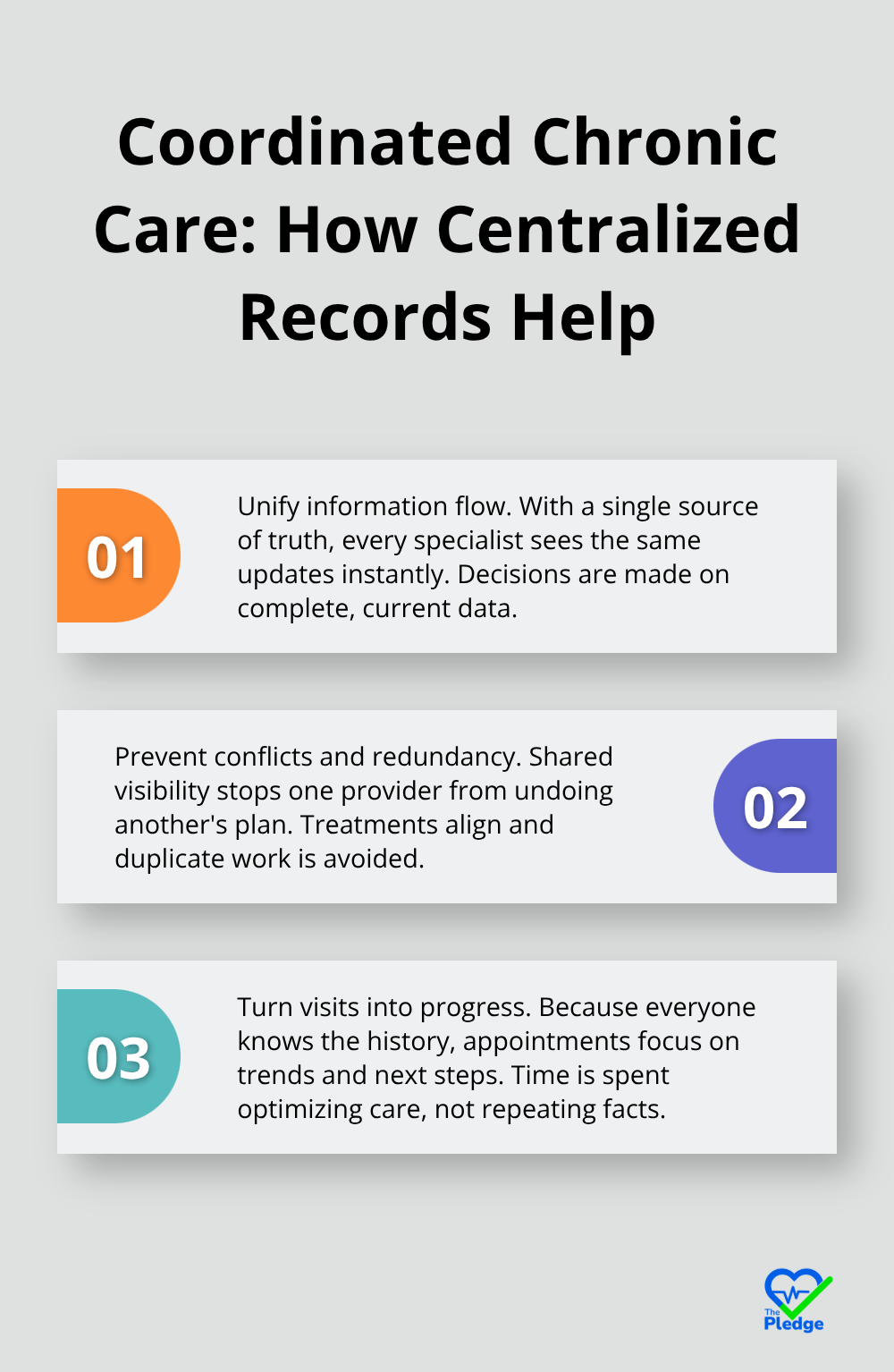
Follow-up appointments focus on progress rather than repeating history. Each provider contributes their expertise to a unified strategy instead of working in isolation.
Final Thoughts
Centralized family health documentation transforms how your family navigates healthcare. When your records live in one organized place under your control, you stop wasting time searching for old test results, prevent dangerous medication interactions before they occur, and coordinate care across multiple specialists without repeating your family’s history. You respond faster during emergencies because critical information reaches you in seconds rather than hours through faxes and phone calls.
The financial impact compounds over time as you eliminate duplicate tests, prevent medication errors that trigger emergency room visits, and catch health problems early through coordinated preventative care. A 2010–2019 evidence review confirmed that electronic medical records reduce costs and improve healthcare quality-centralized systems amplify these benefits by ensuring every provider works from the same verified information. Centralized documentation also shifts power back to your family, letting you control what gets shared, with whom, and when.
We at The Pledge help you organize your family’s health information in one secure platform that centralizes vital medical data, benefits, and real-time health metrics. Your family’s health deserves better than scattered records and disconnected providers.
![[Guide] Incentives That Drive Preventive Health Participation](https://thepledge.app/wp-content/uploads/emplibot/Guide_-Incentives-That-Drive-Preventive-Health-Participation_1783650286-300x168.jpeg)