
Employees skip doses, miss refills, and stop taking medications altogether-and it costs employers billions. When workers don’t take their prescriptions as directed, chronic diseases worsen, absences spike, and healthcare expenses climb.
At The Pledge, we’ve seen firsthand how prescription adherence programs transform employee health outcomes and company bottom lines. The right approach turns medication compliance from a struggle into a sustainable habit.
The Real Cost of Skipped Doses
When employees fail to take medications as prescribed, the damage extends far beyond individual health. In 2021, roughly 44% to 76% of adults did not follow their medication regimen, and that inconsistency translates directly into workplace chaos. Poorly controlled chronic diseases mean more sick days, reduced focus during work hours, and a measurable dip in output. An employee managing uncontrolled diabetes or hypertension isn’t just struggling with their health-they’re costing the company productivity hours that never recover.
The financial reality is staggering. Nonadherence cost the healthcare system approximately $529 billion in 2016 alone, and employers absorb a significant portion of that burden through higher insurance premiums, increased emergency room visits, and preventable hospitalizations. When a diabetic employee skips doses and lands in the ER with a blood sugar crisis, that single visit can cost thousands. When an asthma patient stops taking controller medications and gets admitted to the hospital, the expense balloons to tens of thousands. Medication adherence programs targeting asthma patients can reduce asthma-related medical costs by roughly $15 to $20 monthly per employee while simultaneously improving symptom control and reducing emergency visits. The H-E-B case study demonstrated this clearly: reducing copayments from $20–$30 down to $5, paired with education and patient support services, increased medication adherence significantly and generated measurable medical cost savings. For employers offering health plans, the math is unavoidable-investing in adherence programs pays back through reduced hospitalizations, fewer emergency interventions, and lower total healthcare spending.
Where Productivity Actually Suffers
Uncontrolled chronic disease doesn’t announce itself with dramatic symptoms every day. Instead, it erodes productivity quietly through presenteeism, where employees show up but operate at reduced capacity. A worker managing poorly controlled hypertension experiences fatigue and brain fog. Someone with untreated asthma can’t concentrate because they’re managing breathing difficulties. The Mayo Clinic Proceedings research consistently links nonadherence to worse health outcomes, including more absences and lower job performance. Employers rarely connect these dots back to medication adherence, instead attributing productivity losses to other factors. The connection is direct: when employees adhere to their medication regimens, they experience fewer disease-related complications, better energy levels, and sharper mental clarity. Type 2 diabetes patients who maintain consistent medication adherence achieve better HbA1c levels, meaning fewer diabetes-related emergencies that force time off work. Asthma patients who take their controller medications regularly have fewer exacerbations and can participate fully in their jobs without struggling through shifts.
The Hidden Math on Healthcare Spending
Employers typically focus on premium increases and fail to realize how much of their rising costs stem from preventable complications tied to nonadherence. Individual nonadherence costs can range from approximately $5,271 to $52,341 per member annually (depending on the condition and severity). That range reflects the reality that some employees experience minor complications while others face major hospitalizations entirely preventable through consistent medication use. Copayment barriers worsen the problem-employees with higher out-of-pocket costs skip doses or refills more frequently, triggering a cascade of complications. Programs that reduce copayments for high-value medications, like controller inhalers for asthma, directly increase adherence and reduce downstream costs. The investment in adherence infrastructure-reminders, education, pharmacist support, and financial assistance-costs far less than managing the preventable emergencies and hospitalizations that result from nonadherence.
What Moves the Needle on Adherence
Three distinct levers control whether employees actually take their medications. Simplifying regimens matters enormously-once-daily dosing or fixed-dose combination pills reduce missed doses far more effectively than complex multi-pill schedules. Reducing out-of-pocket costs removes a major barrier; employees with affordable access to medications refill prescriptions consistently. Regular contact from healthcare providers through phone calls, text reminders, or app notifications keeps medications top-of-mind and builds accountability. These interventions work because they address the real obstacles employees face: forgetfulness, cost concerns, and confusion about why they need the medication. When employers combine two or three of these strategies, adherence rates climb measurably and healthcare costs fall. The next section explores how to structure these strategies into a program that actually sticks.
What Actually Works to Boost Medication Adherence
Employers often assume that telling employees to take their medications will solve the problem. It won’t. Adherence requires removing friction from the process itself, starting with how medications are dispensed and tracked.
Synchronization and Smart Reminders
Medication synchronization programs align all of an employee’s refill dates into a single monthly visit, eliminating the chaos of staggered pickups and forgotten prescriptions. When an employee picks up insulin, blood pressure medication, and a cholesterol drug on the same day each month, adherence rates climb measurably because the routine becomes habitual rather than scattered. Smart pill organizers that pair with smartphone apps send reminders only when a dose is actually missed, reducing alert fatigue that plagues generic reminder systems. Research shows that behavioral strategies combining reminders with open communication outperform passive notifications alone, meaning the technology works best when paired with a human touchpoint. Employers should insist that their pharmacy partners offer synchronization as a standard service, not an add-on, because the cost savings from improved adherence dwarf the minimal expense of coordinating refills.
Reducing Financial Barriers
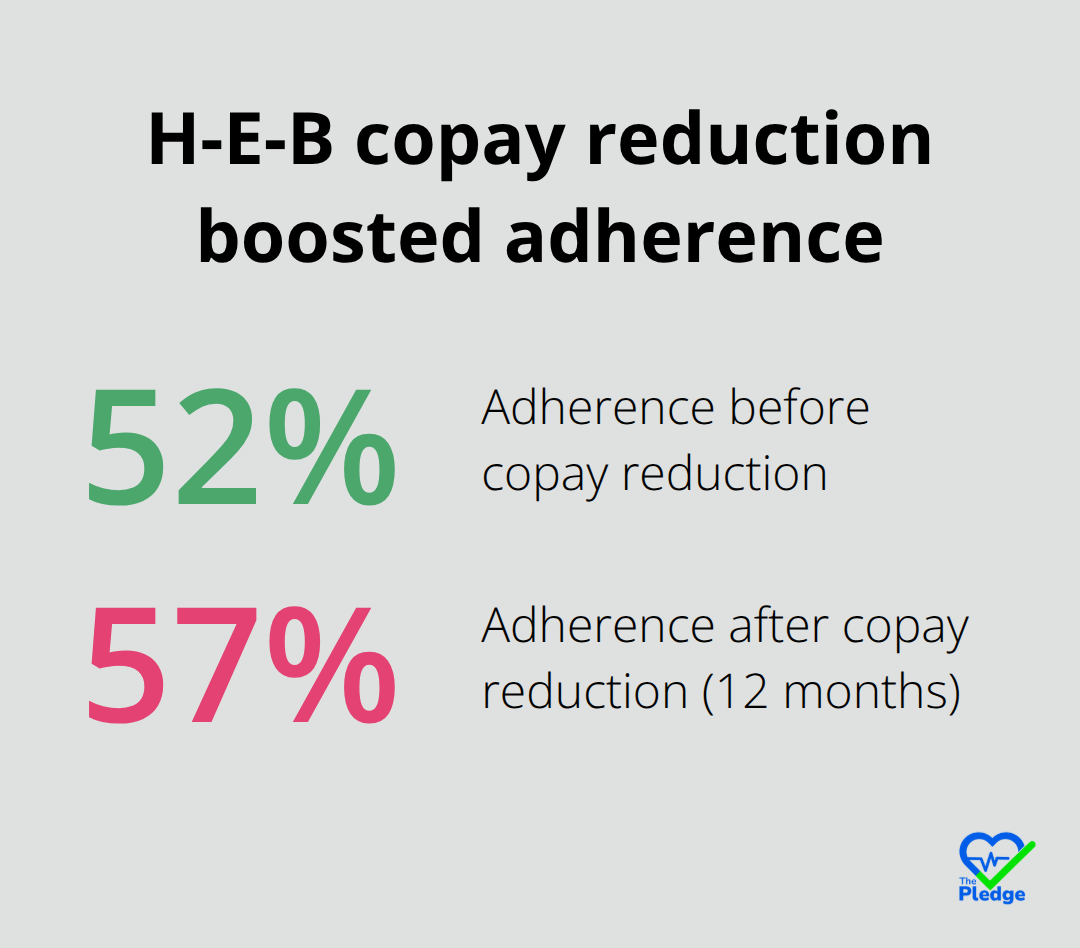
Reducing copayments specifically for high-value medications like asthma controller inhalers or diabetes management drugs removes a major barrier that keeps employees from filling prescriptions in the first place. The H-E-B case study proved this directly: lowering copayments from $20–$30 to $5 for asthma controller medications increased adherence from roughly 52% to 57% within twelve months while simultaneously reducing asthma-related medical costs.
Once-daily or once-weekly dosing formulations matter far more than employers realize because they dramatically reduce the cognitive load of remembering multiple doses throughout the day. Fixed-dose combination pills that merge two or three medications into a single tablet accomplish the same goal. These aren’t nice-to-have conveniences; they’re essential design features that employers should demand from their pharmacy and benefits partners when negotiating plans.
Education and Personalized Contact
Education delivered at the moment of prescribing, not weeks later, shapes whether employees actually understand why they need their medications and what happens if they skip doses. Pharmacists should spend time explaining the connection between medication adherence and real consequences that matter to employees: fewer missed workdays, better energy levels, reduced risk of emergency room visits. One-on-one conversations with healthcare professionals beat generic printed materials because they allow for questions and address individual concerns about side effects or costs. Text message reminders sent from providers to patients about upcoming refills work because they arrive when employees are making daily decisions, not buried in an inbox with dozens of other messages. Telehealth consultations remove the friction of traveling to an office for a quick medication question, meaning employees actually reach out when they have concerns instead of abandoning their regimen silently.
Real Results From Behavioral Engagement
Employers should prioritize programs that combine three specific elements: simplified dosing schedules, reduced out-of-pocket costs, and regular contact from healthcare providers through channels employees actually use. Wellth, an mHealth platform that uses daily reminders paired with financial incentives earned within an app, reports approximately 90% adherence among its users, demonstrating that behavioral engagement paired with meaningful rewards drives sustained compliance. Among Wellth users, asthma and diabetes patients see measurable improvements in clinical outcomes, including a 43% reduction in high-cost utilization and a 29% reduction in emergency room visits. These results reflect what happens when adherence programs address the actual reasons employees skip medications: forgetfulness, cost concerns, and lack of understanding about why consistency matters. The next step involves measuring whether these strategies actually work within your organization and building incentive structures that reinforce the behaviors you want to see.
Building a Sustainable Adherence Program
Track Adherence With Real Data
Adherence programs without clear measurement systems become expensive guesses. The Medication Possession Ratio (MPR) calculates the percentage of days an employee has medication available based on pharmacy refill records and reveals true adherence patterns. An MPR of 80% or higher signals strong adherence; anything below 50% indicates serious problems requiring immediate intervention. Track MPR monthly rather than quarterly because shorter intervals reveal trends fast enough to act before employees abandon their regimens entirely. Beyond MPR, monitor refill rates directly-how many employees actually pick up their prescriptions on schedule-and correlate these numbers against healthcare utilization patterns. When refill rates climb 10%, watch for corresponding drops in emergency room visits and hospitalizations within 60 to 90 days. The H-E-B asthma program demonstrated this clearly by monitoring monthly adherence metrics and adjusting their copayment strategy based on real data. Employers should also measure the asthma controller ratio, which compares controller medications to rescue inhalers; a ratio above 0.75 indicates employees are using preventative medications consistently rather than relying on emergency treatments. Share monthly adherence dashboards with pharmacy partners, benefits consultants, and plan sponsors so everyone sees whether the program actually works.
Connect Incentives to Actual Adherence Behaviors
Incentive structures fail when they feel disconnected from medication adherence itself. The most effective approach ties financial rewards directly to adherence behaviors rather than offering generic wellness bonuses. Wellth’s platform demonstrates this model: users earn financial incentives within their app when they confirm medication adherence daily through photo verification, and those rewards apply toward groceries, gas, or home repairs-genuine needs that matter to working employees. This approach generates strong engagement among participants because the reward arrives immediately after the desired behavior, not months later. Resist the urge to create complex tiered systems; simplicity drives participation. A straightforward offer-earn $50 monthly for maintaining 80% or higher MPR on chronic disease medications-works better than a convoluted point system that employees struggle to understand. Partner with payors and pharmacy benefit managers to align incentives across the entire system because fragmented incentives create confusion. When the insurance company offers a copayment reduction while the employer offers a separate cash reward, employees lose track of what they’re actually earning. The most sustainable programs consolidate incentives into a single clear offer managed through one channel. Employers should also recognize that some employees respond better to clinical outcomes than financial incentives; offering a choice between cash rewards or priority access to specialty care removes friction for different employee preferences.
Final Thoughts
Prescription adherence programs work because they address the real obstacles employees face: forgetfulness, cost barriers, and confusion about medication necessity. When employers reduce copayments, simplify dosing schedules, and maintain regular contact with employees through their preferred channels, adherence rates climb and healthcare costs fall measurably. Asthma patients experience emergency room visits drop by 29%, diabetes patients achieve better blood sugar control, and employees miss fewer workdays while operating at full capacity.
The financial case proves straightforward: spending money now on reminders, education, and copayment reductions costs far less than managing the complications that result from nonadherence. Employers who invest in adherence infrastructure reduce preventable hospitalizations, lower total healthcare spending, and build a workforce that shows up ready to work. Three concrete steps launch an effective program-measure adherence using the Medication Possession Ratio and track refill rates monthly, consolidate incentives into one clear offer tied directly to adherence behaviors, and partner with your pharmacy benefit manager to align incentives across the entire system.
We at The Pledge understand that healthcare complexity drives nonadherence, and our platform removes that friction by centralizing medical information, sending personalized reminders, and coordinating care across your entire health ecosystem. Visit The Pledge to see how a unified health management system transforms employee health outcomes while lowering your costs.
![[Guide] Incentives That Drive Preventive Health Participation](https://thepledge.app/wp-content/uploads/emplibot/Guide_-Incentives-That-Drive-Preventive-Health-Participation_1783650286-300x168.jpeg)