

Healthcare costs are crushing employer budgets. At The Pledge, we’ve seen firsthand how preventive health coaching for employers transforms this reality by stopping expensive health problems before they start.
Your workforce’s health directly impacts your bottom line. When employees stay healthy, absenteeism drops, productivity rises, and insurance claims fall.
This guide shows you exactly how to build a preventive health coaching program that delivers measurable results.
The Real Cost of Ignoring Employee Health
Healthcare spending spirals without intervention
The numbers tell a sobering story. According to Gallup’s 2026 report, only 20% of employees worldwide were engaged in 2025 – costing the world economy $10 trillion in lost productivity. For employers, this means your healthcare spending is heavily weighted toward diseases that never needed to happen in the first place. A typical company with 10,000 workers faces an estimated $20 million in lost opportunity when employees struggle with health issues. That’s not just an abstract figure-it translates directly to reduced output, missed deadlines, and eroded competitive advantage.
Rising insurance premiums mask a deeper problem: your claims climb faster than you can negotiate them down. The CDC’s Workplace Health Promotion model demonstrates that well-implemented preventive programs reduce healthcare costs across multiple categories-absenteeism, medical expenses, workers’ compensation, and disability claims all decline simultaneously. A hospital system in Illinois saw annual claims spend rise 140% above projections before implementing personalized health coaching. After establishing a holistic program with dedicated coaching support, they achieved a 40% reduction in expected claims within three years. This wasn’t achieved through plan design changes or benefit cuts. It came from addressing the root causes: uncontrolled chronic conditions, undiagnosed disease, and poor medication adherence.
According to the CDC National Diabetes Atlas, diabetes prevalence increased from 11.2% in 2001–2004 to 13.5% in 2021–2023. Your employees likely include people with undetected conditions that drive unnecessary emergency visits and complications. Preventive coaching identifies these gaps before they become expensive crises.
Absenteeism and burnout drain productivity faster than most realize
Engaged employees who aren’t thriving experience 61% higher burnout, 48% more daily stress, and 66% more daily worry than their thriving peers, according to Gallup research. Global burnout costs total approximately $322 billion in turnover and lost productivity annually. Voluntary turnover driven by burnout accounts for 15–20% of payroll costs on average.
Health coaching addresses this by connecting employees with practical support for managing stress, chronic conditions, and lifestyle factors that undermine daily well-being. When employees understand their health data-their blood pressure, glucose levels, cholesterol numbers-and receive personalized guidance on what those metrics mean, they gain agency. This clarity transforms abstract health concerns into manageable, actionable goals.
The Illinois hospital system achieved 95% participation among benefits-enrolled employees and saw a 32% decrease in high-risk participants within three years. Employees who engaged with coaching completed their programs at higher rates, especially those who needed support most. Retention improves because employees feel the organization genuinely invested in their well-being, not just their productivity.
Why data-driven coaching changes the equation
Health coaches help employees interpret health data from wearables, biometric screenings, and medical records to make sense of their numbers. With clearer data understanding, employees and coaches set meaningful goals and address risk factors more effectively. Coaching bridges gaps in care by identifying chronic conditions, directing people to primary care providers for evaluation and treatment, and supporting adherence to clinical advice.
The shift from reactive to preventive spending fundamentally changes your workforce economics. Instead of paying for the aftermath of poor health, you invest in prevention. This approach reduces the financial burden while simultaneously improving how employees experience their work and their lives. The next section shows exactly how to measure and maximize this return on investment.
What ROI Can You Actually Expect From Health Coaching
Real results from a hospital system that needed them
The Illinois hospital system faced a crisis. Annual claims had skyrocketed 140% above projections, and their workforce showed rising rates of uncontrolled chronic conditions. Three years after launching a personalized coaching program with dedicated support staff, they achieved a 40% reduction in expected claims and saw high-risk participants drop by 32%. These were real dollars recaptured and real health improvements measured across their entire benefits-enrolled population, which participated at a 95% rate. The ROI materialized through three distinct mechanisms that employers can track and replicate in their own operations.
How health coaching reduces expensive chronic diseases
Health coaching directly reduces the prevalence of expensive chronic diseases by identifying gaps in care and driving behavioral change where it matters most. Ninety percent of the nation’s $4.9 trillion in annual health care expenditures are for people with chronic and mental health conditions. Your workforce likely includes employees with undiagnosed or poorly managed conditions who generate emergency department visits, hospitalizations, and complications that multiply costs. Health coaches interpret biometric screening data, wearable metrics, and medical records to spot these individuals early, then guide them toward primary care providers for diagnosis and treatment while supporting medication adherence. The CDC reports that about 37.3 million Americans have diabetes, with 23% of cases undiagnosed. In a workforce of 1,000 employees, statistically you’re carrying several undetected diabetics whose preventable complications will eventually drain your claims budget. Coaching surfaces these cases before they become crises. When employees understand their blood pressure, cholesterol, and glucose numbers and receive concrete guidance on what those metrics mean for their health, engagement with treatment increases substantially. This shift from reactive crisis management to proactive condition management is where the 40% claims reduction originates, supported by preventive care strategies that lower expenses and boost health outcomes.
Why participation rates predict financial returns
Sustained engagement with coaching programs creates measurable improvements in health outcomes that compound over time. The hospital system’s 95% participation rate resulted from assigning a dedicated Strategic Client Success Manager who tailored the program to diverse employee needs and continuously analyzed outcomes data to refine the coaching approach. Employees who engaged most actively were precisely those carrying the highest health risks, meaning the program captured maximum impact where it was needed. Over three years, this data-driven iteration produced a 32% decrease in high-risk participants, directly reducing future claims liability. For employers implementing similar programs, the practical implication is straightforward: participation rates and sustained engagement serve as leading indicators of ROI. Programs that achieve 80% or higher participation among eligible employees typically show measurable claims reduction within 18 to 36 months. Programs stalling below 50% participation rarely generate sufficient impact to justify the investment.
The retention and productivity advantage
Health coaching improves retention and productivity by addressing the root causes of burnout and disengagement that drain your workforce. Gallup research shows that engaged employees who aren’t thriving experience 61% higher burnout and 48% more daily stress than thriving peers. Employee stress costs U.S. companies $190 billion annually in healthcare expenses, with voluntary turnover driven by burnout accounting for 15–20% of payroll costs on average. Health coaching addresses this by connecting employees with personalized support for stress management, chronic condition self-management, and lifestyle factors that undermine daily well-being. When organizations invest visibly in employee health through coaching programs, retention improves because employees perceive genuine organizational commitment to their welfare. The Illinois hospital system saw this dynamic unfold-high engagement completion rates among those needing support most signaled that employees felt genuinely supported. This translates directly to reduced turnover costs and continuity of institutional knowledge. For a 1,000-person organization, reducing voluntary turnover by even 2 percentage points through improved wellbeing saves approximately $400,000 to $600,000 annually in replacement and training costs, independent of any claims savings.
Moving from measurement to implementation
These three ROI mechanisms-disease prevention, participation-driven outcomes, and retention savings-operate simultaneously within a well-designed program. The financial case is clear, but translating that case into action requires selecting the right platform and integration strategy. The next section walks through exactly how to choose digital tools that scale with your organization and connect seamlessly with your existing wellness infrastructure.
Building a Coaching Program That Actually Works
Platform selection determines program success or failure
The right platform makes your health coaching program scale. The global health coach market is expanding rapidly, with platforms proliferating across digital delivery models. Most employers choose based on feature lists rather than integration capability and engagement track record. Your platform must connect seamlessly with your existing health plan data, benefits administration systems, and employee communication channels. Standalone coaching apps that require separate logins and manual data entry see participation drop below 40% within six months.
Leading vendors like Noom, Health Coach Institute, Concentra, and Wellcoaches have demonstrated engagement at scale. Your decision should hinge on one critical question: can this platform access your claims data, biometric screening results, and benefits information automatically? The Illinois hospital system succeeded because they assigned a dedicated Strategic Client Success Manager who integrated coaching outcomes directly into their benefits data analytics. This person served as the bridge between the coaching platform, HR systems, and claims analysis, ensuring every coaching interaction informed program refinement.
For organizations under 500 employees, a hybrid model works best: use your health plan’s embedded coaching resources combined with a specialized digital platform for personalized lifestyle coaching. Most major health plans now include condition management coaching at no additional cost. Vitality Group’s 2025 acquisition of WellSpark illustrates how the market consolidates around behavior-change platforms that integrate tightly with employer benefits. Your platform selection should prioritize AI-enabled personalization, real-time integration with your health data ecosystem, and demonstrated ability to achieve 70% or higher engagement among high-risk populations. The ResearchAndMarkets Health Coaching Market Report indicates that programs using AI-driven personalization and hybrid delivery models (combining digital and phone coaching) show 30% higher completion rates than single-channel approaches.
Integration amplifies impact across your wellness ecosystem
Integration with existing wellness initiatives amplifies coaching impact rather than replacing it. Your biometric screening program, fitness incentives, mental health resources, and health education seminars all become more effective when tied to personalized coaching. Most employers treat coaching as an isolated intervention rather than the connective tissue that makes other programs stick. When an employee completes a biometric screening and receives their results via email with generic interpretation, engagement stalls. When that same employee receives a call from a health coach who explains what their cholesterol and blood pressure numbers mean, connects those numbers to their personal health goals, and offers concrete next steps like scheduling a primary care visit or adjusting their diet, behavior changes actually happen.
The coach transforms abstract health data into actionable personal strategy. This connection between screening results and personalized guidance is where most wellness programs fail. Your coaching platform should pull biometric data automatically, flag employees whose results indicate elevated risk, and route them to appropriate coaches without requiring manual intervention. This automation removes friction and accelerates the time between screening and coaching contact, which directly impacts whether employees act on their results.
Measure three metrics that reveal program effectiveness
Measuring success requires tracking three distinct metrics that reveal whether your program works. First, participation rate: programs achieving 80% or higher participation among eligible high-risk employees typically show measurable claims reduction within 24 months. Second, coaching engagement completion: the percentage of coaching sessions scheduled that employees actually complete signals program quality and employee trust. Third, health outcome movement: track how many high-risk participants shift to moderate risk or controlled chronic conditions within 12 months.
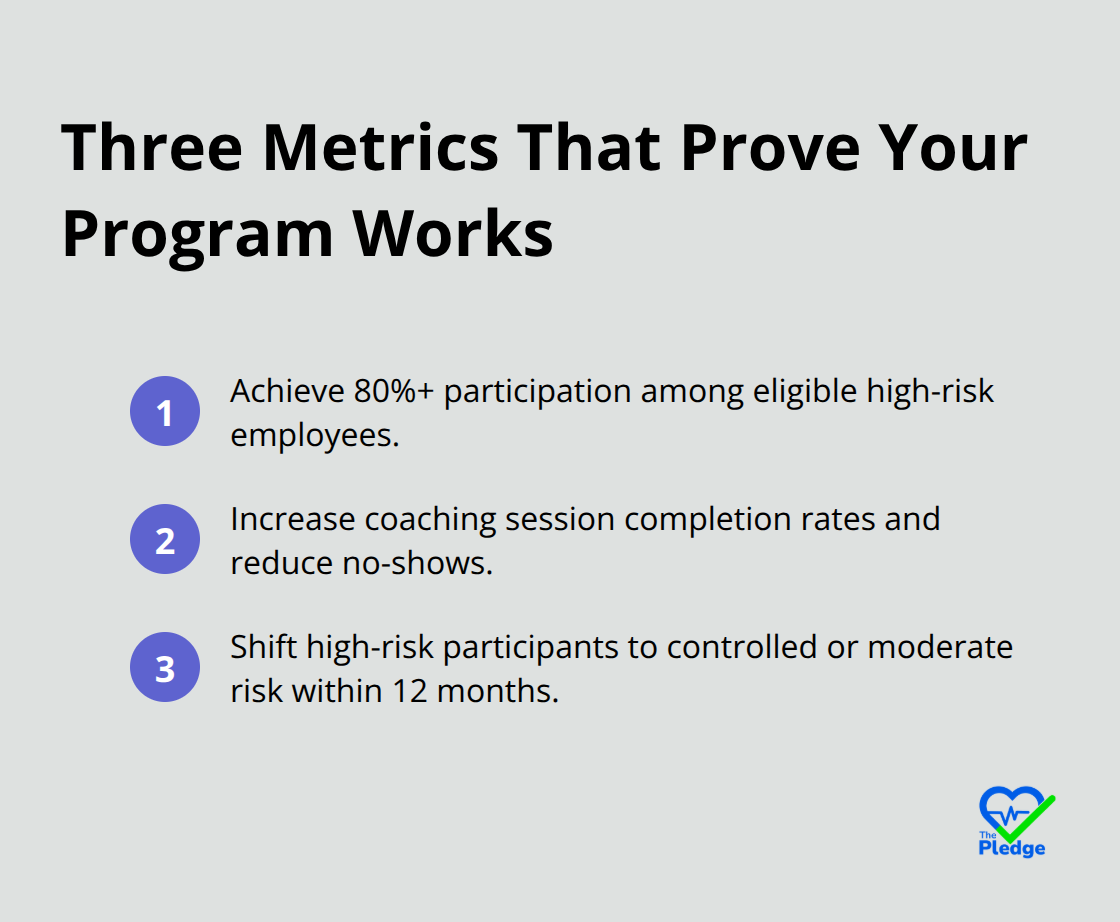
The Illinois hospital system measured these metrics continuously and adjusted their coaching approach based on what worked. They achieved 95% participation among benefits-enrolled employees and a 32% decrease in high-risk participants within three years. This was not luck; it was data-driven iteration. Your organization should establish baseline metrics before launch: current participation in wellness programs, current percentage of high-risk employees, current claims trend, and employee engagement survey scores. Then measure the same metrics quarterly.
If participation remains below 70% after three months, your communication strategy or platform usability needs adjustment. If high-risk participation is high but completion rates lag, your coaches may need additional training or your scheduling flexibility may need improvement. The data tells you exactly where to focus your efforts and resources.
Final Thoughts
Preventive health coaching for employers works because it addresses the root causes of healthcare spending rather than treating symptoms after they become expensive. The Illinois hospital system’s 40% reduction in expected claims and 32% decrease in high-risk participants within three years proves this model delivers measurable financial returns alongside genuine health improvements. Your organization faces the same choice: continue absorbing rising claims costs from preventable conditions, or invest strategically in coaching that identifies gaps in care, drives behavior change, and keeps employees healthy.
Select a platform that integrates directly with your claims data and benefits systems rather than operating in isolation, and assign dedicated program leadership to tailor coaching to your workforce’s specific needs. Measure participation rates, coaching completion, and health outcome movement from day one-these metrics reveal whether your program works and where to focus resources. The difference between a 50% participation program and a 95% participation program typically comes down to one person accountable for making integration work.
Your employees need more than access to healthcare; they need someone to help them understand their health data, connect that data to their personal goals, and guide them toward actionable steps. The Pledge simplifies this investment by centralizing health data and enabling personalized coaching at scale, making it practical for employers of any size to implement programs that work. Start now, measure results, and adjust based on what your data reveals.
![Navigating Your Provider Network for Maximum Savings [Guide]](https://thepledge.app/wp-content/uploads/emplibot/Navigating-Your-Provider-Network-for-Maximum-Savings-_Guide__1781489382-300x168.jpeg)