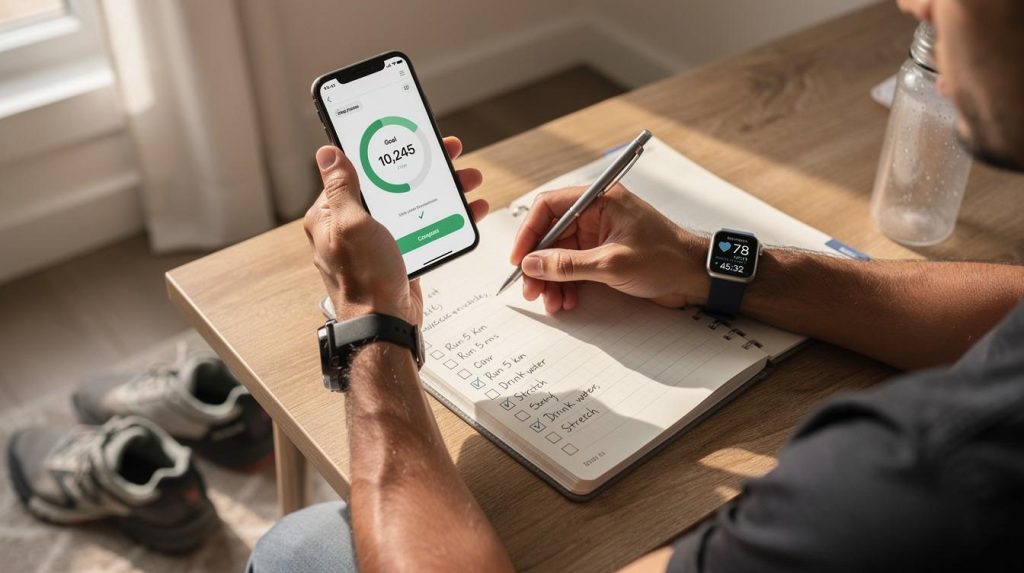
Most people set health goals but abandon them within weeks. The problem isn’t willpower-it’s the lack of a tracking system that keeps you accountable and shows real progress.
At The Pledge, we’ve seen how health goal tracking transforms vague intentions into measurable results. When you monitor your progress consistently, you make better decisions and stay motivated through the tough moments.
How Tracking Reveals What Actually Works
The moment you start tracking health metrics, something shifts. You move from hoping your efforts matter to knowing exactly what’s working and what isn’t. This clarity separates people who achieve their health goals from those who drift back to old patterns. Research from Handley and colleagues across eight primary care practices showed that 53% of patients reported behavior changes aligned with their action plan after just three weeks when tracking paired with structured follow-up. That’s not motivational psychology-that’s the direct result of monitoring progress and adjusting course based on real data.
Accountability Through Numbers
When you track, you can’t ignore reality. A study by Locke and Latham found that difficult goals yield better results when combined with strong goal commitment and self-efficacy. Tracking creates that commitment because you confront whether you’re actually moving toward your target or standing still. If your goal is to walk 10,000 steps daily, tracking shows you whether you’re averaging 6,000 or 9,500. This isn’t abstract-it’s measurable proof of effort. The Goal-Gradient Effect, documented by Kivetz, Urminsky, and Zheng, shows that motivation intensifies as you approach a target. When you see progress accumulating in real time, your brain responds by pushing harder. That’s not willpower; that’s neuroscience. Apps and wearables make this feedback instantaneous, which matters. Research by Lee and Lee demonstrated that wearable devices increase continuous-use intention by aligning health goals with effortless reinforcement. You don’t have to remember to check your progress-it appears on your wrist or phone automatically.
Breaking Large Goals Into Weekly Cycles
One of the most practical insights from behavioral research is that short-term action plans work better than long-term ambitions. Lorig and colleagues found that action plans developed by patients themselves and reevaluated weekly maintain momentum far more effectively than static yearly goals. A plan like “walk 30 minutes five days this week” is infinitely more actionable than “get healthier this year.” Weekly cycles also provide rapid feedback, which builds self-efficacy faster. When you complete a week successfully, you feel competent. When you miss it, you have seven days to adjust your approach without the entire goal collapsing. Coping plans-strategies that anticipate specific barriers-amplify this effect. Sniehotta and colleagues showed that combining action plans with coping plans yields significantly greater adherence than action plans alone. If bad weather typically derails your outdoor walking, your coping plan specifies an indoor alternative before the weather hits.
Data-Driven Decisions Replace Guesswork
When your health metrics live in one place, patterns emerge that you’d otherwise miss. If your step count drops consistently on Wednesdays, you can identify the cause and address it. If your sleep quality improves after you stop checking email after 8 p.m., you have concrete evidence to maintain that boundary. This is the opposite of generic advice. Your data tells you what works for your life, not what works for an average person. Approach goals-those framed around moving toward something positive-also outperform avoidance goals in driving sustained behavior change. Instead of tracking “days without junk food,” track “home-cooked meals completed.” This subtle shift in framing, documented by Coats, Elliot, and Thrash, produces better emotional outcomes and persistence.
From Insight to Action
Tracking transforms raw numbers into actionable intelligence. You spot what derails your progress and what accelerates it. This foundation of real evidence prepares you to select the right tracking tools and strategies that actually fit your life.
How to Build Health Goals That Actually Stick
Define Your Goal With Precision
The difference between goals that transform your health and goals that fade within weeks comes down to specificity and realism. Vague intentions like “exercise more” or “eat better” lack the precision needed to guide daily decisions. Instead, frame your goal around a concrete metric and a realistic timeline. Try “walk 6,000 steps daily for the next four weeks” rather than “get healthier.” This specificity matters because your brain needs a clear target to work toward. Research shows that SMART goals-specific, measurable, achievable, realistic, and time-bound-create success criteria that eliminate ambiguity.
The achievable component is critical; setting a goal 50% beyond your current capacity often leads to failure and eroded motivation. Start where you are. If you currently walk 3,000 steps daily, a 5% weekly increase is far more sustainable than jumping to 10,000 steps overnight. Realistic timelines matter equally. A four-week action plan developed by you-not imposed by generic health advice-produces better results than a twelve-month goal that feels distant and abstract. Lorig and colleagues found that patients who create their own short-term plans and review them weekly maintain momentum far more effectively than those following pre-made templates.
Translate Goals Into Weekly Action Plans
The moment you’ve defined your goal, translate it into a weekly action plan with concrete steps and logistics. Handley’s research across eight primary care practices demonstrated that 53% of patients reported behavior changes within three weeks when they paired their goals with structured weekly action plans. Your plan should specify exactly what you’ll do, when you’ll do it, and where-not just the intention. Rather than planning to walk more, your action plan states: walk 30 minutes on Monday, Wednesday, and Friday at 6 a.m. before work, starting from your front door. This removes decision-making friction.
Anticipate Obstacles With Coping Plans
Equally important is the coping plan: anticipate what will derail you and specify an alternative in advance. If rain typically stops your outdoor walks, decide now that you’ll use an indoor track or follow a walking video instead. Sniehotta and colleagues found that combining action plans with coping plans yields significantly greater adherence than action plans alone. This forward-thinking approach protects your progress before obstacles arise.
Review and Adapt Weekly
The weekly review cycle is where real transformation happens. Every seven days, assess whether you completed your plan, identify what worked and what didn’t, and adjust the following week’s plan accordingly. This rapid feedback loop builds self-efficacy faster than monthly or yearly reviews. You’re not waiting months to discover whether your approach works; you’re learning and adapting weekly. Tools like wearables and health apps automate much of this tracking, but the human act of weekly reflection-deciding what to change-is irreplaceable and drives lasting behavior change.
With your goals defined and your weekly system in place, the next step is selecting the right tools to monitor your progress without adding complexity to your life.
Common Obstacles in Health Goal Tracking
Friction Replaces Clarity in Poorly Designed Systems
Most people don’t fail at tracking because they lack discipline. They fail because their tracking system creates friction instead of clarity. The wrong tool, the wrong metrics, or the wrong cadence turns what should energize you into another chore you abandon. This is where most health goal tracking programs collapse.
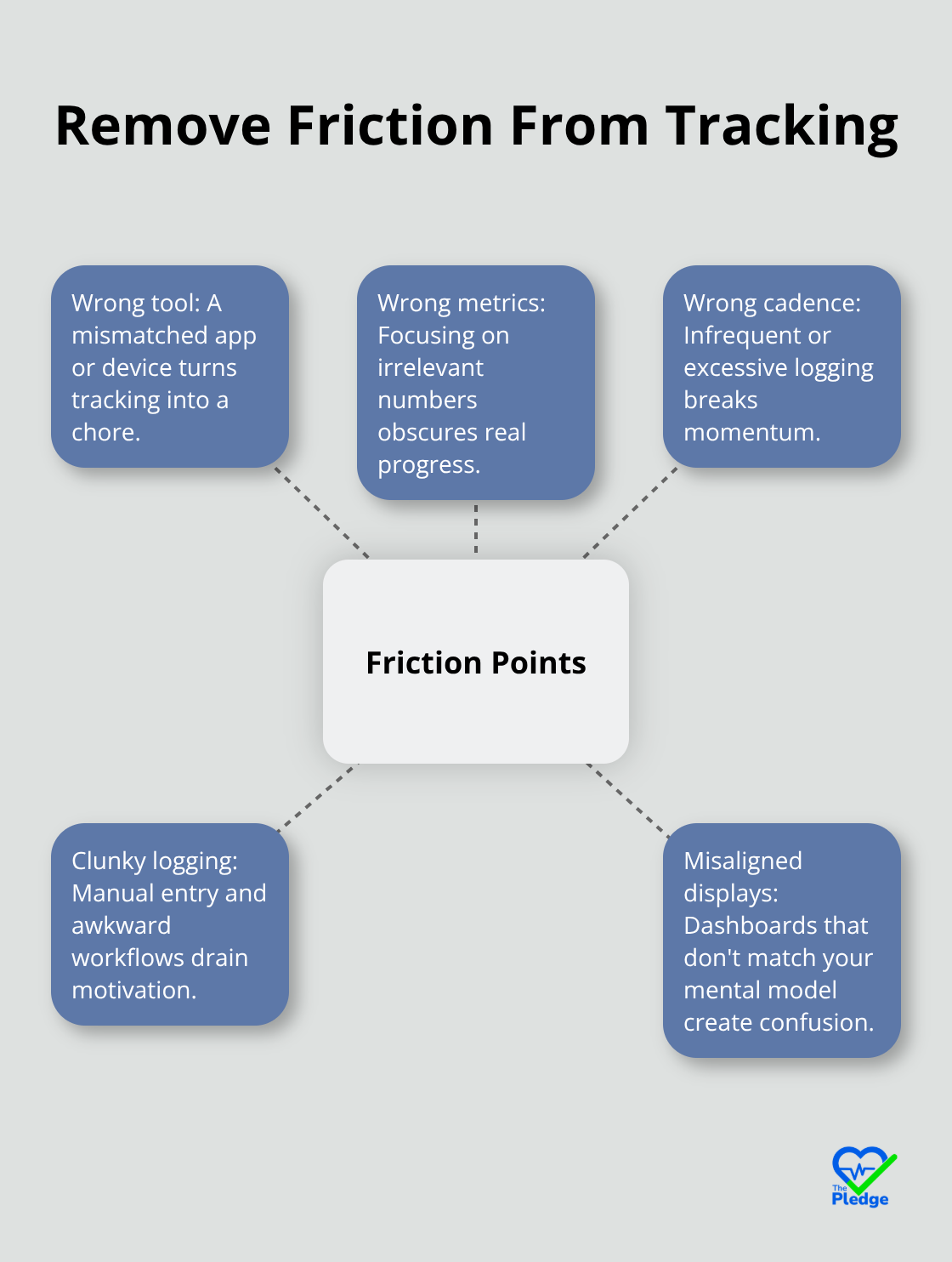
You might start with enthusiasm, logging your steps or meals into an app that feels clunky or displays information in ways that don’t match how you actually think about your health. After two weeks, the friction outweighs the motivation.
Research by Handley and colleagues showed that behavior change maintenance varies widely depending on follow-up support and tracking system design. The problem isn’t your commitment; it’s that many apps require manual entry, display data in confusing dashboards, or send notifications at times that interrupt rather than motivate. Wearable devices that automatically sync data to your phone eliminate this friction entirely. Lee and Lee found that wearables increase continuous-use intention by aligning health goals with effortless reinforcement. You don’t manually log your steps; the data appears. This automation matters because it removes the decision fatigue that derails most people within the first month.
Life Disruptions Break Your Tracking Consistency
Inconsistency compounds this problem. You track consistently for three weeks, then life disrupts your routine. A work deadline consumes your evenings. Your child gets sick. You travel. Your tracking habit breaks, and restarting feels harder than it did initially. Motivation crashes because you’ve lost the weekly feedback loop that builds self-efficacy.
Coping plans strategies anticipating specific barriers combined with action plans yield significantly greater adherence than action plans alone. Without a coping plan, the first obstacle derails your entire system. You need to decide now what you’ll do when travel happens, when work intensifies, or when illness strikes. Will you lower your daily step target to 5,000 instead of 10,000 during high-stress weeks? Will you switch to home workouts when weather prevents your outdoor routine? These decisions made in advance protect your tracking consistency when motivation naturally dips.
Static Goals Become Demoralizing When Life Changes
The third obstacle is equally common: your goals remain static while your life changes. You set a target in January based on your current capacity, but by March you’ve taken a new job with longer hours, or your family situation shifts, or an injury changes what’s physically realistic. A rigid goal that no longer fits your life becomes demoralizing. Weekly reviews, as Lorig and colleagues documented, catch these misalignments early and allow adjustment before frustration builds. The solution isn’t willpower or a better app. It’s anticipating these obstacles before they happen and building flexibility into your tracking system so it adapts to reality instead of breaking when reality changes.
Final Thoughts
Health goal tracking transforms vague intentions into measurable reality that you can act on immediately. Research across primary care practices showed that 53% of patients reported meaningful behavior changes within three weeks when they paired goals with structured tracking and weekly reviews. That’s not motivation or willpower-that’s the direct result of seeing real progress and making data-driven adjustments as obstacles appear.
The most successful health goal tracking systems eliminate friction through automated data collection, provide rapid feedback through weekly reviews, and anticipate obstacles in advance through coping plans. When you combine these elements, tracking stops feeling like punishment and starts feeling like proof that your efforts matter. Your data reveals what works specifically for you-whether Wednesday afternoons derail your progress, whether sleep improves after you stop checking email at night, or whether a 5% weekly increase in activity feels sustainable while a 20% jump triggers burnout.
Start with one specific, realistic goal and a clear timeline, translate it into a weekly action plan with concrete steps, and commit to a weekly review where you assess what worked and adjust the following week’s plan. The Pledge centralizes your health data and sends personalized reminders that keep your tracking system running without adding complexity to your life, so the friction disappears and momentum builds.
![Building Your Employer Health Strategy for [2025]](https://thepledge.app/wp-content/uploads/emplibot/Building-Your-Employer-Health-Strategy-for-_2025__1782094238-300x168.jpeg)


![Navigating Your Provider Network for Maximum Savings [Guide]](https://thepledge.app/wp-content/uploads/emplibot/Navigating-Your-Provider-Network-for-Maximum-Savings-_Guide__1781489382-300x168.jpeg)