
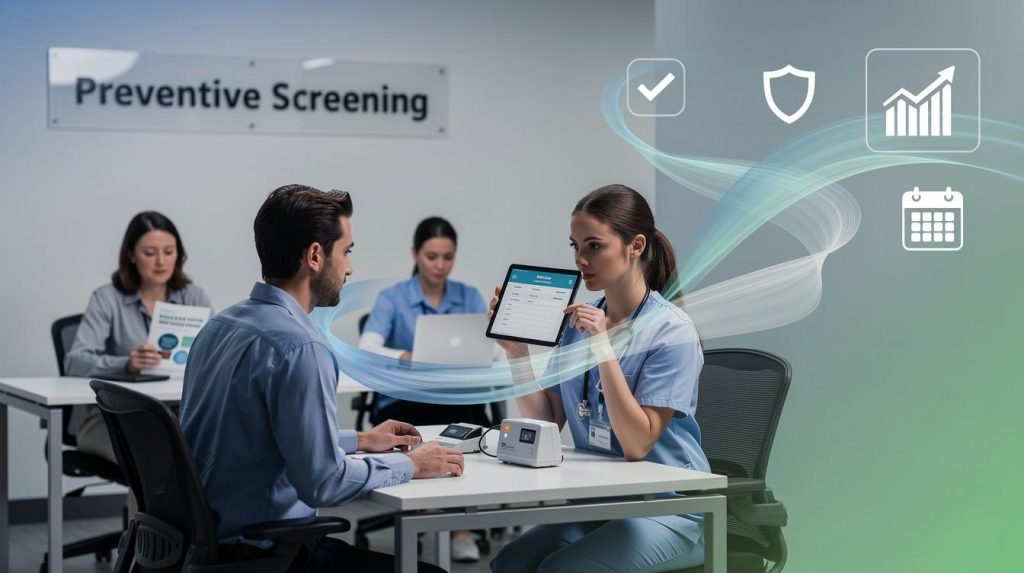
Most employers still treat health screenings as a nice-to-have rather than a business essential. At The Pledge, we’ve seen firsthand how preventive screening importance gets overlooked, even though early detection prevents serious illness and cuts healthcare costs dramatically.
The numbers tell a clear story: companies that invest in workplace screening programs see measurable returns through lower claims, fewer sick days, and better employee retention. This isn’t about wellness theater-it’s about protecting your workforce and your bottom line.
Why Workplace Screenings Actually Work
Chronic conditions account for roughly 90% of US healthcare costs, according to the Centers for Disease Control and Prevention. This single statistic explains why early detection matters so much. When you catch diabetes, cardiovascular disease, or kidney disease before symptoms appear, you stop the cascade of expensive complications. A person diagnosed with prediabetes can prevent full diabetes through lifestyle changes. Someone screened for early chronic kidney disease can slow progression through medication and diet adjustments. Without screening, these conditions advance silently until they demand emergency care, hospitalizations, and years of costly treatment. The financial difference between catching disease early and treating it late is staggering.
The numbers employers actually see
Diabetes costs the US healthcare system an estimated $413 billion annually in medical expenses and lost productivity, according to data cited across occupational health research. Cancer treatment and care costs will reach about $240 billion annually by 2030. Heart disease and stroke cause roughly $168 billion in lost productivity annually. These aren’t abstract figures. When your employees get screened and catch these conditions early, your company avoids the productivity drain of emergency absences, extended medical leaves, and reduced work capacity. The Aflac wellness survey found that nearly 60% of adults report avoiding preventive screenings, which means most workforces are sitting on undetected health risks. Your competitors are ignoring this. You shouldn’t. One in three Americans lacks a primary care provider, making workplace screening the most practical access point for early detection. Your employees won’t find time to schedule appointments on their own, but they will participate in screening at work.
What early detection actually prevents
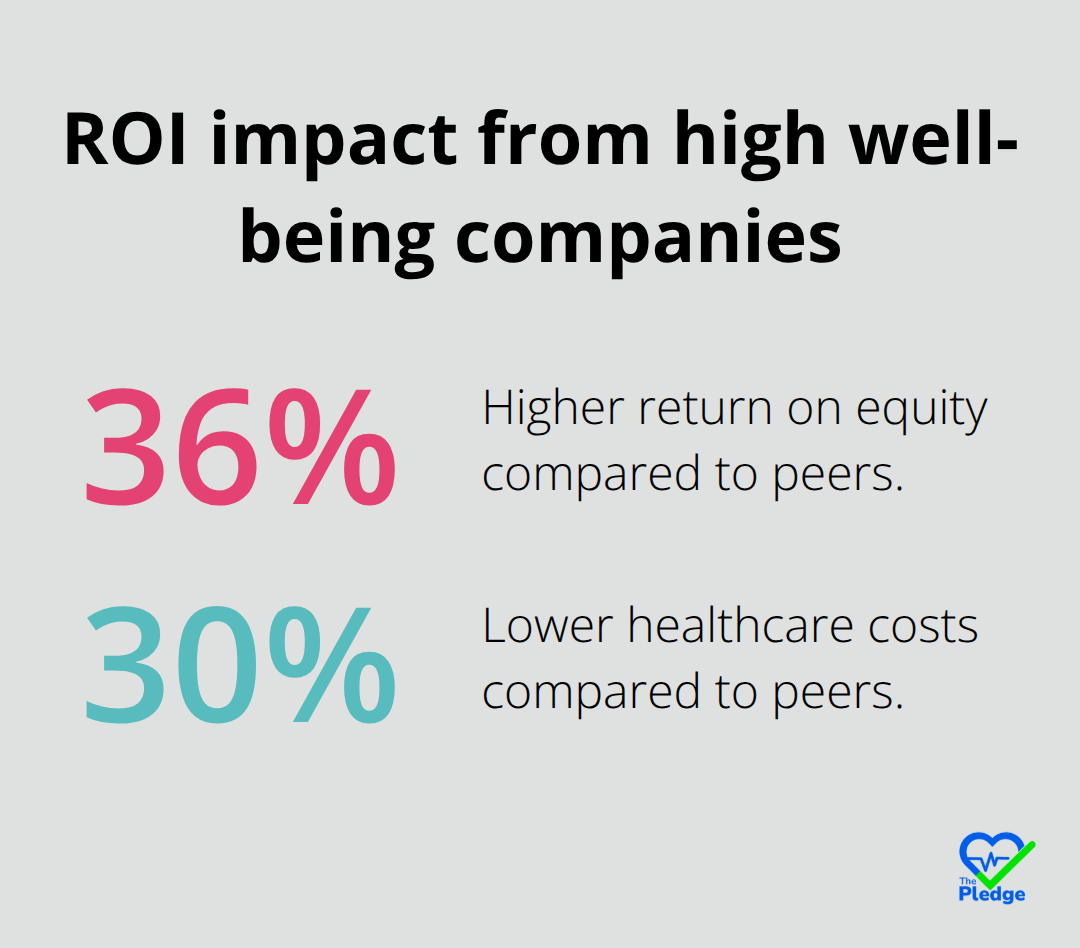
Early screening identifies risk factors years before symptoms appear. Someone with elevated blood sugar levels can start interventions immediately rather than waiting until they develop full diabetes and face insulin injections and monitoring. Colorectal cancer screening through at-home testing catches polyps before they become malignant tumors. A1c screening reveals prediabetes when lifestyle modifications are most effective. The practical impact is straightforward: fewer hospitalizations, fewer long-term disability claims, and fewer employees leaving the workforce due to health crises. Organizations with high well-being scores experience 36% higher return on equity and 30% lower healthcare costs, according to Willis Towers Watson research. That’s not a coincidence. It’s the direct result of employees who catch problems early and manage them effectively rather than employees who suffer preventable complications.
How screening translates to real savings
The connection between early detection and financial outcomes runs deeper than most employers realize. When you screen your workforce, you shift spending from emergency and acute care toward prevention and management. An employee who learns about prediabetes through screening can make dietary changes and increase physical activity-interventions that cost nothing compared to years of diabetes medication and complications. Someone identified with early chronic kidney disease can adjust their treatment plan before progression requires dialysis (which costs roughly $90,000 per year). These aren’t theoretical savings. They show up in your claims data, your disability costs, and your employee retention rates. The question isn’t whether screening saves money. The question is whether you’ll act on the opportunity before your competitors do.
What’s Your Real Return on Screening Investments
Measuring Financial Returns from Prevention
Workplace screening programs generate measurable financial returns that show up in your claims data within months, not years. Willis Towers Watson research demonstrates that organizations with high well-being scores experience 36% higher return on equity and 30% lower healthcare costs compared to their peers. These aren’t marginal improvements. A company with 500 employees spending $8 million annually on health benefits sees a potential $2.4 million reduction through effective prevention strategies.
The mechanism is straightforward: when employees catch diabetes at the prediabetic stage, they avoid $15,000 to $20,000 in annual medication and complication costs. When colorectal cancer screening identifies polyps before malignancy, you eliminate the $240,000 average cost of cancer treatment.
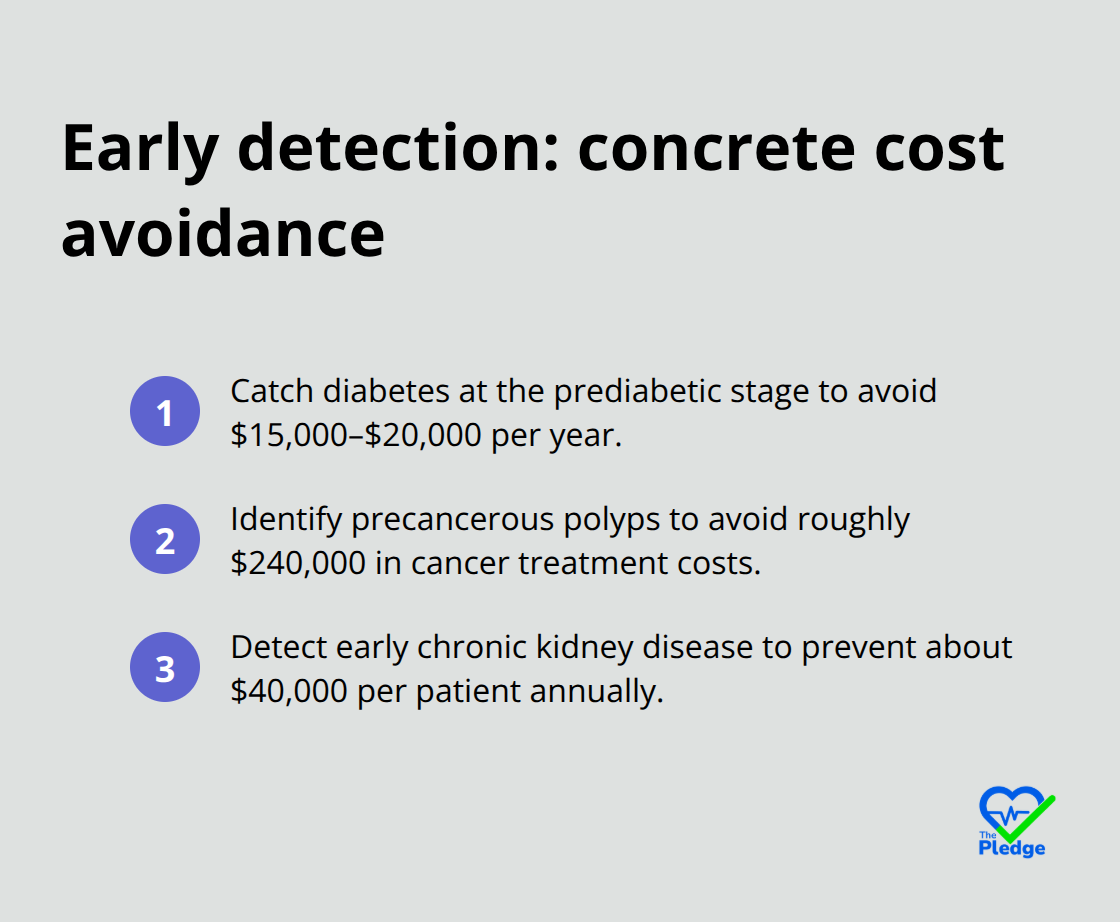
Early chronic kidney disease detection prevents dialysis expenses that run approximately $40,000 per year per patient.
How Employee Engagement Amplifies Your Returns
The engagement and retention benefits amplify these financial gains significantly. Employees who participate in workplace screenings feel their employer genuinely invests in their health, which directly correlates with tenure. Companies reporting high participation in preventive programs experience roughly 25% lower absenteeism according to HR research, and reduced turnover means you avoid the 50% to 200% cost of replacing skilled workers.
Participation rates matter more than most employers realize. When your workforce engages with screening programs, you build momentum toward a prevention-focused culture where employees take ownership of their health outcomes.
Stabilizing Insurance Costs Through Better Health Profiles
Your health insurance premiums stabilize when your claims profile improves. Insurers reward companies with lower disease prevalence and better health management through rate reductions and renewal negotiations. An organization that screens 60% of its workforce and identifies early-stage conditions before they become expensive claims demonstrates lower actuarial risk, giving your broker leverage to negotiate better rates in the next renewal cycle.
This creates a compounding effect: lower premiums reduce your total benefits spend, freeing capital for additional screening tools or other employee benefits. The real ROI multiplies when you factor in reduced workers’ compensation claims from healthier, more alert employees, decreased short-term disability usage, and improved productivity from employees who manage chronic conditions proactively rather than reactively.
Beyond Direct Savings: The Productivity Multiplier
Healthier employees make better decisions at work. They miss fewer meetings, produce higher-quality output, and stay focused on strategic priorities rather than managing health crises. An employee managing prediabetes through lifestyle changes experiences better energy levels and mental clarity. Someone who catches early kidney disease and adjusts their treatment plan avoids the cognitive fog that accompanies untreated chronic illness. These productivity gains don’t always appear in spreadsheets, but they compound across your entire organization.
The question shifts from “Can we afford screening programs?” to “Can we afford not to implement them?” Your competitors who delay screening investments will face higher claims costs, increased turnover, and weaker negotiating positions with insurers. Organizations that act now build sustainable cost advantages that persist for years. The next step involves selecting the right screening tests and removing the barriers that prevent your workforce from participating.
Building a Screening Program That Actually Works
Match Your Screening Tests to Your Workforce
Selecting screening tests without understanding your workforce’s health profile wastes resources and misses opportunities. Start with your claims data, employee demographics, and occupational risks. A manufacturing company with a workforce averaging age 45 faces different health priorities than a tech startup with employees averaging age 32. Your claims data reveals what conditions actually cost you money right now. If diabetes and hypertension dominate your claims, those become your screening priorities. If you’re seeing high rates of musculoskeletal injuries, you need occupational health screenings alongside metabolic panels. Personalized screening strategies aligned with workforce composition generate stronger ROI than generic screening menus.
Once you identify your target conditions, test selection becomes straightforward. A1c screening catches prediabetes and diabetes at stages where lifestyle intervention works. Colorectal cancer screening through at-home tests removes the embarrassment and scheduling friction that prevents participation. Blood pressure checks identify hypertension before it triggers stroke or heart disease. Chronic kidney disease screening through simple lab work catches progression before it requires dialysis.
Eliminate the Barriers That Kill Participation
The Aflac wellness survey found that 94% of employees face barriers to preventive care, including scheduling conflicts and time constraints. Workplace screening eliminates these barriers entirely. On-site testing takes 15 minutes. Home-based test kits arrive at employees’ homes.
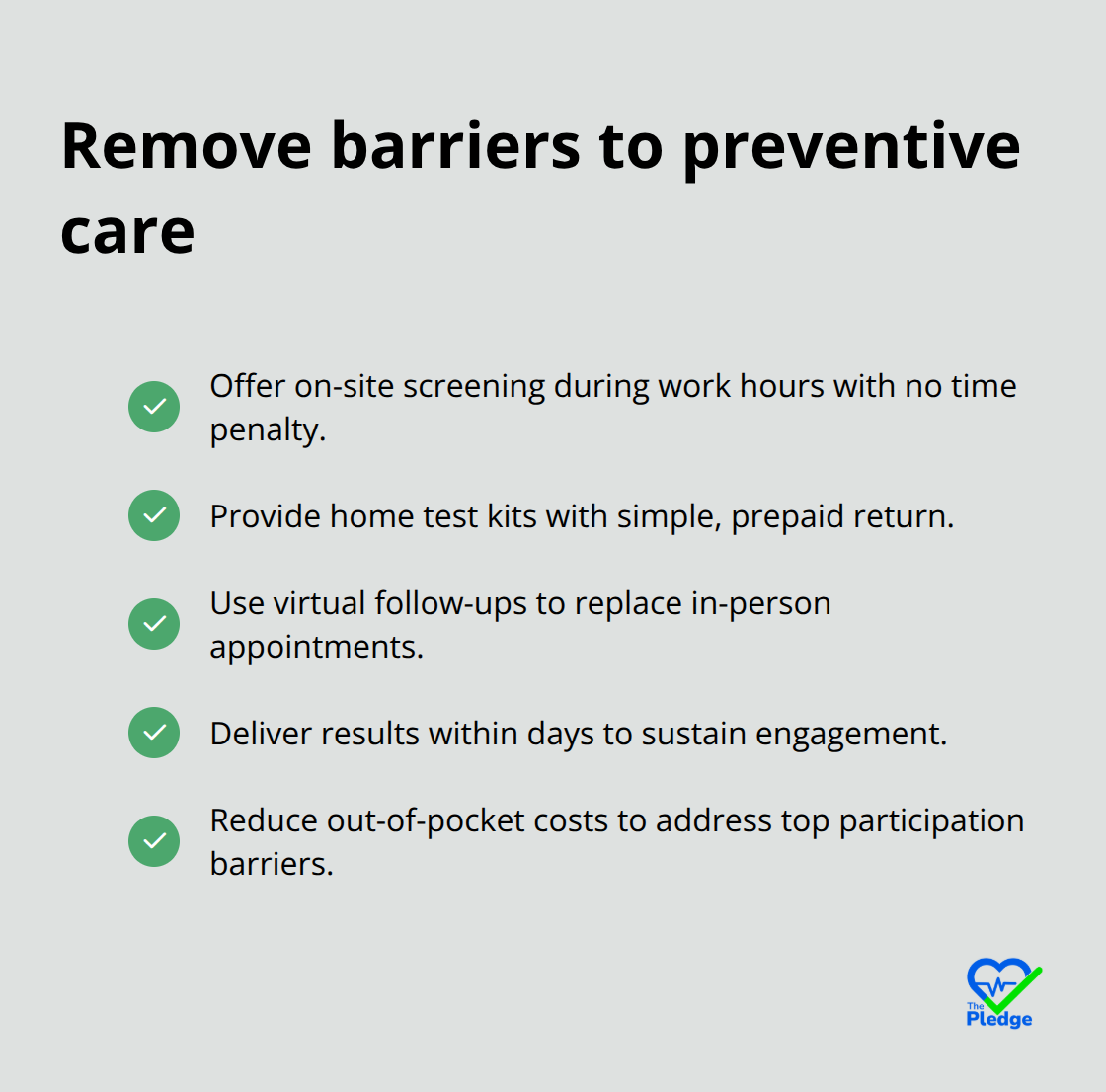
Virtual follow-ups replace appointment scheduling. The Aflac data shows nearly 60% of adults avoid preventive screenings altogether, and cost and scheduling rank as the top reasons.
Your program must remove friction points that prevent participation. Offer screening during work hours with no time penalty. Provide results within days, not weeks. Schedule follow-up consultations through video calls rather than in-person appointments. Programs with high accessibility see participation rates exceeding 70%, while programs requiring employee effort outside work hours struggle to reach 30%. Quest Workforce Health Solutions demonstrates this model with 2,400 patient service centers and home collection options, showing that accessibility directly drives participation rates.
Connect Screening Results to Real Interventions
Data tracking separates screening programs that work from those that waste money. Capture participation rates by department, demographics, and risk level. Monitor how many employees with abnormal results complete follow-up care. Track whether employees with detected prediabetes actually engage in lifestyle programs or medication management. This data reveals whether your program creates real behavior change or just generates test results nobody acts on.
Organizations that connect screening data to intervention programs see measurable health improvements within 12 months. An employee identified with elevated blood pressure who receives personalized coaching on sodium reduction and exercise sees meaningful pressure drops. Someone screened for prediabetes who gains access to a nutrition program and activity tracking avoids progression to full diabetes. Without this follow-up infrastructure, screening becomes theater.
Use Data to Refine Your Program Over Time
The data also shows which tests generate the highest return. If your A1c screening identifies 40 prediabetic employees but only 15 engage with lifestyle programs, you need stronger outreach or different intervention options. If colorectal cancer screening finds polyps in 2% of screened employees but those findings prevent future cancer diagnoses, that test delivers exceptional value. Use 12-month data to refine your program, eliminate low-value tests, and invest more heavily in interventions that change employee behavior and health outcomes.
Final Thoughts
The business case for preventive screening importance stands on solid ground. Organizations that invest in workplace screening programs see measurable returns through lower claims, reduced absenteeism, and improved employee retention-with high well-being companies experiencing 36% higher return on equity and 30% lower healthcare costs. These gains compound over time, creating sustainable competitive advantages that persist across multiple business cycles.
Leadership commitment transforms screening from a compliance checkbox into a strategic priority. Audit your claims data to identify which tests generate the highest return for your workforce, then design your program around accessibility through on-site testing, home collection kits, and virtual follow-ups. Establish data tracking systems that connect screening results to interventions, ensuring that detected health risks actually lead to behavior change and improved outcomes rather than sitting in a file.
We at The Pledge understand that healthcare information fragmentation prevents employees from taking action on screening results. Our platform centralizes vital health data and sends personalized reminders that keep employees engaged with preventive care, transforming detection into meaningful health improvements while reducing costs. The organizations that act now on preventive screening will build advantages that competitors cannot easily replicate.
![Building Your Employer Health Strategy for [2025]](https://thepledge.app/wp-content/uploads/emplibot/Building-Your-Employer-Health-Strategy-for-_2025__1782094238-300x168.jpeg)



![Navigating Your Provider Network for Maximum Savings [Guide]](https://thepledge.app/wp-content/uploads/emplibot/Navigating-Your-Provider-Network-for-Maximum-Savings-_Guide__1781489382-300x168.jpeg)